Sunday, December 22, 2013

Washington Capitals: That Was The Week That Was -- Week 12

It was a heavy schedule for the Washington Capitals in Week 12.  At the end of it, one could find the good, the bad, and the ugly in it.  That’s why we’re here, so let’s get to it.


Record: 2-1-1

It was the eighth winning week for the Caps so far this season, their second in a row.  It also was “Metro Rivalry Week.”  The Caps had a home-and home set with the Philadelphia Flyers and games against the Carolina Hurricanes and New Jersey Devils.  When the week started the Caps had a two-point lead on third-place Carolina, a five-point lead on fifth-place New Jersey, and a six-point lead on the sixth-place Flyers.  At week’s end, the Caps’ lead expanded to four points over Carolina, while they held their own over the Devils and Flyers, maintaining the margins over those teams with which they started the week.  When you are the lead dog among those four teams, not losing ground has to be considered a good thing.  Perhaps, however, it could have been better.


Offense: 3.50/game (season: 2.97 / rank: 7th)

Ten Capitals shared in the 14 goals scored for the week.  Alex Ovechkin led the way with four goals, one in each of the four games. He is into round numbers lately – four in four games for the week, ten in his last ten games.  He became the sixth player in the post-1967 expansion era to record 30 or more goals in each of his first nine seasons.

Marcus Johansson had a pair of goals this week, the only other Cap to record a multi-goal week.  It brought him out of a drought in which he had only one goal in 16 games dating back to his scoring in consecutive games back on November 5-7.  When he was held off the score sheet against New Jersey to end the week, it broke a three-game streak of points for the week and a five-game points streak overall.

Speaking of overall, 13 different Caps recorded points for the week.  Nicklas Backstrom topped the list with seven point, all on helpers.  His four assist game against Carolina on Friday was his ninth career four-assist game, the most in the league since he came into the NHL in the 2007-2008 season.  In fact, he has as many as the second and third place players (Ryan Getzlaf, Sidney Crosby) combined.

Defense: 4.00/game (season: 2.94 / rank:24th)

Blech!  The Caps allowed nine goals over two games to the 22nd ranked scoring offense in the league, five goals to the 23rd ranked offense.  There is no way to put a prom dress on that pig and make it prom queen.  The Caps allowed 141 shots on goal – 35.3 per game.  True, that is precisely the Caps’ season average of shots allowed per game, but that is the second worst average in the league.  It caught up with them this week.

The possession numbers?  Yeesh.  For the week the Caps were sub-40 percent in both Corsi-for (37.8 percent) and Fenwick-for (39.9 percent) percentage in 5-on-5 close score situations.  They were sub-40 percent (38.0 percent) in Corsi-for and barely cracked the 40-percent level (43.2) in Fenwick-for in all 5-on-5 situations.  Graphically, the trend (depicted as a rolling 10-game progression for Fenwick-for, 5-on-5 close situations) is, from a hockey perspective, alarming. 


The last few games of that chart look disturbingly like the share price for Lehman Brothers leading up to their bankruptcy in 2008…


Let’s hope things turn around for the Caps more than they did so for Lehman.

Goaltending: 2.55 GAA / .930 save percentage (season: 2.69 / .922 / 1 shutout)

A tale of two goalies.  One tale describes that of Philipp Grubauer, who was called upon twice this week. He won both games, stopping 63 of 69 shots in the process (.913 save percentage).  It was a good, if not extraordinary performance overall. 

Then there was Braden Holtby.  Two appearances, two losses (one in overtime), ten goals allowed on 72 shots (a .861 save percentage). It is part of a longer struggle Holtby has had recently.  In his last five appearances he is 1-2-1, 4.92, .863.  Holtby’s problem, at least this week, was later-game collapses.  In his two games he stopped 16 of 17 first period shots (.941 save percentage), but allowed four goals on 26 shots in the second periods of those games (.846) and four goals on 27 shots (.852) in the third periods of those games.

It was not a good week overall for the goaltenders, Holtby in particular, but then again they had a heavy workload, too.  They faced an average of 34.8 shots per 60 minutes of work for the week, part of a longer trend in which the Caps have yielded a lot of shots.  The word for this week might be “regression.”

Power Play: 5-12 / 41.7 percent (season:  percent 26.1 percent / rank: 2nd)

The Caps are making teams pay, and pay dearly for stepping outside the rule book.  This week it was power play goals in three of the four games, five power play goals overall on 13 chances.  The Caps recorded those five goals on 21 shots in 17:14 of power play time.  Four different players had power play goals for the Caps this week, Marcus Johansson being the only one to hit the twine twice.  The one thing each power play goal had in common was that Nicklas Backstrom recorded an assist.  Five of Backstrom’s seven assists for the week came on the man advantage.  Backstrom finished the week with 21 power play assists for the year, a five assist lead over Evgeni Malkin for the league lead.
e

Penalty Killing: 12-17 / 70.6 percent (season: 81.3 percent / rank: 20th)

It seems so long ago now, all those penalties killed off in a row back in October and early November.  In the here and now, the Caps’ penalty kill stinks on toast.  First, there were the opportunities.  The Caps allowed opponents four or more power play opportunities in three of the four games for the week.  When the penalty kill is struggling, you don’t want the penalty killers on the ice.  Then there were the shots.  Opponents recorded 30 shots on goal in 26:03 of power play time.  It seems almost inevitable, absent some herculean effort from the goaltenders, that the penalty kill would continue to struggle.

Even Strength Goals For/Against: 9-11 (season: 70-77; 5-on-5 GF/GA ratio: 0.92 / rank: 20th)

Despite the minus-2 week at even strength the Caps did not sink lower in the league standings in 5-on-5 goals for/goals against ratio.  That’s the good part.  Seven of the even-strength goals against either tied the game or gave opponents a lead.  Washington was out-shot at even strength by a 107-88 margin for the week.  The Caps out-shot their opponents at even strength in three of the first four periods in regulation for the week and failed to out-shoot opponents at even strength in any period thereafter for the week.  It is not as if these are isolated circumstances.  The Caps have been struggling at even strength for most of the season.  Only Ottawa and Toronto allow more shots perminute at 5-on-5 than do the Caps.  Only five teams allow more even strength goals per minute of ice time than do the Caps.  This is not a good even strength team.

Faceoffs: 125-232 / 53.9 percent (season: 49.3 percent / rank: T-18th)

It was a uniformly good week in the circle for the Caps.  The Caps won all three zones – 55.2 in the offensive zone for the week, 53.7 percent in the defensive zone, 53.3 percent in the neutral zone.  Nicklas Backstrom was a good reflection of the consistency, going 55.0 percent in the offensive zone (11-for-20), 55.0 percent in the defensive zone (11-for-20), and 52.2 percent in the neutral zone (12-for-23).  Martin Erat carried the biggest load in the defensive zone, taking 25 draws for the week and winning 14 of them (56.0 percent).  Jay Beagle was right there, though, winning nine of 15 defensive zone draws (60.0 percent).  No Capital taking more than ten draws this week finished below 50 percent for the week.

Goals For/Against by Period:


The second period was once more good to the Caps, but again, it might have been better.  Eight of the 14 goals for the week scored by Washington came in the second period, but they allowed six to opponents.  And, the Caps allowed another six goals in the third periods of games.  It made for a difficult week, especially since the Caps still cannot seem to get off to good starts on a consistent basis.  They had only one first period goal for the week.  Only five teams have fewer goals scored in the first period this season than the Caps.  They are a minus-11 in goals scored for and against in the first periods of games this season.

In the end…

A 2-1-1 record is not bad.  It shows a certain consistency of results, the Caps having recorded winning weeks in three of the last four weeks (the other being a .500 week) and eight winning weeks in the last ten.  But scratch the surface, and the question remains, is this a team playing to its record?  If you answer that question in the negative, then the question becomes one of whether there is a correction – and perhaps a big one – to come that aligns the Caps’ record more cleanly with their underlying performance numbers. 

The Caps are not playing well at 5-on-5, their penalty killing has been fair to awful, they allow too many shots, their possession numbers are weak, they are being carried more or less by Alex Ovechkin and Nicklas Backstrom.  Yet, they win.  For now.

Washington Capitals: A ONE point night -- Game 36: Devils 5 - Capitals 4 (OT)

This being the holiday season, the Washington Capitals were in a giving mood on Saturday night against the New Jersey Devils.  The Caps twice had two goal leads in the third period, but allowed the Devils to come back to tie the game, then win the game in overtime, 5-4.

After the Devils scored the first goal – a one-timer from the left wing circle by Marek Zidlicky on a Devils power play in the first period – the Caps came back with a vengeance in the second period.  Joel Ward got the first scoring play started by digging the puck out from the left wing wall and chipping it along to Martin Erat in the corner.  Erat eased the puck along the wall to Jason Chimera, who was lost by the Devils’ defense, allowing him to circle around the cage to try to stuff the puck past goalie Martin Brodeur.  His first attempt was unsuccessful, but with no Devil close enough to challenge Chimera, he got another whack at it and batted it under Brodeur to tie the game.

Four minutes later the Caps took the lead. It was a tic-tac-toe play starting with Troy Brouwer in the left wing corner getting the puck into the high slot for Eric Fehr.  From there, Fehr had the option to shoot or pass.  He chose to take a half step around defenseman Eric Gelinas to open a passing lane to Mikhail Grabovski stepping out from below the goal line.  Fehr hit Grabovski, and Grabovski snapped the puck behind Brodeur to make it 2-1, Caps.

The third goal in the Caps’ sequence came in the last minute of the second period.  It started with a pad save by Braden Holtby that allowed the Caps to break out in numbers.  Mike Green carried the puck into the New Jersey zone on the right side and unloaded a slap shot that Brodeur handled a bit clumsily.  His right pad save allowed for a long rebound onto the stick of Joel Ward.  With Brodeur still down, Ward buried the rebound in the back of the net, and the Caps had a 3-1 lead at the second intermission.

New Jersey started their comeback in the sixth minute of the third period.  New Jersey won a power play faceoff in the Caps’ end, despite the puck lying tantalizingly free at the top of the circle after Travis Zajac pulled it back from the draw.  Patrick Elias was first to the puck, but Andy Greene chipped it off Elias’ stick into open ice where he took control.  Greene maneuvered around a diving John Carlson and circled around the Caps’ net.  With Carlson down, his partner Karl Alzner slid over to cover Zajac at the front of the net.  That left the ice to the left of Holtby open, and who should be there but old nemesis/friend/nemesis Jaromir Jagr.  From behind the Caps’ net, Greene had only to get the puck to Jagr’s stick.  He did, and Jagr chipped the puck into the open net behind Holtby to get the Devils to within a goal.

The Caps restored their two goal lead less than three minutes later.  Patrik Elias could not clear the puck out of the Devils’ zone from the left wing circle, as he was being challenged by Marcus Johansson.  The puck made it only so far as the stick of Karl Alzner at the blue line.  Alzner, perhaps knowing his role, found the shooter rather than take the shot himself.  He bump-passed the puck to Alex Ovechkin, who wristed the puck through the pads of Brodeur to make it 4-2.

Then things took a turn.  Zidlicky got the Devils to within a goal when Zajac wriggled free of Jason Chimera behind the Caps’ net and found Zidlicky coming down the slot.  Zajac’s pass barely eluded the stick of Joel Ward, but it did, and Zidlicky buried it to the far side of Holtby to make it 4-3.

Getting a chance in the slot figured again for the Devils just over two minutes later.  Holtby tried to clear the puck around the boards from behind his net and got the puck to the top of the circle along the wall where Zajac picked it off.  Zajac threw the puck at the net, and Dainius Zubrus – another nemesis/friend/nemesis of the Caps – who was steaming down the slot, beat Carlson to the puck and deflected it past Holtby to tie the game.

That is how things ended in regulation, but it took little time to settle things in overtime.  In the first minute of the extra session the Devils moved deliberately out of their own zone, the puck making its way to the stick of Patrik Elias on the right wing outside the Caps blue line.  Elias gained the zone, then fed Jagr, who wristed the puck at Holtby.  The initial shot was stopped by Holtby, but it popped into the air to his right where Andy Greene was arriving.  The puck struck Greene and tumbled into the net for the game-winner just 43 seconds into overtime, giving the Devils a Christmas gift, a 5-4 overtime win.

Other stuff…

-- OK, now we are concerned about Braden Holtby.  Not every goal is a goaltender’s fault, and the Devils had a hall pass to the slot all night.  However, in his last five appearances he is 1-2-1, 4.92, .863.  Here are some other numbers… .895, his even strength save percentage over those five games… .650, his save percentage on the penalty kill… three, the number of consecutive games now that he has allowed two power play goals.  On the power play theme, he has allowed at least one power play goal in nine of his last 12 appearances.

-- The goalie is said to be the team’s best penalty killer, but there is a team aspect to it, too.  And right now, penalty killing is killing, alright.  It is killing the Caps’ chances of advancing further in the standings.  New Jersey scored on both of its power play chances last night.  That leaves the Caps 23-for-31 in December, a 74.2 percent penalty killing rate.

-- Another game, another goal.  Alex Ovechkin has goals in four straight games, five of his last six, six of his last eight, and…well, you get the point.  In the modern era of hockey (since the 1967-1968 expansion), only six players had 30 or more goals in each of their first nine seasons in the league – Mike Bossy, Mike Gartner, Wayne Gretzky, Jari Kurri, Brian Trottier, and now, Alex Ovechkin.  Ovechkin is the first to accomplish the feat since Kurri posted his ninth straight 30-goal season to start his career in 1989.  Ovechkin is the only one of the six to do it having to hit the 30-goal mark in an abbreviated season.

-- At least the Caps had balance.  Nine different players shared in the scoring for the evening.  The third line was conspicuous in this regard.  Martin Erat had a pair of assists, Joel Ward had a goal and an assist, Jason Chimera had a goal.  The trio combined for seven of the Caps’ 22 shots on goal and nine of the team’s 37 shot attempts.

-- It was a hard night for John Carlson.  He was on ice for all five Devils’ goals.  His partner, Karl Alzner, escaped that result only because he was not paired with Carlson on the overtime winner; Carlson was on ice with Dmitry Orlov.

-- Jaromir Jagr has found the fountain of youth.  His goal and two assists made it seven straight games with points (2-9-11), and he is now tied for 17th in the league in points (13-20-33). 

-- Andy Greene had three points for the Devils (1-2-3).  It was his first three-point game since he had three assists in a 6-5 Gimmick loss to the Toronto Maple Leafs on October 29, 2008, 345 games ago.

-- Martin Erat seems to be taking to his role as a center.  He has assists in three straight games and six of his last ten contests (0-7-7).

-- Joel Ward’s goal was his first at Verizon Center since November 12th in a 4-3 overtime win over the Columbus Blue Jackets.

-- For Jason Chimera, his goal broke an even longer home goal-scoring drought.  His goal was his first at Verizon Center since he scored a goal on October 10th against Carolina in a 3-2 loss.  That is his only other home goal this season.

-- If you think possession is a crucial factor in determining outcomes, consider the Caps lucky to have come out of this game with a point.  Their possession numbers were awful – 35.0 percent Corsi-for percentage in close score 5-on-5 situations, 38.6 percent Fenwick-for.  Graphically, the Fenwick chart looks like this…


In the end…

The Caps opened the door for their guests, and the Devils came in and took the presents from under the tree.  No team with bigger aspirations than merely contending for a playoff spot gives away two-goal leads in the third period.  Washington has yet to lose in regulation when leading after two periods, but with two extra time losses, their winning percentage when leading after 40 minutes is merely middle of the pack.  One could argue that the overtime winner was a bit of luck, caroming off Greene, or even a bit of subterfuge, the puck being knocked in with Greene’s glove.  However, there is no way things should get to that state, because when you have the opportunity to close a club out and don’t, things happen.  And not in a good way. 

Saturday, December 21, 2013

The Peerless Prognosticator is ON THE AIR!!! -- Game 36: Devils at Capitals, December 21st

The Peerless Prognosticator is ON THE AIR!!!

Welcome to an abbreviated version of the prognosto, this being an extremely busy week for The Peerless in other facets of day to day experience.  The Washington Capitals are hosting the New Jersey Devils tonight in the back half of a back-to-back set of games in another Metropolitan Division skirmish.  Let’s get right to our takes for the clubs…


1.  New Jersey comes into this game with a less-than-happy record for December (3-4-2).  Worse, the Devils have not yet won a road game in regulation this month, losing three times and beating the New York Rangers in overtime.  Their power play is only 4-for-28 in their nine December games (14.3 percent), while their penalty kill is 21-for-26 (80.8 percent).

2.  Through Wednesday’s games Washington had been the only club in the league that scored precisely as many goals as it had allowed.  Well, now that odd result belongs to the Devils (actually, they share it with Phoenix).  New Jersey has scored 2.36 goals per game (24th in the league in scoring offense) and allowed 2.36 goals per game (ninth in scoring defense).

3.  New Jersey is the Boeing of NHL teams, at least in terms of one-goal games.  Their record is 7-7-7, just like the wide-body aircraft.

4.  Speaking of wide-body aircraft, would you have believed that at age 41, the second oldest skater in the league (to Teemu Selanne), that Jaromir Jagr would be leading the Devils – or any NHL team – in goals scored?  He has 12 goals, one of only two members of the club to top ten goals (Michael Ryder has 10).  Jagr comes into this game on a six-game points streak (1-7-8).  How impressive is that?  He had only one longer streak as a member of the Caps, an eight-game streak in the 2001-2002 season.

5.  The Devils are a solid possession team, ranking fifth overall in Corsi-for percentage in 5-on-5 close situations (53.8 percent) and eighth in Fenwick-for percentage (52.8 percent).  Even while their record has been so-so on December, their possession numbers remained solid – 55.9 Corsi-for percentage in 5-on-5 close situations, 53.3 percent Fenwick-for.


1.  ‘Tis the Season.  Nicklas Backstrom is celebrating the holiday season by spreading good cheer.  He has 14 assists in his last seven games, 12 in his last five contests.  He now leads the league in helpers with 33, one more than Sidgeni Malksby in Pittsburgh.

2.  Since Backstrom broke into the league in the 2007-2008 season, recording four or more assists in a game has been done 115 times, nine of them by Backstrom.  No one – not Sidney Crosby (four times), not Ryan Getzlaf (five times), not Joe Thornton or Henrik Zetterberg (three times apiece) – has done it as many times over that span of time.

3.  By winning after allowing the first goal last night, the Caps have climbed to seventh in the league in winning percentage when allowing the first goal (.368).  Given that only one team (Anaheim) has a .500-plus record (.643), we’d just as soon the Caps not test this proposition as frequently as they do, allowing the first goal 19 times through 35 games to date (7-9-3 record).

4.  Back to Backstrom… Only two players – Sidney Crosby (21) and Patrick Kane (19) – have more points scored against their respective division opponents than Backstrom (16).  No player has more intra-divisional assists (13).

5.  Alex Ovechkin likes his home cookin’.  Of his 29 goals, 19 of them have been scored at Verizon Center (leads the league in home goals), and 25 of his points have been recorded there (third in the league).  As you might expect, Nicklas Backstrom does not trail far behind.  He is fourth in home points scored, first in home assists recorded.

The Peerless’ Players to Ponder

New Jersey:  Patrik Elias

Patrik Elias seems to have been with the Devils since they came out of Colorado to settle in the swamps of northern New Jersey.  Actually, he took the ice for the Devils for the first time back in 1995-1996 when he got one game of experience (no points and a minus-1 in a 2-1 loss to Toronto on December 7, 1995, if you were wondering).  He is 16th among active players in games played (1,118), eighth in points (952), tied for tenth in assists (570), fifth in plus-minus (plus-193), fifth in game-winning goals (78), tied for 12th in shorthanded goals (15).  What might be forgotten but for Elias, his family, and die-hard Devils fans is that he was a member of the all-rookie team of 1997-1998 and was a first team all star in 2000-2001.  Still, he is one of the most underrated players of this era, overshadowed by the success the club has enjoyed over his career in New Jersey (two Stanley Cups and two other trips to the finals).  This season he is second on the club in scoring and has points in six of his last eight games (2-6-8).  He is 21-33-54 in 55 career games against Washington.

Washington: John Carlson

Don’t look now, but John Carlson is now fifth in the league in goal scoring among defensemen (seven).  He has, at least for the time being, taken over the trigger man duties from Mike Green on the blue line.  He also is assuming a larger burden of power play time, logging 2:35 per game (to Green’s 3:22).  Carlson leads the team and is tied for third in the league in power play goals (four), including the power play tally he had last night in Carolina.  What had been curiously absent from Carlson’s game, from an offensive perspective, is assists.  He had 30 helpers in 82 games in his rookie season and had not really come close since (he had 23 in his sophomore season and 16 last year in an abbreviated season, a 27-assist pace).  He has seven helpers so far this year, a 16-assist pace.  It might not matter much if that booming shot continues to develop.  In 11 career games against New Jersey, Carlson is 2-6-8.

In the end…

The Caps are 5-2-1 in December, 7-2-1 in their last ten games.  You might not like how they got there, I might not like how they got there, but they got there.  This isn’t the Beauty Contest Series in college football, wins and losses are what matters, and the Caps have the fifth best 10-game record in the league at the moment.

On the other side of the ice, the Devils are 3-4-2 in December, 5-7-2 in their last 14 games.  If anything, it is their defense and goaltending letting them down, at least by Devils standards.  Over their last 14 games the Devils have scored and allowed 37 goals, a 2.64 goals per game scored and allowed.  It is the allowed number that is of concern here.  Only twice in nine games in December have the Devils allowed fewer than three goals (not coincidentally, they won both games).  That’s the fault line upon which this game will be decided.

Capitals 4 – Devils 2

Washington Capitals: A TWO point night -- Game 35: Capitals 4 - Hurricanes 2

The Washington Capitals and Carolina Hurricanes locked horns last night in Raleigh, North Carolina.  The Caps came out with a win, a 4-2 decision that pushed the Caps to a six-point lead over the Hurricanes in the Metropolitan Division standings and left them five points ahead of the third-place Philadelphia Flyers.

We do not have a lot to say about the game (real life having intruded this week to keep us from spending a lot of time here), but we do have a few comments…

-- Odd that Alex Ovechkin would score his 400th career goal into an empty net.  Only 22 of his 400 goals are of that variety, and he has only three in his last 160 games.

-- With four assists, that makes nine times in his career Nicklas Backstrom hit that mark in a single game.  It is the second time he did it this season (he had four ten days ago against Tampa Bay) and the third time he’s done it in his last 48 games.

-- Three power play goals in four chances makes it 9-for-19 in their last five games for the Caps (47.4 percent) and 11-for-30 in December (36.7 percent).

-- Lost in the Ovechkin/Backstrom news is that Troy Brouwer had his first multi-point game of the season, a goal and an assist.  His goal was credited as the game-winner.  His last multi-point game came against Montreal on April 20, 2013, a two-goal effort in a 5-1- win (one of his goals also was the game-winner).  Last night broke a 37-game streak without a multi-point game.

-- The second line was more active offensively than we have been used to seeing lately.  They accounted for nine of the 29 shots on goal for the Caps and 12 of the 42 shot attempts.

-- Give Philipp Grubauer credit.  There was the 39 saves on 41 shots (.951 save percentage), but things could have gotten ugly for the Caps early, being outshot 13-10 in the first period (allowing one goal) and by 28-19 over the first 40 minutes (26 saves on 29 shots).  He was a rock in the third, turning away all 13 of the shots he faced.

-- Your leader in hits for the Caps… Trou Brouwer?...no.  Alex Ovechkin?... no.  John Erskine?... no.  It was Dmitry Orlov.  He had five.

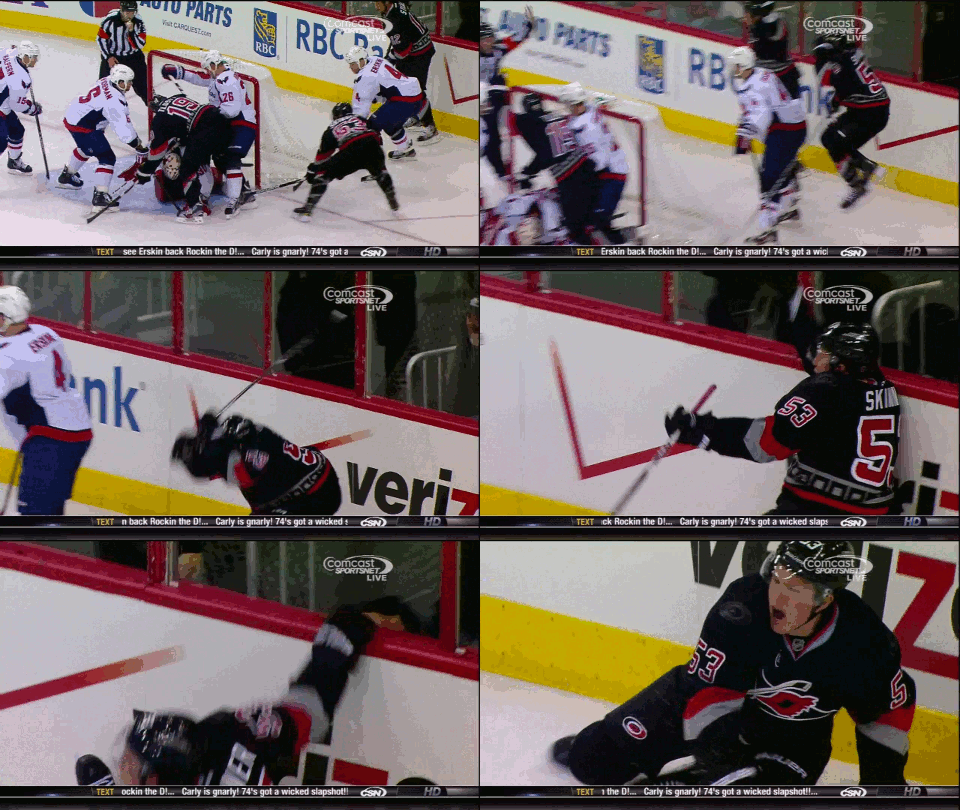
-- Jeff Skinner had 15 shot attempts for the Hurricanes and nothing to show for it.  What do youthink of that, young man?...


Friday, December 20, 2013

The Peerless Prognosticator is ON THE AIR!!! -- Game 35: Capitals vs. Hurricanes, December 20th

The Peerless Prognosticator is ON THE AIR!!!

The Washington Capitals return to their brief sojourn through the Metropolitan Division on Friday evening with a visit to Raleigh, North Carolina.  It is the third of four straight divisional games for the Caps and a chance to improve on their 7-5-0 record against their new/old rivals.

The Caps are part of a great big “meh” I the middle of the new Metro Division, at least insofar as insofar as intra-divisional rivalries are concerned.  Pittsburgh is way out in front in wins and losses within the division with a 12-4-0 record.  At the other end the New York Islanders are a dismal 2-8-3 (through Wednesday’s games). 

The Caps, with their 7-5-0 divisional record, are in that great glop of goo in the middle, standing in third place among the clubs in intra-divisional records.  It is not much better than the seventh-place Columbus Blue Jackets, who are 5-5-1.

In second place (by virtue of having played fewer divisional games) is Carolina at 7-4-0, including two wins in Washington so far this season.  This will be the clubs’ first contest in Carolina this year.  The Hurricanes, who started December with a 3-1-0 record, have displayed a bit of symmetry in their last four games, losing three of four (two in overtime).  The Hurricanes’ 4-2-2 record for the month has given them a boost, jumping from sixth in the Metro when play started on December 1st to third place as the Caps descend on Raleigh.

Carolina has 24 goals in eight games in December, a tidy 3.00 goals-per-game average.  Eleven players share in the 24 goals, and 18 players have recorded points.  Jeff Skinner, a.k.a. “The Human Tantrum,” has had a fine December to date – eight goals (two game-winners, including one against Washington on December 3rd) and two assists.  The eight goals pushed Skinner’s total to 12 for the season in 23 games, just one off his total for last season in 42 games.  In 18 career games against the Caps, Skinner is 4-10-14, plus-1.

Skinner’s mirror image in December is Eric Staal, who has three goals and seven assists for ten points of his own.  It is part of a longer stretch of games that has him recording points in 14 of his last 16 games (6-13-19) after going only 3-6-9 over his first 18 games of the 2013-2014 season.  If there is an odd number to his season to date it comes in Friday games.  He has more penalty minutes recorded (14) and a worse plus-minus (minus-9) on Friday than he has on any other day of the week.

Andrej Sekera is quietly putting together what might be a career year for himself.  Through 32 games, the eighth-year defenseman is 6-12-18, good enough to rank in the top-20 in scoring among defensemen through Wednesday’s games.  Sekera is on a pace to go 15-30-45, which would obliterate his personal bests in goals (he has already topped his best of four goals in 2009-2010, with Buffalo), assists (26, with Buffalo in 2010-2011), and points (29 in 2010-2011).  He is doing it while averaging 23:16 a game, more than two minutes more than his personal best of 21:12 set last year with Buffalo, and more than three minutes above his career average of 20:14 a game.

Here is how the teams compare in their overall numbers..


1.  Cooking has not been especially flavorful for the Hurricanes down in Raleigh so far this season.  In 17 home games so far this season Carolina has topped two goals only three times.  They have allowed more than two goals ten times over those 17 games.

2.  Carolina’s power play has been nothing to get excited about this season, and the trend continues in December.  In eight games the ‘Canes are 3-for-27 with the man advantage (11.1 percent).  It is part of a longer slump in which Carolina is 7-for-69 over their last 22 games dating back to November 1st.  Carolina has only 15 power play goals for the season (26th in the league), but two of them came against the Caps on nine opportunities in two games.

3.  At least the penalty kill has picked up.  After a November in which Carolina went 36-for-45 killing penalties (80.0 percent), they are 21-for-24 in December (87.5 percent).  They are 8-for-9 killing penalties against the Caps in two games this season.

4.  The good and the bad.  Carolina is adept at eking out points in one-goal decisions.  In 18 one-goal decisions so far this season they have points in 16 of them (9-2-7).  One of them came against the Caps, a 3-2 win on October 10th.  The Hurricanes have less success in games decided by three of more goals.  In eight such decisions they are only 3-5, but one of their wins came against Washington, a 4-1 win on December 3rd.

5.  Carolina struggles with possession in critical moments of games.  The Hurricanes are ranked 24th in Corsi-for percentage in 5-on-5 cloase situations, 27th in Fenwick-for percentage in those situations.  They have been better lately, though. In eight games in December they are over 50 percent in Corsi-for seven times (including their last six contests), over 50 percent in Fenwick-for in six of them , those being their last six contests.


1.  Only four teams have more one-goal wins than do the Caps (10). 

2.  Washington is the only team in the league to score precisely as much as they allow – 99 goals scored and 99 goals allowed in 34 games.

3.  No team has more wins than the Caps when trailing after two periods.  Not that it is a sure thing; Washington is 5-10-1 in such situations, tied with Chicago (5-5-0) for the league lead in wins.

4. Only Toronto and Philadelphia have more penalty minutes per game than do the Caps.  But here is the thing.  The Caps have 120 penalty minutes in three games against Philadelphia (40.0 per game), 370 penalty minutes in 31 games against everyone else (11.9 minutes per game).

5.  The Caps are still stuck in the mid-20’s in the league’s possession rankings in 5-on-5 close situations – 26th in Corsi-for percentage, 25th in Fenwick-for percentage.  In their last four games their Corsi-for percentage is 38.8 percent, their Fenwick-for is 36.3 percent.

The Peerless’ Players to Ponder

Carolina: Alexander Semin

After missing 12 games to a concussion, Alexander Semin returned to the lineup for Carolina on December 12th against Calgary.  In two games back in the lineup he has yet to register a goal on six shots or a point in just over 42 minutes of total ice time.  He has not had a goal since October 24th (12 games without one).  The Enigmatic One has been more productive in losses (2-3-5) than he has in wins (1-3-4), although the differences are slight.  It indicates he has not been a difference maker, at least so far, although the populations of games are small for making conclusions.  It is quite different from last season in which he recorded 10 of his 13 goals in wins and had a 17.2 percent shooting percentage in wins (3.3 percent in losses).  We would just as soon he have a nice, clean, enigmatic score sheet.  In six games against his former squad, Semin is 2-3-5, minus-3.

Washington: Joel Ward

Joel Ward is second on the Capitals roster in goals (ten), but he has only one in his last 15 games.  His experience with the Caps in his time here has been better starts than finishes.  Last year he had five goals in his first 12 games, only three in his last 27 games. In 2011-2012 he had four goals in his first 12 games, only two in his last 61 contests.  If he is going to score, tonight might be the time.  Four of his ten goals have come in five Friday contests.  The Caps are 3-1-1 in those games.  In 15 career games against Carolina, Ward is 1-3-4, minus-3.

Keys:

1.  Backup the Backup.  What do you want to bet Justin Peters gets this start?  In seven career appearances against the Caps he is 4-3-0, 1.67, .938 with two shutouts.  However, he has not faced an exceptionally large workload – 27.1 shots per 60 minutes.  The Caps need to do a better job of applying pressure.

2.  Score first.  Carolina is one of only two teams (Chicago is the other) yet to lose a game in regulation when scoring first.  They just don’t do it much (7-0-2, compared to Chicago’s 19-0-3).  Whisper sweet nothings in their ears, do a dance, pull their pants down.  Do what you have to do to score first.

3. Get under his Skin(ner).  Jeff Skinner is feeling all fat and happy with nine goals in his last nine games. Carolina is 3-1-2 in games in which he scored in that stretch.  Make him unhappy.  Jostle him, bang him, muss his hair.   

In the end…

It’s the last weekend before the holiday, and like anyone else, there are distractions.  Those for the Caps are compounded by the fact that this is the first of a back-to-back set of games (they host New Jersey tomorrow).  This is a club that seems to have had focus issues all season.  It is something to watch for – and beware of – against one of their old time Southeast rivals.

Capitals 4 – Hurricanes 3

Wednesday, December 18, 2013

Washington Capitals: A NO point night -- Game 34: Flyers 5 - Capitals 2

Eventually, you're actually going to lose when you play badly.  The Washington Capitals did the latter and suffered the former in Philadelphia last night, dropping a 5-2 decision to the Flyers.

It had all the makings of a close, hard-fought, Patrick Division kind of night.  At least for 35 minutes.  The Caps and Flyers skated to a scoreless first period in which the Caps had nine shots on goal, the Flyers with ten.  In the second period things opened up.  Alex Ovechkin scored a power play goal in the first minute of the period on a backhand from a severe angle when goalie Steve Mason tried to sweep a loose puck from his stick to his glove along the ice and missed his glove.

However, these being the Caps, a lead could not last long.  The Flyers scored just 58 seconds later when Jakub Voracek called his own number on a 2-on-1, ripping a wrist shot past goalie Braden Holtby to tie the game.

The Caps regained the lead in the sixth minute when, after a lead pass from Martin Erat to Troy Brouwer was too long, Brouwer tracked down the puck behind the Flyers’ net and sent it out to Eric Fehr for a one-timer past Mason.  The Caps yielded the lead once more, but at least it was not in the next minute.  Matt Read scored just under 12 minutes into the period, finishing up a sequence in which the Flyers had two shots blocked in front in quick order, but the Caps could not secure and clear the puck.  Read collected the loose puck in the slot and snapped it past Holtby to tie the game.

Then came what could only be explained as “youthful exuberance.”  With Casey Wellman tied up with Nicklas Grossmann tied up in the corner fighting for a loose puck, the Flyers’ Brayden Schenn dug out the loose puck and circled to his right in the corner to Holtby’s right.  Tom Wilson drew a bead on him, and as Wilson closed on him, Schenn turned ever so slightly to his left, exposing his numbers to Wilson.  Wilson freight trained him right in the numbers, sending Schenn to the boards head first.  As Schenn crumpled to the ice, Grossmann went after Wilson, and the other players paired off.  Schenn tried several times to get up and skate off to the bench under his own power, but had difficulty doing so.

Wilson was assessed a major for charging, a fighting major, and a game misconduct.  There were other, coincidental penalties, but it was the collection of penalties to Wilson that would be consequential.  The charging major gave the Flyers a five-minute power play.  They made good on it with a pair of goals.  First, Mark Streit banged one in off the post to give the Flyers the lead.  Then, Jakub Voracek scored his second of the game when he took a pass from Kimmo Timonen in the right wing circle, took a step toward the slot, and wristed the puck past Holtby to give the Flyers a 4-2 lead with less than two minutes in the period.

There would be no late-game heroics or come from behind fireworks for the Caps in this one.  Wayne Simmonds scored in the eighth minute of the third period, and the Flyers skated off the last 12 minutes to secure a 5-2 win and take three points from the two game home-and-home series.

Other stuff…

-- There was once a stretch of nine games over which the Capitals killed off 34 straight power plays.  Then, in their sixth shorthanded situation against Florida on November 2nd, they allowed a goal.  They followed that up by killing off five of five shorties against the New York Islanders on November 5th, giving them 39 kills in 40 situations (97.5 percent).  Since then, over the next 19 games through last night, the Caps are 51-for-68 killing penalties.  A 75.0 percent success rate killing penalties is the very epitome of “regression.”  And not just in a statistical sense.

-- The 20 minutes earned by Wilson in penalties puts him in an awkward position.  First, he is almost certainly going to be contacted by the Department of Player Safety.  Second, the 20 minutes he sustained in penalties vaulted him to the top of the list in penalty minutes among rookies (78).

-- It was nice (ok, for a little while) to see the second line score a goal in tandem.  Martin Erat and Troy Brouwer each had points on Eric Fehr’s goal.

-- If not for the major penalty to Wilson, the Caps had a pretty good night defensively.  They held the Flyers to 13 even strength shots over the first 40 minutes.  Then again “Our American Cousin” was probably not a bad piece of theater before Abraham Lincoln was struck down at Ford’s Theatre.

-- Alex Ovechkin was credited with no shot attempts in the first period of the contest, although there were those who noted that he did fire what looked like a shot attempt from outside the blue line on one occasion.  Still, it was unusual.

-- We noted the good about the second line.  Now, the not.  They finished the night with a combined five shot attempts and three shots on goal.

-- In his last four appearances, Braden Holtby is 1-2-0, 4.91, .863, and has been pulled twice.  Last night was not his fault, but he was not sharp, either.

-- With the loss, the Caps are 10-13-0 in regulation and overtime games.

Consider that last bullet.  If you do the arithmetic (and we did so that you don’t have to), the Caps are tied with the Edmonton Oilers for 26th place in the league in points earned in regulation and overtime, and only one point ahead of 28th place Florida.  If you are not concerned about this, perhaps you should be, Caps fans.  There is no trick shot competition in the playoffs, and it is not a tie-breaker factor in determining who makes the playoffs.

The Caps have been playing with fire for a while now.  Last night was the third time in four games in which they fell into a three-goal hole.  Last night, they failed to climb out of it for the first time in those three games.

Washington still has a five-point lead on Carolina for second place in the Metropolitan Division, and they face the Hurricanes on Friday in Raleigh.  Then the schedule opens up with four games in five against teams with sub-.500 records (New Jersey, the Ranges, Buffalo, and Ottawa) before a return engagement with Carolina to open the new year. 

However, in the larger scheme of things – the hockey portion of the hockey competition – the Caps look like a sub-.500 team, too.  There is nothing to be taken for granted with such a team, good or bad.  The game home-and-home series against the Flyers demonstrated that.


Sunday, December 15, 2013

Washington Capitals: A TWO point night -- Game 33: Capitals 5 - Flyers 4 (OT/Gimmick)

Well, the Washington Capitals certainly give their fans their money’s worth.  For the third straight game and 11th time this season, the Capitals went to the limit, settling their contest with the Philadelphia Flyers in the Gimmick and making another comeback worth the effort with a 5-4 win.

It looked really grim in the third period.  The Flyers, if not painstakingly, at least persistently got out to a 4-1 lead.  They did it with four unanswered goals after Washington drew first blood (it would not be the only blood drawn this evening).  Alex Ovechkin scored his 27th goal of the season on a goal originally credited to Marcus Johansson. 

On a power play, Nicklas Backstrom took a pass from John Carlson along the right wing wall.  Backstrom walked the puck down the wall, then found Ovechkin on a cross-ice pass.  From the top of the left wing circle Ovechkin sent what looked to be a pass to the goal mouth on a set play, Johansson stepping out from beneath the goal line to goalie Steve Mason’s left.  The pass did not get through, clipping defenseman Kimmo Timonen’s stick and deflecting past Mason.

After that it was all Flyers, or rather “no Caps.”  The team had little life in it over large chunks of the next 40 minutes.  The Flyers scored late in the first period, a score by Claude Giroux left open in the high slot, in the last minute of the period to tie the game.

The Flyers took the lead in the second period when the Caps were baited into a bad turnover.  Karl Alzner tried to find Nicklas Backstrom on a long lead pass through the middle.  However, Mark Streit was lurking at the red line and stepped up to intercept the pass.  He took fed the puck ahead to Michael Raffl, who touch-passed it right back to Streit hitting the blue line.  Streit stepped up and wristed a shot under goalie Philipp Grubauer’s left arm.

That was how the game went to the third period, but the Flyers added two goals in quick fashion.  Sean Couturier and Jakub Voracek scored 1:14 apart to give the Flyers a 4-1 cushion, and it looked as if the competitive portion of the evening was over (certainly we did).

Even when Mike Green stepped around Matt Read high in the offensive zone and wristed a shot high over Mason’s right shoulder at 11:20 to cut the margin to 4-2, it looked a bit like window dressing.  But then something odd happened.  Joel Ward won a faceoff, Eric Fehr dug it out and fed Dmitry Orlov, and Orlov one timed a rocket past Mason to get the Caps to within a goal.  That had the joint rocking, because at that point, one almost knew what was coming.

It did.

With the clock ticking under a minute left in regulation and Philipp Grubauer on the bench for the extra attacker, Mike Green fired the puck in deep behind the Flyers’ net.  Mason circled around to play the puck, but the puck squirted past the blade of his stick.  He managed to retrieve it, but his timing was now off.  He swung the puck around to the corner where the puck took an odd bounce off the boards and onto the stick of Joel Ward.  From the low left wing circle Ward threw the puck out to Green, but Alex Ovechkin jumped past Green, took the puck and wristed a knuckleball that eluded Mason, who could not scramble back to the net and square himself up for the shot in time. 

The goal capped a furious – certainly more furious than the second period and half of the third – comeback for the Caps, who stole a point they had no business stealing.  They secured the other one when Eric Fehr and Claude Giroux exchanged trick shot goals, then Nicklas Backstrom snapped a shot past Mason’s left pad.  That left it up to Grubauer, who denied Sean Couturier and sent the Caps fans off into the cold night with a warm glow in their hearts.

Other stuff…

-- Dmitry Orlov gives something the Caps have lacked – a big shot from the left side.  Mike Green is more the pitcher who uses guile and changes of speed, while John Carlson has a big shot.  Both are right-handed, though.  Orlov provides a balance that the Caps are not going to have with Karl Alzner and John Erskine out there.  Those two have their values, but making goalies quake is not among them.

-- On Orlov’s goal, watch Nicklas Grossmann playing defense for the Flyers.  From the faceoff to the goal, he never moved an inch and ended up screening his own goaltender.

-- On Ovechkin’s second, game-tying goal, if he isn’t as “selfish” as he is reputed to be, snaking past Mike Green to jump on the puck and fire it, do the Caps tie the game? 

-- With two goals, Alex Ovechkin takes over second place in franchise history.  He has 399 goals, breaking the tie he had with Mike Gartner for second place all-time.  Peter Bondra is the franchise leader with 472 goals.

-- How “furious” was the comeback?  The Caps registered 14 shots in the first and second periods, combined.  They had 16 shots on goal in the third period.

-- The Caps won 11 of 14 defensive zone draws (78.6 percent).  That’s pretty good.  Overall, Michael Latta was the only Cap under 50 percent on draws (2-for-5). 

-- Mikhail Grabovski was a late scratch with flu-like symptoms.  So let’s see…the Flyers couldn’t beat the Caps with Alex Ovechkin out of the lineup (the 7-0 loss on November 1st), and they couldn’t win this game with Grabovski out and Jay Beagle serving as second line center.  Flyer fans must be irked.

-- Speaking of Beagle… 12:32, two shots, three hits, six wins on ten faceoffs.  That’s good for a fourth-line center.  It’s not bad for a third-line center.  Those are roles Beagle can fill and fill with some effectiveness.  It is not a winning production line for a second line center.  

-- That's the above-the-clouds view.  Down on the ice, the faceoff win that Eric Fehr dug out to get to Dmitry Orlov for a goal was a win by Beagle.  You do what you can do, and sometimes it's the little things that matter most.

-- John Erskine returned to action after being out since October 26th.  It was not an especially auspicious return.  Erskine was on ice for two of the Flyers' first three goals and got only two shifts in the third period, none in the last 13 minutes.

-- Who led the Flyers in giveaways?  Steve Mason.  Doesn’t seem too surprising, even if you place little faith in the veracity of giveaway statistics.

-- The Caps held the Flyers to 28 shots on goal, breaking an eight game streak in which the Caps allowed more than 30 shots on goal.  It was only the fifth time in 33 games that the Caps allowed an opponent fewer than 30 shots.  The Caps are 2-2-1 in those games, both wins coming in extra time, an overtime win over Carolina and this win.

-- With a power play goal in this game, the Caps have extra man goals in three straight games and five of six games in December.  They are 7-for-24 (29.2 percent) on their December power play.

-- With an assist, Marcus Johansson now has points in three straight games (0-3-3).  It is his fourth three-game points streak of the season.  He does not yet have a four-game streak.  He also has another odd streak – six straight games with a single shot on goal.  Of course, there is the one that got away, the first goal of the game originally credited to Johansson that was awarded later to Ovechkin.

-- Nicklas Backstrom had another multi-point game, his fourth in his last five.  He is 2-9-11 over those last five games.

In the end…

All’s well that ends well, or so the saying goes.  Good luck with that.  The Caps have come back from three-goal deficits twice in three games, scoring the game-tying goal twice in the last minute of regulation, both times off the stick of Alex Ovechkin.  It makes for great theater, not unlike “All’s Well that Ends Well (if you’re into Shakespeare)."  But one has to wonder if this is a sustainable strategy.  Play like crap for 30-40 minutes, heave a bunch of shots late, get a last minute goal from Ovechkin, win in the freestyle competition.  Sound like a winner?

The Caps might sit in second place in the Metropolitan Division, but only the New York Islanders have fewer wins in regulation and overtime (five) than the Caps (ten).  In fact, there are only five teams in the entire league – Winnipeg, Edmonton, Florida, the Islanders, and Buffalo – with fewer wins in regulation and overtime.

But still…you get wins in this league how and when you can, especially when you're a little thin in the lineup.  You bank them away for those times you aren’t on the good side of the hockey gods, or you use them as a foothold to move up in the standings when you do start performing better.  Besides, when it’s the Flyers falling in a way such as this, it is among the guiltiest and most pleasing guilty pleasures there are for a Caps fan.

Washington Capitals: That Was The Week That Was -- Week 11

It was one of the stranger weeks for the Washington Capitals in this first half of the 2013-2014 season, one that started better than it ended.  It was a week that ended with a record that the Caps might not have deserved, but it was one they surely will take without apology.


Record: 2-0-1

It was a week with a certain “Back to the Future” air to it.  Washington opened the week with a game against their recent post-season nemesis, the New York Rangers, and their world-class goaltender Henrik Lundqvist.  It was a long time since the Caps scored on Lundqvist – Game 5 of the Eastern Conference quarterfinals last spring, in fact.  After two shutouts to wrap up that series and a shutout in the teams’ only meeting to date this season, Lundqvist carried a 180 minute shutout streak into last Sunday’s game against the Caps.  Lundqvist added another period for good measure, but with just over two minutes gone in the second period Jason Chimera, himself a personal nemesis of Lundqvist, swept in a loose puck lying at Lundqvist’s side to break the streak at 202:28 of shutout goaltending.  The Caps added three more of goals, one on a penalty shot by Mikhail Grabovski, and won going away, 4-1.

The other two games rekindled old rivalries, such as they were, from the old Southeast Division.  The Caps hosted the Tampa Bay Lightning in the middle game of the week and nearly were run out of their own building.  The Lightning built a 3-0 lead after just 11:07 and chased starting goalie Braden Holtby.  The Caps came back with a vengeance, scoring late in that first period, then adding three in the second period while the Bolts were adding one of their own.  The teams exchanged third period goals and a scoreless overtime, leaving it to the Gimmick, which is becoming a Capitals specialty this season.  Washington won it on a Troy Brouwer strike to save what looked like a certain defeat.

That defeat came in the week’s last game, a 3-2 trick shot loss to the Florida Panthers.  The Caps were a step behind all night, twice falling behind by a goal to the Panthers.  It didn’t help that their own scoring was taken off the board by the officials, an early goal by Mike Green disallowed for Martin Erat being in the crease and a goal by Alex Ovechkin taken off the board for the official blowing the play dead.


Offense: 3.67/game (season: 2.91 / rank:7th)

It was the Nicklas Backstrom and Alex Ovechkin show this week, a product of big nights against the Tampa Bay Lightning in the middle game of the week.  Backstrom finished the three games 2-5-7 (1-4-5 against Tampa Bay), while Ovechkin finished the week 4-0-4 (all goals coming against the Lightning.  After that, the Caps had four goals scored, plus another on a conversion of a penalty shot by Mikhail Grabovski. Those four goals did not come from scoring lines.  Nate Schmidt and Steve Oleksy scored from the blue line, Jason Chimera scored from the third line, and Joel Ward scored on a power play.  The second line of Mikhail Grabovski, Eric Fehr, and Troy Brouwer was held without a goal, save for Grabovski’s penalty shot, and they had but one assist, that recorded by Grabovski (both Grabovski and Brouwer recorded power play assists).

Defense: 2.67/game (season: 2.81 / rank: 20th)

Another week, another week without a game allowing opponents fewer than 30 shots.  In three games the Caps allowed opponents 114 shots on goal (38.0 per game).  It was a pretty brutal week of possession for the Caps.  Overall, in all 5-on-5 situations, they had a Corsi-for percentage of 40.5 percent, a Fenwick-for percentage of 41.9 percent, and an overall shots-for percentage of 41.6 percent.  And that is with a game against the Rangers in which they were over 50 percent in all three measures.  Their Corsi-for of 29.9 percent against the Lightning is their worst performance of the season.  The game against the Panthers was their third worst of the season.  And that is the root of a team allowing 38 shots a game for the week.  On the basis of these numbers, it is a wonder that the Caps didn’t finish the week 1-2-0 at best.  

Goaltending: 2.55 GAA / .930 save percentage (season: 2.69 / .922 / 1 shutout)

Here is a big part of how the Caps finished the week 2-0-1 instead of 1-2-0.  Philipp Grubauer, who had 20 minutes of mop-up work in one game this season coming into this week, logged 177:29 of ice time in three games, one of them in early relief of Braden Holtby, who had one of the more forgettable weeks of his young career.  But back to Grubauer.  In those 177-plus minutes Grubauer stopped 101 of 106 shots (.953 save percentage).  As much as anything, Grubauer did what is the first thing a goaltender should do – give his team a chance. He was 27-for-27 in first period saves for the week, including four he made in relief of Braden Holtby against Tampa Bay when the Caps fell behind 3-0.

As for Holtby, he is in something of a mini-slump.  He allowed three goals on eight shots in 11 minutes and change this week.  Over his last three appearances he has only 111 minutes of ice time, having been pulled twice, and has a goals-against average of 4.86 with a save percentage of .866.

Power Play: 4-10 / 40.0 percent (season:  percent 24.6 percent / rank: 2nd)

It was a good week.  Then again, it had to be.  Four of the week’s 11 goals came via the man advantage.  It was the best week for the power play since going 7-for-16 in three games in Week 6.  Nicklas Backstrom figured in all four power play goals, scoring one on his own and recording assists on the other three.  Alex Ovechkin had two of the goals, Joel Ward getting the fourth. 

It was a rather efficient week for the Caps, too.  The four shots came on 17 shots in 17:39 of total power play time.  Ovechkin was 2-for-5 shooting, the rest of the club was 2-for-12.  Given that Nicklas Backstrom scored on his only power play shot of the week, 1-for-11 from seven other players is something the team needs to work on.
e

Penalty Killing: 7-9 / 77.8 percent (season: 82.9 percent / rank: 13th)

This was the fourth straight week that the Caps did not kill more than 80 percent of the shorthanded situations they faced (they were right at 80.0 percent in Week 10).  Over that time the Caps are 28-for-38 (73.4 percent), a far cry from the highly ranked PK unit through the first five weeks of the season.

It wasn’t the opportunities this week (nine in three games is manageable) as much as the shots.  Opponents recorded 18 shots on goal in only 15:54 of power play ice time.  What saved the week was Grubauer’s play in goal; he stopped all 15 power play shots he faced.

Even Strength Goals For/Against: 7-6 (season: 61-66; 5-on-5 GF/GA ratio: 0.93 / rank: T-20th)

Given the Caps possession statistics at 5-on-5, it is a wonder that the won the week in even strength goals.  In two of the three games their 5-on-5 Corsi-for and Fenwick-for percentages were under 40 percent. For the week they were at 40.5 percent in Corsi-for, 41.9 percent in Fenwick-for.  It was reflected in the shots.  The Caps dominated the Rangers, outshooting them at even strength by a 32-23 margin.  However, the Caps managed only 39 even strength shots on goal in the next 130 minutes of hockey to end the week while surrendering 72.

Faceoffs: 91-168 / 54.2 percent (season: 48.8 percent / rank: 21st)

It was a good week, to a point.  The Caps had been sliding into the lower half of the faceoff rankings in recent weeks but finished Week 11 well above 50 percent.  But the result has two parts to it.  Washington dominated the circle in the defensive end, winning 40 of 66 draws.  Nicklas Backstrom was especially successful, winning 16 of 24 draws (66.7 percent).  Joel Ward (6-for-10; 60.0 percent) and Mikhail Grabovski (7-for-13; 53.9 percent) also had good weeks in the defensive end.

In the offensive end, things were different.  The Caps won 22 of 49 draws overall in the offensive zone (44.9 percent) and had a devil of a time with Tampa Bay (3-for-15; 20 percent).  Troy Brouwer was the only Cap over 50 percent in the offensive zone for the week (5-for-8; 62.5 percent).

Goals For/Against by Period:


The Caps have had a knack for scoring in bunches in the second period this season, and they did it again this week.  They scored eight of their 11 goals for the week in the middle frame – three against New York and Tampa Bay, two against Florida.  They continue to struggle, though, in the first period.   They were 1-for-21 in first period shooting for the week, quite different from their 8-for-38 shooting (21.1 percent).  If there was a plus for the week is was in allowing only one even strength goal in the first period, that part of Tampa Bay’s three-goal burst in the first period of the Caps’ 6-5 trick shot win.  It was the only game of the three this week in which the Caps allowed any first period goals.

In the end…

When it comes to wins and losses, it’s not how, it’s how many.  The Caps were 2-0-1 this week, and in that context it was a good week.  That says nothing about the Caps’ ability to sustain such results in wins and losses by losing the possession battle, falling behind in games, relying on the power play (and, more specifically, Alex Ovechkin and Nicklas Backstrom to bail them out), and getting top-notch goaltending from the number three goalie on the depth chart.

There are going to be times when the Caps play well and have little to show for it.  This week they did not play especially well, but reaped the rewards, anyway.  In the long run, the Caps are going to have to display more consistency in being able to win even-strength battles, minimize opponents’ possession advantage, and get better goaltending from Braden Holtby than what he has endured lately.  With four divisional games on tap in the upcoming week, getting to that happy place cannot come soon enough.