Sunday, January 16, 2022

Washington Capitals: That Was The Week That Was - Week 14

The best that might be said of Week 14 for the Washington Capitals is that it was better than Week 13.  If optimism is your thing, you could say that a week that began with a disaster at home ended on a high note on the road.  Something to build on after a sluggish start to the new year.


Record (1-1-0)

The Caps began the week extending a losing streak to four games (0-2-2), their longest losing streak of the season and longest since Games 10-13 last season, from February 1st through February 14th, also a four-game losing streak.  The seven goals that the Caps allowed ij a 7-3 loss to Boston to open the week were the most goals allowed to the Bruins on home ice since the Caps dropped a 7-2 decision to the B’s on October 30, 2002.  The loss to the Bruins extended a string of alternating wins and losses to five games (the Caps are 2-3-0 in that streak).

The Caps finished off their two-game week with a grind-it-out 2-0 win over the New York Islanders.  The shutout in the first meeting of the teams this season was the Caps’ second consecutive shutout of the Islanders, having blanked them, 1-0, in the third of three consecutive games played against the Islanders late last season.  It was the third time in four games against the Isles that the Caps recorded a shutout, beating them in a 1-0 Gimmick win last April 22nd in the first of those three consecutive games to start the run of stinginess.


Offense: 2.50 / game (season: 3.29 / 9th)

It was not a particularly good week on the offensive side of the puck for the Caps, who managed four goals against goaltenders and an empty netter to end the 2-0 win over the Islanders to end the week.  Conor Sheary was the only Capitals with a multi-goal week, posting a pair in the 7-3 loss to Boston.  T.J. Oshie, Tom Wilson, and Alex Ovechkin (empty net) were the other goal scorers. 

Sheary, Ovechkin, and Evgeny Kuznetsov were the only players with multi-point weeks, each posting a pair.  In all, nine players recorded points, none of them by a defenseman. 

The odd part of the week might have been the Caps’ considerable advantage in shot attempts at 5-on-5.  They were plus-16 in attempts (60 for, 44 against) in the loss to Boston, which might be explained away as scoring effects.  The Caps were plus-22 against the Islanders (49 for, 27 against) in a dominating possession performance.

Defense: 3.50 / game (season: 2.68 / 8th)

Before the Bruins torched the Caps for seven goals in the first game of the week, the Caps had not allowed more than five goals in a game, although they have done that six times, twice in an overtime loss, not including the Boston debacle.  It was the largest margin of defeat to the Bruins on home ice (minus-4) since the Caps dropped a 7-2 decision to the Bruins on October 30, 2002, a span of 33 games between those two games.

The Caps allowed 31 shots to the Bruins, only the second time in eight games that they allowed more than 30 shots (37 to the Devils on January 2nd).  In each of the other six games, including the game against the Islanders in which they allowed only 23 shots, they allowed fewer than 25 shots.  It allowed the Caps to finish the week having allowed the second fewest shots per game for the season overall (28.1), trailing only Carolina (27.8).

Goaltending: 3.50 / .870 (season: 2.55 / .908 / 5 shutouts)

Reality can be cruel, and it hit Zach Fucale hard in the loss to Boston.  Having allowed one goal on 50 shots in his first three NHL appearances, he was abused by the Bruins to the tune of four goals on 16 shots in less than 28 minutes of work in the 7-3 loss.  It might be a blip, it might be a signal that he is coming back to earth in his performance, but he remains one of the feel good stories for the Caps so far this season, still with a .924 save percentage in 171 minutes of work to date, 12th in the league among 78 goalies with at least 150 minutes played.

Vitek Vanecek got the remainder of the work for the week, and it was a case of very “meh” followed by very good.  He allowed three goals on 15 shots in 32 minutes of relief in the loss to Boston, but followed that up with a 23-save shutout of the Islanders to end the week.  Vanecek has been the beneficiary of some stinginess by the Caps in shots allowed, the 23 he faced against the Islanders being the sixth time in 15 games in which he played the full contest that he faced 25 or fewer shots.  Even the shutout had an odd stinginess aspect to it.  Only once in the last 11 shutouts by Caps goalies did the goalie face more than 30 shots (Ilya Samsonov, 34 shots versus Los Angeles November 17, 2021), only twice faced more than 25 shots (Samsonov: 26 shots versus the Islanders on April 22, 2021).

Power Play: 0-for-4 / 0.0 percent (season: 14.3 percent / 30th).

The streak of two weeks with at least, well only, one power play goal came to an end in Week 14, and the four chances were the fewest of any week this season, albeit in only two games.  What is also concerning about the power play is the neighborhood in which the Caps reside with regard to shorthanded goals allowed.  While they did not allow one in Week 14, they have allowed five so far this season, tied for fourth-most in the league.  Of the six teams allowing five or more shorthanded goals, Los Angeles has the most efficient power play, if you can call a 24th ranked power play (16.7 percent) “efficient.”  The Caps (14.3 percent and five shorthanded goals allowed) are neither efficient scoring with the man advantage and have been leaky in defensing on the power play.


Penalty Killing: 5-for-7 / 71.4 percent (season: 82.5 percent / 9th)

As with most aspects of this week, the Caps were poor on the penalty kill against Boston (3-for-5) and better against the Islanders (3-for-3).  It was the first week the Caps allowed more than one power play goal since a disastrous four goals allowed in Week 10.  It also brought to an end a three-week streak without having allowed a power play goal (15-for-15).  John Carlson (6:09), Tom Wilson (5:48), and Martin Fehervary (5:04 were the three Caps logging more than five minutes of penalty killing ice time for the week.


Faceoffs: 58-for-126 / 46.0 percent (45.7 percent / 32nd)

It is just a rinse and repeat cycle at this point, the Caps being a mid-40’s winning percentage on faceoffs.  And, they once more were consistently weak by zone, with 45.7 percent in the offensive zone, 43.9 percent in the defensive end, and 48.7 percent in neutral ice. Nicklas Backstrom was the only Capital taking more than ten draws with a winning week in the circle and was over 50 percent in all three zones while leading the team in faceoffs taken.


Goals by Period

The second period has been a problem for the Caps this season, and allowing four goals to Boston in the middle frame of the 7-3 loss only added to the woes.  But the Caps denied the Islanders a second period goal in the 2-0 win, the first time they did not allow a second period goal since December 4th in a 3-1 win over Columbus and the first time they did so on the road since November 30th in Florida in a 5-4 loss to the Panthers in which the Caps followed up that second period blanking with allowing four third period goals.


Year-over-Year

The Caps slipped a bit in year-over-year record compared to last season but are still only three standings points behind the pace set last season.  The defense, despite the seven goal ambush by Boston, remains ahead of last season by about a third of a goal per game, and this is reflected, too, in shots on goal, where the Caps have improved by a net 190 shots over last season, and in shot attempts at 5-on-5, where the Caps are up a net 217 attempts.  The power play this season is unrecognizable compared to last year’s at the 38-game mark, while the penalty kill is roughly equivalent. 


In the end…

We are getting into the long dark winter of the hockey season, and the Caps seemed intent on getting a head start on the “dark” part with their loss to Boston.  The shutout of the Islanders was a gritty affair of the sort that the Caps have been on the short end of late, but they were stingy and opportunistic in grinding out a win against the Islanders.  Consistency is now Task 1 as the season moves forward, the Caps needing to marry effort to results if they are to regain the top spot in the Metropolitan Division.

Three Stars

  • First Star: Vitek Vanecek (23-save shutout, first shutout this season)
  • Second Star: Conor Sheary (2-0-2, plus-1, four shots on goal, four attempts)
  • Third Star: Alex Ovechkin (1-1-2, plus-1, eight shots on goal, 13 shot attempts, five credited hits)

Saturday, January 15, 2022

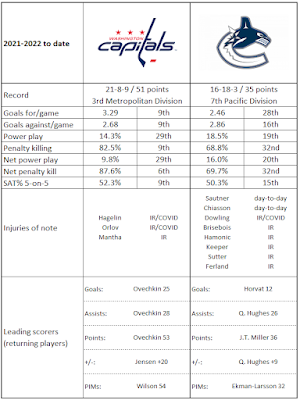
The Peerless Prognosticator is ON THE AIR!!! -- Game 39: Canucks at Capitals, January 16th

The Peerless Prognosticator is ON THE AIR!!!

The Washington Capitals wrap up their back-to-back weekend and “Former Caps Coaches Week” with a visit from the Vancouver Canucks and former coach and legendary f-bomb dropper, Bruce Boudreau.  The Canucks, like the Caps, are playing in the back half of a back-to-back set of games, dropping a 4-1 decision to the Carolina Hurricanes on Saturday.

The Canucks turned a sluggish start around with the hiring of Boudreau, earning points in their first nine games (8-0-1) under their new bench boss.  But when streaks end, the pendulum often swings in the other direction, and it has done so for Vancouver, 1-3-1 over their last five games, including a current three-game losing streak, since winning their first seven games under Boudreau.

The Canucks outscored opponents, 21-11 (not including shootout goals), in those seven wins to open Boudreau’s Vancouver tenure. Since then, the Canucks have been outscored, 16-11, in going 1-3-1.  Nine different Canucks have goals over those last five games, but only two – Tyler Motte and Bo Horvat – have as many as two.  They are two players having taken different paths to this point.  Motte has had the longer road to travel.  The last pick of the fourth-round (121st overall) of the Chicago Blackhawks in the 2013 Entry Draft, he went on to play three seasons at the University of Michigan that were unusual for the nature of his progress.  In his first two seasons with the Wolverines, he was 18-31-49, plus-10, in 69 games.  But in his third season he blossomed, going 32-24-56, plus-28, in 38 games, second on the team in goals to current Winnipeg Jet Kyle Connor.  He spent a year and change with the Rockford Ice Hogs in the AHL and 33 games with the Blackhawks, who traded him to the Columbus Blue Jackets in June 2017 with a sixth-round draft pick in 2017 and Artemi Panarin for a fifth-round draft pick in 2018 , Anton Forsberg and Brandon Saad.  After 31 games with the Blue Jackets in 2017-2018, he was a deadline day trade acquisition by Vancouver in February 2018, going to Vancouver with Jussi Jokinen for Thomas Vanek.  He has yet to come close to displaying the scoring touch he had in his last collegiate year, posting 25 goals in 169 games to date with the Canucks.  Motte has points in three of his last four games, a three-game streak stopped in Vancouver’s loss to Carolina on Saturday.  He is without a point and has a minus-1 rating in three career games against the Capitals.

Horvat, on the other hand, was a ninth overall pick in the same draft in which Motte was taken – 2013.  Leading up to that draft, Horvat was 63-72-135, plus-30, in 121 games over two seasons with the London Knights of the Ontario Hockey League.  He followed that up with a 30-44-74, plus-20, in 54 games with the Knights in 2013-2014.  The AHL portion of his apprenticeship lasted five games, and he is now in his eighth season with the Canucks.  In 539 regular season games with the Canucks (22nd on the all-time list among Vancouver skaters), he has 151 goals (15th on the franchise list), 184 assists (25th), 335 points (19th), four overtime goals (tied for ninth), 18 game-winning goals (19th), 47 power play goals ((tied for 14th), and seven shorthanded goals (tied for ninth).  On the other side, his minus-74 career rating is 13th-worst among 587 skaters to dress for the Canucks.

Last season was Horvat’s first in five in which he failed to reach the 20-goal mark, finishing with 19 in 56 games.  With 11 in 36 games so far this season, he has a good chance to start another 20-goal season streak.  His goal scoring has been more efficient on the road so far this season with seven in 20 road contests and a 14.3 shooting percentage, while at home it is four goals in 16 games and a 7.7 shooting percentage.  Horvat has two points (both goals) in his last six games after going 4-4-8, plus-4, in his previous nine games.  He is 2-6-8, minus-5, in ten career games against Washington.

A team like Vancouver, seeking to lift its game to a keener competitive edge, might be giving rookies chances to make a mark.  The Canucks, however, have dressed only three rookies this season and only one for more than ten games.  Vasily Podkolzin is perhaps not a household name outside of, well, his own household, but he has displayed a scorer’s touch in his rookie year with seven goals in 35 games. Tied for sixth in his rookie class to date.  Podkolzin was a first-round pick of the Canucks in the 2019 Entry Draft, and they are hoping to have the same sort of luck with him that they have had with their top picks in recent drafts (Quinn Hughes in 2018, Elias Pettersson in 2017, Brock Boeser in 2015, Jake Virtanen in 2014, Bo Horvat in 2013).  Podkolzin’s career is a bid odd in that while he was drafted out of Russia and played several seasons with SKA St. Petersburg in the KHL, he had no North American experience before earning a roster spot with Vancouver this season.  As with some rookies, the adrenaline rush of opening a rookie season leads to good production, and Podkolzin was 3-0-3, plus-1, in his first ten games.  But since then, he has slipped just a bit, going 4-2-6, plus-2, in his last 25 games and has two points (both goals) in his last ten games.  This would be his first career appearance against the Caps.


1.  Only Montreal has lost more games in regulation on the road (14) than Vancouver (11, tied with seven other teams).

2.  The Canucks have the worst penalty killing record on the road so far – 71.7 percent.

3.  Vancouver is one of three teams in the league to have allowed more than 20 goals in each of the first, second, and third periods of road games (22,22, and 25 goals, respectively).  Montreal and Detroit are the others.

4.  The Canucks are one of eight teams that have not allowed an overtime goal on the road this season.  They do, however, have two Gimmick losses on the road, tied for third-most in the league (Florida and Arizona have three apiece).

5.  Vancouver has the best net penalties per 60 minutes (drawn less taken) in the league in road games (plus-0.47/60).

1.  In five January games, the Caps have one power play goal scored and one shorthanded goal allowed; their 0.0 percent net power play is tied for third-worst in the league.

2.  The Caps have 2.60 power play chances per game in the new year, tied for seventh fewest in the league.  Their 3.00 chances per game in the 2021 portion of the season ranked 11th most in the league.

3.  Washington’s 0.78 net penalties per 60 minutes in January is fifth-best in the league.  Their penalties taken per 60 minutes (2.34) is tied with Vegas for the fewest in the league.

4.  The Caps broke a 12-game streak of having allowed at least one second period goal when they shut out the Islanders on Saturday.  Still, the nine they have allowed in January are tied for second most in the league (with Vegas), one behind Boston.

5.  Four times in five games, the Caps have scored first in January, but they are just 1-2-1 in those games.

The Peerless’ Players to Ponder

Vancouver: Jaroslav Halak

Bet you were wondering where the well-traveled goalie Jaroslav Halak was playing these days.  It is in Vancouver, and with Thatcher Demko getting the call on Saturday in the loss to Carolina, the Caps might be facing an old nemesis once more.  Halak has eight games on his resume this season but has yet to take the ice in the new year.  He has been a bad luck goalie compared to his netmate, Demko.  Despite almost identical underlying numbers – 2.59 goals against average to 2.70 for Demko, .915 save percentage compared to .914 for Demko – he is just 1-4-2 in his eight games (one no-decision) compared to 15-14-1 record for Demko.  Halak, who was signed as a free agent by Vancouver last July, is tending goal for his sixth NHL team, including a 12-game stop in Washington in 2013-2014, in a 16-season career.   

He has been one of those below-the-radar kind of goaltenders since arriving in the NHL in 2006-2007.  Since then, he ranks 14th of 314 goalies to dress in at least one NHL game in games played (547), 15th in wins (282), 23rd of 148 goalies logging at least 2,500 minutes in goals against average (2.48), 28th in save percentage (.916), and tied for fifth in shutouts (52).  The odd part of his career is that he has only 17 postseason wins in 39 games, although Caps fans will remember him as not being quite that ordinary.  The good news for Caps fans, should he get the call, is that he has yet to win on the road this season, albeit in few chances and getting little in the way of offensive support (0-3-1, 2.55, .923).  Halak is 11-11-1, 2.70, .906, with one shutout in his career against the Caps.

Washington: Daniel Sprong

When the Caps shut out the Islanders on Saturday, he was the only skater to play the entire game without a shot attempt (T.J. Oshie had none in 1:46 of ice time before his day ended with an injury).  Quite unusual for a player whose emphasis in in the offensive end of the rink.  Fortunately for the Caps, his being quiet on the shots front has not been too debilitating (the Caps are 3-1-2 in the six games in which he did not record a shot on goal), but with the Caps struggling with health and offensive production issues in the new year (11 goals scored in five games to date), production from Sprong would be welcome.   

He has been pretty good in that regard lately, going 3-2-5, even, in his last ten games after posting only one point (an assist) with a minus-3 rating over his previous eight games.  If there is an odd stat with respect to Sprong, though, it is in his ice time.  In 15 games in which he skated at least 13 minutes this season, the Caps are 5-4-6.  This despite his posting a 4-1-5, plus-1, scoring line in those games.  One would think that a player who is primarily an offensive threat would be more efficient as a shooter, but that has been a bit of a problem for Sprong this season, his 8.1 shooting percentage being the second-worst of his six-year career to date (he was 5.9 percent in eight games with Anaheim in 2019-2020).  It is quite a difference from the career best 17.6 percent shooting he recorded with the Caps last season in 42 games.  Sprong is 0-1-1, even, in five career games against Vancouver.

In the end…

Vancouver is coming off the coaching change high that a lot of teams experience when a change is made.  The Caps need to stand on the throats of the Canucks and keep them in the post-high slump that also often accompanies a coaching change.  That means jumping on the visitors early, and with a 37-22 goals for and against differential in first periods this season, the Caps certainly have the capacity to do just that.

Capitals 4 – Canucks 3