Well, because there should be, and here is why. Let's look at the 2008-2009 season. In it, we will assume that the top-six defenders were as follows:
Mike Green
Shaone Morrisonn
John Erskine
Tom Poti
Milan Jurcina
Jeff Schultz
That group of six defenders played together in 25 games last year. Playing together in fewer than one in three games is indicative of the injury/illness issues with which the defense had to contend last year. Whether that is extraordinary compared to other teams, we don't know, but it isn't relevant to the point we are about to make.
In those 25 games, the Caps compiled a record of 15-6-4. That would be a 113 point pace over 82 games. In the other 57 games the Caps were 35-18-4... a 106 point pace. Was an intact defense that much superior to what at times was a make-shift defense? One could say that it was a case of guys like Karl Alzner, Tyler Sloan, Bryan Helmer, and Sean Collins stepping up when needed, but those guys were in Hershey for a reason, just as the six we mentioned were the top six defensemen in games played. Presumably, the latter group is better.
But were they that much better? Even if we introduce the factor of a Brian Pothier return, it didn't seem to matter a lot. There were an additional eight games in which Mike Green and Pothier played, with a mix of defensemen filling the other four slots. In those games, the Caps were 5-2-1, a 113-point pace (although the small number of games doesn't lend itself to much in the way of conclusions).
If you take the combined "top-six" and "Return of Pothier" games, that's a collection of 33 games in which the Caps went 20-8-5, a 112-point pace. It didn't seem to matter in any demonstrable sense which six players -- as a group -- were manning the blue line (conversely, maybe it's just a case of the forwards being so good as to overshadow various mixes of defensemen).
We could be accused of splitting hairs when no matter which of these groups of six we're looking at, we're looking at a record that reflects a 100+ point pace. And given how bad the Caps defense was a short few years ago, we might be seen as splitting the split hairs. But we would think that a "top-six" group would matter more. And if the Caps are going to seriously contend for a Stanley Cup this year, we suspect they will have to matter more.
Wednesday, September 09, 2009


Tuesday, September 08, 2009
2009-2010 Previews -- Defensemen: Jeff Schultz

Jeff Schultz
Theme: “When they boo you, you know they mean you.”
Theme: “When they boo you, you know they mean you.”

George Halas said that in reference to football, but it pretty much applies to any sport or art form. And no one, it seems, is the target of more boos, or at least more ill feeling among Caps fans, than defenseman Jeff Schultz. Frankly, we’re not seeing either the reason or the purpose. First, there is the calendar. If Karl Alzner does not make the opening night roster (or John Carlson), Schultz will start the year as the youngest defenseman on the roster (he will not turn 24 until next February). Then there is performance. Schultz has played two full seasons and about half of another, and he has been either first or second in plus-minus in each. He has, by far, the best cumulative plus-minus among defensemen over the last three seasons (+30 to Mike Green’s +20).
But Schultz is 6’6”, 221 pounds. And big defensemen are supposed to hit – hard and frequently. Well, maybe. Four defensemen of 6’6” stature played in at least half of their team’s games last year – Alexei Semenov, Marek Malik, Chris Pronger, and Schultz. Only one – Semenov – recorded at least one hit per game (1.13 in 47 games). Pronger came in at 0.95 in 82 games, Schultz at 0.83 in 64 games, and Malik at 0.33 in 42 games. It’s not a large sample, but then again, large defensemen heeding Fred Shero’s philosophy of taking the shortest route to the puck carrier and arriving in ill humor is not a universal truth among big defenders, either.
And here is another odd fact about Schultz. Last season, of the 11 defensemen in the NHL standing 6’6” or taller, only Zdeno Chara and Pronger played in more games, hinting at a certain durability in Schultz’ game (of lack of it in others of his stature). In 2007-2008, only two of 11 (Chara and Hal Gill) played in more than the 72 games Schultz played.
We’re not here to sing Schultz’ praises, inasmuch as he’s a young defenseman (174 career regular season games) who has a considerable way to go in his development, as much as we scratch our head over the antipathy shown to him by Caps fans. Is he – or will he ever be – a top-pair defenseman? Probably not. John Carlson and Karl Alzner would appear to have more promise as a partner for Mike Green down the road. But Schultz can – even as his body fills out some more – be a solid second-pair defenseman.
Fearless: OK, let’s play a game…two defensemen, both in their third year in the league:
Defenseman 1: 67 games, 2-8-10, +11, 20 PIMs
Defenseman 2: 64 games, 1-11-12, +13, 21 PIMs
Even Cheerless can figure out that Defenseman 2 is Schultz. But Defenseman 1?... That would be the 1986-1987 line for third year defenseman Sylvain Cote, who ended up playing in almost 1,200 games over 19 seasons. This isn’t to say Schultz will have as long, or even as prolific a career as Cote – a solid player for almost two decades. But it isn’t out of the realm of possibility that there is an upside to Schultz that hasn’t manifested itself (and might not for a few years – for example, Cote wouldn’t become a 40-point defenseman until his eighth season, his first with the Caps). And Schultz should not be penalized in the comparison just because he’s Pronger-sized and not Cote-sized.
Cheerless: In two years’ worth of playoffs, the Caps have played in 21 games. Schultz has been around for three of them. He missed most of the Flyers’ series in 2008 with a back injury and almost all of the 2009 playoff season with a rib injury. In the last 23 games of the regular season last year, he was 0-2-2, -5 after starting the year 1-9-10, +18 in his first 41 games. You can’t predict injuries, and incurring them isn’t a player’s fault, but you’d like to see stronger finishes than what he’s had so far.
In the end…
Following on to an observation we made about Karl Alzner, nine defensemen were selected in the first round of the 2004 draft. Of that group, three – Mike Green, Ladislav Smid, and Andrej Meszaros – have played in more games. Two – Andy Rogers and A.J. Thelen (one of the great busts in recent memory) – have yet to play in an NHL game. One might conclude that while Alzner has rocketed to the NHL (OK, we concluded that), Schultz’ development has been entirely reasonable within the context of his class. Of those playing more games so far in their respective careers, Smid (9th) and Mesazros (23rd) were selected above Schultz in the 2004 draft, Green (29th) two picks after Schultz.
Last year, Schultz had an impressive plus-minus, but had the worst Corsi rating among Caps defensemen playing in at least 30 games (5-on-5, according to behindthenet.ca). He also had the third worst mark among Caps defensemen playing in at least 30 games at 5-on-5 goals against/60 minutes. But he played a higher quality of competition than did Shaone Morrisonn, Milan Jurcina, or John Erskine (all of who had better 5-on-5 goals against/60 minutes (all numbers from behindthenet.ca). The point of all this is that Schultz is very much a work in progress, even if there is a vocal crowd of Caps fans imploring him to hit something… anything.
Projection:
60 games, 2-11-13, +11
2009-2010 Previews -- Defensemen: Tom Poti

Tom Poti
Theme: “More power!!!”

Five times in Tom Poti’s ten year career, he has recorded at least ten power play points. In two seasons with the Caps, he has a total of ten points, none of them goals. It’s hard to argue with the success of a team that compiled the second highest power play conversion rate since before the clutch-and-grab era and that set a club record for conversion rate (25.2 percent). But what was the composition of that power play? Among defensemen playing at least 30 games, Mike Green logged almost four times as much time (5:22) a night on the power play as the next defenseman – Poti (1:26). Would the Caps benefit by spreading that time more evenly among those two defensemen? If looking toward the spring is one’s focus, it seems a fair question.
But on Poti’s side of things, he’s fought groin injuries in each of his two seasons in Washington and has missed a total of 41 games in his two years with the Caps. That has been accompanied by a drop in offensive production from 44 points in his last year with the Islanders to 29 points in his first year with the Caps to 13 points last year. And that reflects a drop in power play scoring from 32 points in that last year with the Islanders to eight points, to two last year.
The irony of this is that a defenseman who spent a good portion of his career with a mixed reputation for being primarily an offensive defenseman with some issues in his own end has become the elder statesman of this Capitals defensive squad and more of a two-way player. Despite an unfortunate episode with his stick in Game 5 of the second round playoff series, Poti was the Caps’ best defenseman in the post season last year and had the best post season of his career.
For Poti, then, there are more question marks than one might expect to see in a defenseman who is perhaps still in his prime years. Can he stay healthy? Can he deal with the Verizon Center ice? Will he get more time on the power play? Was his playoff production a harbinger of what he could contribute this year, or is his offensive production in decline? Is he really morphing into a two-way defenseman, or is that merely his role on this team as Mike Green logs the big power play minutes and bears the offensive load?
Fearless: Look at the last four years of Poti’s career. Playing with the Rangers, Islanders, and two years with the Caps he played on decent teams – all of them playoff teams – and was a combined plus-27. Yeah, yeah, we know. Plus-minus is the worst statistic since the invention of the base-10 numeral system. But it hints at a maturity in Poti’s game (note: there is a chicken/egg thing here… for four years he had good offensive numbers, but bad plus-minus on lesser teams; then for four years he had uneven offensive numbers, but good plus-minus numbers on better teams Were the numbers better because of the better teams around him, or better because he got better, or more to the point, more responsible?). He has two years remaining on his contract with the Caps, and he could provide a welcome sense of stability and adequate production as the younger guys like Karl Alzner and John Carlson work their way into the lineup.
Cheerless: He had some good years in Edmonton, some difficult ones – defense-wise – in New York, and has had health problems in DC. Is it the ice? That Edmonton sheet is pretty nice, to hear players tell it. What they say about the Garden and Verizon Center isn’t really the sort of thing you see in family publications. Poti, as recently as last February, described the ice as “disgusting” and an “embarrassment.” Then he really warmed up... "It's why so many guys are hurt with groins… I can't even imagine a guy like Alex Ovechkin on a decent sheet of ice, how many goals he'd get, and a guy like Mike Green as well. You look at the puck, and it's just bouncing and rolling and flipping all over the place." In three years, Poti has gone from 78 games played (on Long Island) to 71 to 52 last year.
In the end…
Tom Poti takes the ice this year as the oldest (32) and most experienced (717 regular season games) defenseman on the parent roster. But there is experience, and there is experience. Poti has been to the playoffs seven times, and his teams have one series win to show for it (last year’s seven game opening round win over the Rangers). It’s sort of the Caps’ problem in a nutshell – not enough playoff success on the resume. But Poti’s game seems to have rounded out in his two years with the Caps. He is not – and won’t be this year – the guy called upon to put up big numbers from the blue line. He would not seem likely to be called upon to be the shutdown defenseman on this team (one way to look at this – Poti was on the ice for the last shift in three of the Caps’ seven playoff wins last spring), although just who that shutdown defenseman is remains something of a mystery.
Poti has had issues with the home ice surface. Those issues have been expressed in word and – if there is a causal relationship – in missed games. Last we looked, there is still an arena on 7th Street in which the Caps will play this year. Whether the ice surface is better, or at least to Poti’s liking (or that of his teammates), well… the proof is in the pudding (which is what the Caps might be skating on). Poti should be as productive as he has been the last two years in the games he plays, assuming a more balanced role…
Projection:
66 games, 4-17-21, +4
Monday, September 07, 2009
2009 Rookie Camp -- Day One
Hockey is back!
This morning the Capitals kicked off their 2009 rookie camp with a spirited two-hour session that didn’t lack for entertainment on a Labor Day Monday. It didn’t provide much in the way of hints about who’s up and who’s down, but it was something of a “get acquainted” session. As in, get acquainted with skating… lots of it. Some snippets…
Semyon Varlamov and Braden Holtby manned the nets for the inaugural session, Michal Neuvirth being held out of this one.
Let it be said that Kevin Schmidt was fingered to do the first lap of camp for being tardy to the chalkboard when called by coach Bruce Boudreau.
Joe Finley started the morning at forward, but he did not return to the ice after an intermission to resurface the ice. Apparently, he took an injury in the opening session.
Anton Gustafsson paid homage to Tiger Williams upon his return to the ice after the resurfacing intermission, riding his stick across the ice to the players’ bench. On the heels of that video he did a short while back, we're thinking YounGus lives in his own world.
Stefan Della Rovere did not appear in today’s drills, apparently nursing an injury of his own.
We took some snapshots of the proceedings, and here are some scenes…




Coach Woods whispering..."oh, are you guys in for it in a few minutes..."


Herbie Time!

Dmitry Kugryshev reprising last year's "Oh, God, come and take me now" pose.
This morning the Capitals kicked off their 2009 rookie camp with a spirited two-hour session that didn’t lack for entertainment on a Labor Day Monday. It didn’t provide much in the way of hints about who’s up and who’s down, but it was something of a “get acquainted” session. As in, get acquainted with skating… lots of it. Some snippets…
Semyon Varlamov and Braden Holtby manned the nets for the inaugural session, Michal Neuvirth being held out of this one.
Let it be said that Kevin Schmidt was fingered to do the first lap of camp for being tardy to the chalkboard when called by coach Bruce Boudreau.
Joe Finley started the morning at forward, but he did not return to the ice after an intermission to resurface the ice. Apparently, he took an injury in the opening session.
Anton Gustafsson paid homage to Tiger Williams upon his return to the ice after the resurfacing intermission, riding his stick across the ice to the players’ bench. On the heels of that video he did a short while back, we're thinking YounGus lives in his own world.
Stefan Della Rovere did not appear in today’s drills, apparently nursing an injury of his own.
We took some snapshots of the proceedings, and here are some scenes…
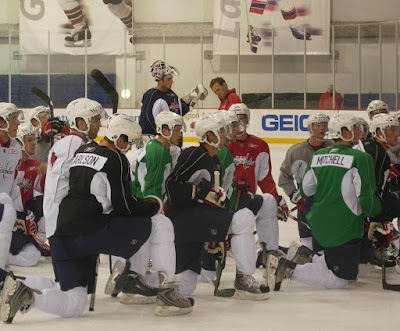
Coach Evason wondering why his number isn't hanging down at the other end with Labre, Hunter, Gartner, and Langway
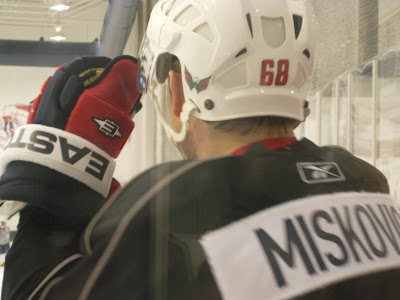
Zach Miskovic, wearing the equivalent of a "KICK ME" sign on the back of his helmet
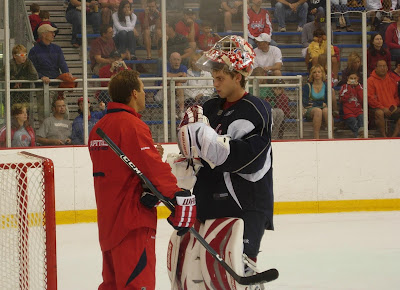
Arturs Irbe chatting with Semyon Varlamov during drills

More chatting...

...and more chatting...
Your turn, Holtby...Archie seems to have that whole "hands on" thing down with the goalies.
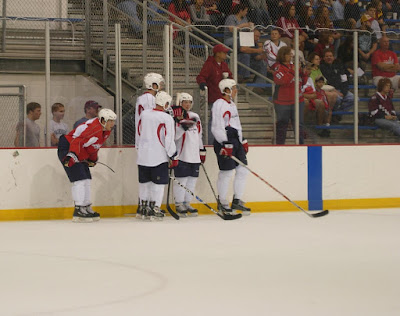
Joe Finley towers over his teammates...it was the last Finley sighting of the day.

Coach Woods whispering..."oh, are you guys in for it in a few minutes..."
Why is John Carlson wearing Alexander Semin's gloves? Maybe he thinks he can find an extra dozen or so goals in them.

Herbie Time!

Dmitry Kugryshev reprising last year's "Oh, God, come and take me now" pose.
2009-2010 Previews -- Defensemen: Brian Pothier

Brian Pothier
Theme: “For solitude sometimes is best society, and short retirement urges sweet return.”
Theme: “For solitude sometimes is best society, and short retirement urges sweet return.”

Last year, we didn’t do a preview on Brian Pothier. Not that such a thing matters in the larger world of hockey coverage, but in our little world it is an indicator of how far he’s come back from an injury that robbed him of more than a season's worth of games. And what the Caps are getting back is a decent contributor from the blue line, based on his per-82 game averages over his career. Pothier has had something of an odd career arc. He’s 32 years old, but he’s only played in 301 games in eight NHL seasons. Only twice in his career has he played in more than 55 games. In his first four seasons he split time between the NHL and the minors, and he lost parts of an additional two seasons to injury.
One might think that he is the NHL equivalent of the jalopy that the little old lady only drove to church on Sundays – low mileage. But there is the matter of his having lost 117 games in the last two seasons to the aftermath of a concussion suffered when he sustained a hit by Boston’s Milan Lucic. Even though much of the period of inactivity after the concussion was a result of a problem with his eyes, the concussion he suffered was the fourth of his career. He might be “low mileage,” but that doesn’t necessarily mean they aren’t hard miles.
But he did play respectably in his late season return, finishing with a goal and two assists in the last nine games of the regular season, and two assists and a plus-1 in 13 playoff games. He averaged more than 16 minutes of playing time in the 22 total games he played. This makes him something of a wild card full of questions. Will he play 70-plus games for only the third time in his career? Will he provide some relief for Mike Green on the power play? If he does play in 70-plus games, can he contribute at his career pace of production (6-22-28, +7 per-82 games)? Does his return make another defenseman (Morrisonn? Jurcina?) expendable in trade?
Fearless: Pothier has been pretty consistent in terms of his production on a year-to-year basis over the last two-and-a-half seasons before his concussion. There is no way he is – or should be on this team – the 24 minute a night player he was in his first year with the Caps. But getting 16-18 minutes a night is probably in his comfort range if he’s healthy. With that sort of ice time, 25 points wouldn’t be out of the question. And even if he isn’t the most physical defenseman on this team, he can probably be effective in a second or third pair role.
Cheerless: What’s up with these guys? Everyone was banged up when the season ended – Mike Green’s shoulder, Jeff Schultz’ ribs, Tom Poti and John Erskine each with a broken foot, and Pothier with questions about whether he can compete for a full season. Their deductible would keep me in beer for a couple of years (more like into mid-October). The Caps might need to keep eight defensemen as insurance, or seven and Alzner in Hershey.
In the end:
Cheerless has a point. We know, whodathunkit? Last year, the top seven defensemen for the Caps – Green, Morrisonn, Jurcina, Schultz, Erskine, Poti, and Pothier – missed a combined 178 games. Pothier missed 73 of those games. He could return to be a 70-plus game player, but that is hardly a certainty, even if he’s pronounced as having a clean bill of health. Pothier is likely to open the season as the second oldest defenseman on the Caps roster (Tom Poti is 24 days older). But whereas Poti has over 700 games of NHL experience, Pothier’s 301 games is almost 50 fewer career games than Shaone Morrisonn (26 years old), and fewer than 30 more games than Milan Jurcina (26) and John Erskine (29).
Stepping right in after losing so much time to injury and playing every night seems like a stretch for Pothier, and there is the matter of a player like Karl Alzner pushing for more time. His role might be a bit limited by his own circumstances and perhaps eight defensemen competing for time. In any case, for Pothier a “sweet return” is not the stuff of Paradise Lost, from which the line above is taken, but perhaps what he might contribute to next spring – a deep playoff run.
Projection:
60 games, 5-13-18, +4
Sunday, September 06, 2009
2009-2010 Previews -- Defensemen: Shaone Morrisonn
 Shaone Morrisonn
Theme: “Success is like reaching an important birthday and finding you're exactly the same.”

Audrey Hepburn wasn’t much of a hockey player, but her quote is a faint hint at this being a contract year for Shaone Morrisonn. This is the second year Morrisonn will have been playing on a one-year contract, last year as a product of an arbitration ruling, this year signing a one-year deal in advance of arbitration. You can interpret how that might play out in a couple of ways. One, Morrisonn could have the sort of year that a lot of guys have leading up to a new contract – the sort of year they’ll look back on and say, “that was a helluva year,” whether he re-signs with the Caps or not. Or, he could mark time, play out the string, and play all year with the intention of moving on in July after this season.
There has been a sort of “sameness” to Morrisonn’s stay with the Caps. Plug him in when the season starts, watch him play 75 or so games, see him get a couple of goals, 10 or so assists, and he provides adequate at times, very good at other times defense. But what Morrisonn saw last year was his average ice time pulled back. In his first three full seasons with Washington, Morrisonn averaged over 20 minutes a game (averaging 20:39 a game). Last year, he averaged 17:57 and was seventh on the team among defensemen (30 games minimum) in even strength ice time (he was third in each of the previous three years).
Allegations of incipient cannibalism aside, Morrisonn has seen his penalty minutes drop in the last couple of years, and he dropped a bit from his high perch atop the Caps minor penalty rolls among defensemen (first or second in his first three full seasons with the Caps), ranking third in minors taken in 2008-2009. Penalties figure oddly in Morrisonn’ year last year in that of the 30 minors he recorded, eight of them were for interference. But it was a slow, or at least something of an indifferent start to the year that found Morrisonn spending more time in the penalty box. He was whistled for at least one penalty in seven of the first nine games of the year (eight minors for 16 minutes), half of the penalties he earned being for interference. His was an undisciplined (some might call it lack of effort ) sort of performance. He was much more disciplined late, earning only seven minor penalties in his last 22 games.
Another somewhat odd part of Morrisonn’s year last year was the difference between his performance against Eastern Conference teams and those in the West. He was 3-9-12, plus-9 in 55 games against the East, but only 0-1-1, minus-5 against the West in 17 games. He had similar disparity in the 2007-2008 season (0-8-8, +7 in 66 games against the East, 1-1-2, -3 in 10 games against the West). That might be viewed as a good thing, as long as such a difference is going to manifest itself. OK, guys…your turn.
Fearless: Morrisonn finished a lot stronger in the second half than his first half performance. Before the All-Star Game, he was 1-3-4, minus-2, with 32 PIMs in 38 games. After the break, he was 2-7-9, +6, with 36 PIMs in 32 games (although 15 of those PIMs came in a single game against Florida on February 7th). One would hope that carries over into this year.
Cheerless: Cuz? What about that playoff finish? 0-1-1, minus-5 in the last six games of the Penguin series. He was on the ice for nine of the 20 even strength goals the Penguins scored in those six games, not what one would expect of a defenseman whose forte is, well, defense (the odd part is that he was on the ice for only one of the nine power play goals the Penguins scored in those last six games).
In the end…
Morrisonn will turn 27 in December; one would think he is now entering his prime playing (not to mention earning) years. He has an opportunity here that can benefit both Morrisonn and the club. If he can put together a season that looks like the second half of last year (with a sprinkling of the sort of penalty killing effectiveness he displayed in the Penguin series last spring), it could only be good news for the Caps, and Morrisonn will be in line for a larger pay day (unfortunately, that could price him out of the Caps’ comfort range). He certainly has that sort of ability – he was the Caps’ shut down defenseman for his first two seasons and was the policeman patrolling the back end as partner Mike Green was developing his offensive side. And on a team as bad as the Caps were in the 2005-2006 season, he was the only defenseman who played more than half the season’s games and has a “plus” rating (plus-7, best among Caps defensemen). But Morrisonn is also prone to taking the odd penalty here and there. His consistent season results cover a bit of inconsistency within seasons. This year, sameness wouldn't be bad, but it would be nice to see some of the potential he showed in his first two years here that he hasn't seemed to quite reach.
Projection:
78 games, 1-11-12, +8
2009-2010 Previews -- Defensemen: Milan Jurcina

Milan Jurcina
Theme: “International arbitration may be defined as the substitution of many burning questions for a smoldering one”
Theme: “International arbitration may be defined as the substitution of many burning questions for a smoldering one”

That quote from Ambrose Bierce’s essay on arbitration focused on economics, and that was the summer of Milan Jurcina. In this instance, it was his winning an arbitrator’s award of $1.375 million to skate for the Capitals in 2009-2010. It isn’t the sort of award that will break the bank, but it does shine something of a brighter light on Jurcina coming into the season. And if one turns that light on Jurcina’s performance with the Caps, the two words that come to mind are, “not bad.” For instance, his 2008-2009 numbers improved over the previous season’s results in goals (from one to three), assists (from eight to 11), points (from nine to 14), and hits (from 151 to 157). On the other hand, he tied for seventh among all defensemen in the NHL in penalties taken-per-60-minutes at 5-on-5 (50 games minimum). Of the 34 minor penalties he took, 23 of them were of the “obstruction” variety (holding, hooking, interference, tripping). And, he averaged one giveaway for every 25 minutes of play last season. This doesn’t approach the Mike Green level of giveaways, but then again, Jurcina doesn’t often have the puck in an offensive situation.
Subjectively, Jurcina should have more potential than, say, John Erskine. But his production suggests another defenseman whose time might better be “managed,” so as to avoid speedy teams that can exploit his propensity to take those “obstruction” sorts of penalties. What he is, is inconsistent. That displays itself in the nature of the competition he faces. In 29 games against the seven other teams in the East that made the playoffs last year, he 0-1-1, minus-4. In 32 games against the seven teams that didn’t make the playoffs, he was 2-7-9, plus-5. OK, so he did better against weaker teams. But what of those games against playoff teams? If you look closer, Jurcina compiled a rather ghastly 0-0-0, minus-6 in four games against the Rangers. But in the playoffs, he was a much more respectable 1-0-1, plus-4 in seven games against the Blueshirts. That he seems capable of so much more makes “not bad” somewhat infuriating. You guys have anything to add?...
Fearless: Jurcina’s role on this team has changed quite a bit in the not quite three full seasons he’s spent with the club. In his first year, after arriving from Boston, he averaged more than 23 minutes of ice time a game. That has since dropped to less than 17, and last year a shade more than 16 minutes. More to the point, his special teams ice time has shriveled to just about nothing. He averaged 5:35 in special teams ice time in his first year. Last year, that dropped to 1:02. That’s a reflection of two things that might be mirror images of one another. The first is the growth and improvement of defensemen around him (Mike Green and Jeff Schultz from within, Tom Poti from the outside). The other is that Jurcina’s game does not seem to have progressed.
Cheerless: There’s another way to get at this, cuz. Ask yourself, “does it matter?” Jurcina took at least one penalty in 30 games last year. The Caps were 17-10-3 in those games, a 101 point pace. He was off the PIM register in 49 games, and the Caps were 31-13-5, a 112-point pace. You could say that the difference was in having to endure extra power plays, as opposed to Jurcina providing a positive influence in those games in which he didn’t deprive the Caps of his presence on the ice. What he has been is durable. No Caps defenseman has played in more games the last two years than has Jurcina (154). But cuz?...if you really want to save yourself some time, just read Japers’ mock arbitration.
In the end…
The Caps defensive squad has gone – and is going – through a number of phases the last few years and in the next few years to come. Coming out of the lockout, the Caps lacked for talent on the blue line on the parent squad, having only selected Mike Green and Jeff Schultz in the 2004 draft. In that first post-lockout year, the talent was really thin, unless Bryan Muir and Mathieu Biron are your cup of tea. The next year, the Caps dipped into the free agent market to grab Brian Pothier, and they picked up Jurcina in trade. Still, it was a squad thin in talent.
The following season constituted the next phase, Tom Poti was brought on board, Green emerged as an offensive force, and Jeff Schultz stepped up as a defenseman with some upside. Brian Pothier would have been a mainstay, but played in only 38 games because of injury. Jurcina adopted a somewhat lesser role in this scenario. Last year was similar in that Green, Poti, and Schultz, when healthy (they missed a combined 62 games), assumed important roles. Jurcina had much the same role as in the previous year – almost entirely an even-strength skater, usually against the lower half of the forward lines of opponents.
This phase might be coming to an end as youngsters Karl Alzner and John Carlson emerge to join the likes of Mike Green and Jeff Schultz on the blue line. For players such as Jurcina (and Shaone Morrisonn, Brian Pothier, Tom Poti, and John Erskine) roster spots will be subject to more competition. Does that augur an exit for Jurcina after this season? As much as anyone, it’s up to him. The “smoldering question” is can he be more consistent, avoid the odd obstruction penalty, chip in a little more offense, perhaps, and improve his chances of having a spot on the 2010-2011 squad?
Projection:
65 games, 2-7-9, +2
Subjectively, Jurcina should have more potential than, say, John Erskine. But his production suggests another defenseman whose time might better be “managed,” so as to avoid speedy teams that can exploit his propensity to take those “obstruction” sorts of penalties. What he is, is inconsistent. That displays itself in the nature of the competition he faces. In 29 games against the seven other teams in the East that made the playoffs last year, he 0-1-1, minus-4. In 32 games against the seven teams that didn’t make the playoffs, he was 2-7-9, plus-5. OK, so he did better against weaker teams. But what of those games against playoff teams? If you look closer, Jurcina compiled a rather ghastly 0-0-0, minus-6 in four games against the Rangers. But in the playoffs, he was a much more respectable 1-0-1, plus-4 in seven games against the Blueshirts. That he seems capable of so much more makes “not bad” somewhat infuriating. You guys have anything to add?...
Fearless: Jurcina’s role on this team has changed quite a bit in the not quite three full seasons he’s spent with the club. In his first year, after arriving from Boston, he averaged more than 23 minutes of ice time a game. That has since dropped to less than 17, and last year a shade more than 16 minutes. More to the point, his special teams ice time has shriveled to just about nothing. He averaged 5:35 in special teams ice time in his first year. Last year, that dropped to 1:02. That’s a reflection of two things that might be mirror images of one another. The first is the growth and improvement of defensemen around him (Mike Green and Jeff Schultz from within, Tom Poti from the outside). The other is that Jurcina’s game does not seem to have progressed.
Cheerless: There’s another way to get at this, cuz. Ask yourself, “does it matter?” Jurcina took at least one penalty in 30 games last year. The Caps were 17-10-3 in those games, a 101 point pace. He was off the PIM register in 49 games, and the Caps were 31-13-5, a 112-point pace. You could say that the difference was in having to endure extra power plays, as opposed to Jurcina providing a positive influence in those games in which he didn’t deprive the Caps of his presence on the ice. What he has been is durable. No Caps defenseman has played in more games the last two years than has Jurcina (154). But cuz?...if you really want to save yourself some time, just read Japers’ mock arbitration.
In the end…
The Caps defensive squad has gone – and is going – through a number of phases the last few years and in the next few years to come. Coming out of the lockout, the Caps lacked for talent on the blue line on the parent squad, having only selected Mike Green and Jeff Schultz in the 2004 draft. In that first post-lockout year, the talent was really thin, unless Bryan Muir and Mathieu Biron are your cup of tea. The next year, the Caps dipped into the free agent market to grab Brian Pothier, and they picked up Jurcina in trade. Still, it was a squad thin in talent.
The following season constituted the next phase, Tom Poti was brought on board, Green emerged as an offensive force, and Jeff Schultz stepped up as a defenseman with some upside. Brian Pothier would have been a mainstay, but played in only 38 games because of injury. Jurcina adopted a somewhat lesser role in this scenario. Last year was similar in that Green, Poti, and Schultz, when healthy (they missed a combined 62 games), assumed important roles. Jurcina had much the same role as in the previous year – almost entirely an even-strength skater, usually against the lower half of the forward lines of opponents.
This phase might be coming to an end as youngsters Karl Alzner and John Carlson emerge to join the likes of Mike Green and Jeff Schultz on the blue line. For players such as Jurcina (and Shaone Morrisonn, Brian Pothier, Tom Poti, and John Erskine) roster spots will be subject to more competition. Does that augur an exit for Jurcina after this season? As much as anyone, it’s up to him. The “smoldering question” is can he be more consistent, avoid the odd obstruction penalty, chip in a little more offense, perhaps, and improve his chances of having a spot on the 2010-2011 squad?
Projection:
65 games, 2-7-9, +2
2009-2010 Previews -- Defensemen: Mike Green

Mike Green
Theme: So… what have you done for me lately?
Theme: So… what have you done for me lately?

Record-setting goal scorer among defensemen, first-team NHL all star, runner-up for the Norris Trophy. You’d think that on the heels of such a season, such a player would be hailed as one of the top two or three defensemen in the NHL.
Well, not these days. Mike Green is given little better than an even chance to make his country’s Olympic hockey team, and there are whispers – ok, shouts in some quarters – that he’s less of a defenseman and more of a fourth forward.
That’s what a month in the spring will do. Despite finishing the regular season as the league’s top scoring defenseman in goals (31), power play goals (18), and points (73); despite finishing the season fifth in plus-minus among defensemen (while playing in only 68 games); despite finishing tied for third among defensemen in game-winning goals; despite finishing with more goals and points in a season than Scott Niedermayer has ever had in his career, more goals in a season than in any in the career of Nicklas Lidstrom, and more points in a season than in all but one season of Lidstrom’s career, no Capital seems to have more questions attached to his outlook for the upcoming season than does Mike Green. And that is the result of a month of playoff games last spring in which he was 1-8-9, -5, in 14 games, and didn’t have a goal in his last eight games (tied for his longest drought of the season). Worse, no defenseman in the playoffs had more giveaways than the 25 that Green had in only those 14 games.
That finish was a sour ending to a fine season, and it seemed to validate the view held by some folks that Green simply isn’t that good a defenseman. Statistically, he is not as bad a defenseman as some would assume. His plus-24 was best among Capitals defensemen (almost twice as good as Jeff Schultz’ plus-13). He had the highest Corsi rating on the team and was third best in goal-against-per-60-minutes (5-on-5) while facing the third highest quality of competition on the club (minimum 30 games played), according to behindthenet.ca. Green’s problem is not so much “half-court” defense as it is another problem, one already hinted at – turnovers. He finished second among NHL defensemen in giveaways last season. That makes for a lot of puck-chasing transition defense, which really isn’t the sort of thing the Capitals are going to be successful in executing if they – including defensemen like Green – are pressing their attack at the other end.
Part of the problem Green has is one that a point guard has in basketball – when he’s on the ice, he’s spends more time than others carrying the puck up ice. He is going to have more opportunities, for lack of a better word, for turning the puck over. But the fact remains that unless he can improve that aspect of his game, he – and the Capitals in general – are going to struggle defensively, and Green is going to be seen as a somewhat one-dimensional “offensive” defenseman, not the standard for two-way defense that Niedermayer and Lidstrom represent.
Fearless: If you drill into that giveaway number, the comparison of Green to Niedermayer and Lidstrom becomes even starker. Lidstrom averaged one giveaway for every 42 minutes of ice time last year, Niedermayer one in every 30 minutes. Green averaged one every 18 minutes. In the playoffs, that was one giveaway every 14 minutes. The silver lining here is that we’re making comparisons to two guys who have already had their plaques made for the Hockey Hall of Fame; we’re just waiting for the induction ceremonies down the road. And Green won’t turn 24 until the second week of the season. Lidstrom came into the league as a fully-formed, productive defenseman at both ends, but he might be among the top five defensemen ever to play in the NHL. Niedermayer wasn’t “Niedermayer” until perhaps his sixth or seventh full season. And if defensive defensemen take a while to mature, so should it be expected that the defensive side of Green’s game should be the last part of his repertoire to mature. He is, now, the best offensive defenseman in the game.
Cheerless: I was cruising the Interweb (“Internet,” doofus) and saw an article by this Pierre LeBrun guy, and he said this about Green and the playoffs… “There were questions about Green's fitness level. He simply wasn't the same blueliner come playoff time. He lacked confidence with the puck. I won't soon forget the night of the Capitals' Game 7 second-round loss to the Penguins. A distraught Green never came out to talk to the media, likely devastated by what he knew was a subpar playoff performance.” How long does that linger with a player? If Green gets off to a bad start, are the whispers going to start all over? If he’s held off the Canadian Olympic team, does his star start to fade?
In the end…
Green suffered an awkward spill in the Ranger series that might have left him physically sub-par for the remainder of the playoffs. That seems as likely an explanation of the drop-off in his performance as his “fitness level.” But if there is a player in the NHL less lacking for motivation than Mike Green, we’d appreciate your pointing him out to us. He finished second in the Norris Trophy voting, had a weak series against the Rangers, a poor series against the Penguins, might not make the Canadian Olympic team, and is being called out in just about any hockey publication you can find. But here’s the thing, Green has improved in each of his full seasons in the NHL on a per-82 game basis in goals (from two to 18 to 37), assists (from 12-38-51), points (from 14 to 56 to 88), plus-minus (from -12 to +6 to +29). This year, though, one can imagine a Green with a great deal more focus at both ends of the ice… unless he hears the whispers.
Projection:
77 games, 24-48-72, +26
Well, not these days. Mike Green is given little better than an even chance to make his country’s Olympic hockey team, and there are whispers – ok, shouts in some quarters – that he’s less of a defenseman and more of a fourth forward.
That’s what a month in the spring will do. Despite finishing the regular season as the league’s top scoring defenseman in goals (31), power play goals (18), and points (73); despite finishing the season fifth in plus-minus among defensemen (while playing in only 68 games); despite finishing tied for third among defensemen in game-winning goals; despite finishing with more goals and points in a season than Scott Niedermayer has ever had in his career, more goals in a season than in any in the career of Nicklas Lidstrom, and more points in a season than in all but one season of Lidstrom’s career, no Capital seems to have more questions attached to his outlook for the upcoming season than does Mike Green. And that is the result of a month of playoff games last spring in which he was 1-8-9, -5, in 14 games, and didn’t have a goal in his last eight games (tied for his longest drought of the season). Worse, no defenseman in the playoffs had more giveaways than the 25 that Green had in only those 14 games.
That finish was a sour ending to a fine season, and it seemed to validate the view held by some folks that Green simply isn’t that good a defenseman. Statistically, he is not as bad a defenseman as some would assume. His plus-24 was best among Capitals defensemen (almost twice as good as Jeff Schultz’ plus-13). He had the highest Corsi rating on the team and was third best in goal-against-per-60-minutes (5-on-5) while facing the third highest quality of competition on the club (minimum 30 games played), according to behindthenet.ca. Green’s problem is not so much “half-court” defense as it is another problem, one already hinted at – turnovers. He finished second among NHL defensemen in giveaways last season. That makes for a lot of puck-chasing transition defense, which really isn’t the sort of thing the Capitals are going to be successful in executing if they – including defensemen like Green – are pressing their attack at the other end.
Part of the problem Green has is one that a point guard has in basketball – when he’s on the ice, he’s spends more time than others carrying the puck up ice. He is going to have more opportunities, for lack of a better word, for turning the puck over. But the fact remains that unless he can improve that aspect of his game, he – and the Capitals in general – are going to struggle defensively, and Green is going to be seen as a somewhat one-dimensional “offensive” defenseman, not the standard for two-way defense that Niedermayer and Lidstrom represent.
Fearless: If you drill into that giveaway number, the comparison of Green to Niedermayer and Lidstrom becomes even starker. Lidstrom averaged one giveaway for every 42 minutes of ice time last year, Niedermayer one in every 30 minutes. Green averaged one every 18 minutes. In the playoffs, that was one giveaway every 14 minutes. The silver lining here is that we’re making comparisons to two guys who have already had their plaques made for the Hockey Hall of Fame; we’re just waiting for the induction ceremonies down the road. And Green won’t turn 24 until the second week of the season. Lidstrom came into the league as a fully-formed, productive defenseman at both ends, but he might be among the top five defensemen ever to play in the NHL. Niedermayer wasn’t “Niedermayer” until perhaps his sixth or seventh full season. And if defensive defensemen take a while to mature, so should it be expected that the defensive side of Green’s game should be the last part of his repertoire to mature. He is, now, the best offensive defenseman in the game.
Cheerless: I was cruising the Interweb (“Internet,” doofus) and saw an article by this Pierre LeBrun guy, and he said this about Green and the playoffs… “There were questions about Green's fitness level. He simply wasn't the same blueliner come playoff time. He lacked confidence with the puck. I won't soon forget the night of the Capitals' Game 7 second-round loss to the Penguins. A distraught Green never came out to talk to the media, likely devastated by what he knew was a subpar playoff performance.” How long does that linger with a player? If Green gets off to a bad start, are the whispers going to start all over? If he’s held off the Canadian Olympic team, does his star start to fade?
In the end…
Green suffered an awkward spill in the Ranger series that might have left him physically sub-par for the remainder of the playoffs. That seems as likely an explanation of the drop-off in his performance as his “fitness level.” But if there is a player in the NHL less lacking for motivation than Mike Green, we’d appreciate your pointing him out to us. He finished second in the Norris Trophy voting, had a weak series against the Rangers, a poor series against the Penguins, might not make the Canadian Olympic team, and is being called out in just about any hockey publication you can find. But here’s the thing, Green has improved in each of his full seasons in the NHL on a per-82 game basis in goals (from two to 18 to 37), assists (from 12-38-51), points (from 14 to 56 to 88), plus-minus (from -12 to +6 to +29). This year, though, one can imagine a Green with a great deal more focus at both ends of the ice… unless he hears the whispers.
Projection:
77 games, 24-48-72, +26
Saturday, September 05, 2009
2009-2010 Previews -- Defensemen: John Erskine

John Erskine
Theme: "If the power to do hard work is not a skill, it's the best possible substitute for it."

But with physical play comes the unfortunate result of injury, and it is something Erskine has had to deal with in each of his three seasons with the Caps:
2006-2007: fractured foot (25 games), thumb (14 games)
2007-2008: lower body injury (one game), upper body injury (six games)
2008-2009: concussion (22 games), flu (one game), leg injury (two games)
These aren’t physical breakdowns as much as they are the effects of collision. But will they accumulate? Erskine might be asked to take on an additional role this year. If not the Caps’ “enforcer,” the departure of Donald Brashear might pull Erskine into a larger role as a player to keep the peace, or at least keep opponents honest. In 132 games with the Capitals, Erskine has been in 12 fights, so he is no stranger to that aspect of the game. But while he had five in 29 games in the 2006-2007 season, he had four in 51 games in 2007-2008 and three in 2008-2009. That might be explained by his taking on a larger role in terms of his on-ice responsibilities, it also might be explained by his having sustained a concussion last year. Erskine should not be expected next year to assume the mantle worn by Brashear – policing the ice is likely to be done by committee, Erskine being a member of that group.
On defense, Erskine appears to be one of those players who can thrive in certain situations, but struggle in others. He was a minus-5 in five games against the Carolina Hurricanes (three of which the Caps won, games in which Erskine was minus-3), a team with considerable team speed. On the other hand, against the four teams in the East that finished above Carolina (Boston, New Jersey, Philadelphia, and Pittsburgh, none of which are as quick as Carolina), Erskine finished plus-4 in 13 games and was not a minus player in any of them.
Although using a plus-minus statistic on its own as an indicator carries with it its own problems, it does at least suggest managing how Erskine is deployed. With players coming up from below (Karl Alzner, John Carlson) who might see some time, and the return of Brian Pothier, the prospect of Erskine playing in 50-55 games seems less to be a product of health this coming season as it is spreading time around among defensemen.
Cousins?
Fearless: There is an underestimated efficiency to Erskine’s game. He might be looked at by some as something of a bruiser lacking the skill of a Mike Green or even a Tom Poti or Brian Pothier, but Erskine had the best goals-against-per-60-minutes of any Caps defenseman (5-on-5, 30 games minimum) last year. A lot of that is not facing a team’s top scoring lines (he faced the lowest quality of completion among those Caps defensemen playing at least 30 games, according to behindthenet.ca), but the job presented to Erskine is one he performed reasonably well. He’ll probably be managed with respect to the teams against which he skates and the situations into which he is placed, but he’s probably going to have more success in those situations than Caps fans might give him credit for. Erskine is one of four NHL roster defensemen under contract at least through 2010-2011 (Mike Green, Tom Poti, and Karl Alzner being the others). One would expect that he’s going to man a 5/6/7 defenseman position for the next couple of years.
Cheerless: There’s nothing special about Erskine. OK, cuz, before you smack me, wait a second. What I mean by that is that of the seven Caps defensemen playing at least 30 games last year, only Milan Jurcina had less ice time on special teams (1:02/game) than did Erskine (1:39). And, his shorthanded time has dropped from 2:57/game in 2006-2007 to 2:16 in 2007-2008 to 1:39 last year. You could say that is a product of other defensemen growing up around him (most notably Mike Green, whose shorthanded ice time climbed from 20 seconds a game in 2007-2008 to 2:28 last year). Erskine might not get more than a minute’s worth of penalty killing time a game this year, and I might get more time on the point on the power play.
In the end…
We’re not going to see Cheerless on the power play, mainly because you generally want to keep two hands on the stick, and one of his is always occupied by a can of beer. As for Erskine, he would not appear likely to improve on his career best 52 games played last year, even if healthy, absent a trade of or injury to one of the other defensemen. Alzner could going to eat into some of his time, and Pothier is starting the year healthy. There will be other defensemen out there for the skills portion of the show – power play and penalty killing, but Erskine has carved out a role based on hard work and competing in those situations he’s called upon to play.
Projection:
51 games, 1-4-5, even
2009-2010 Previews -- Defensemen: Karl Alzner
It’s September… time for kids to return to school and hockey players to return to the ice. And for those of us in the prognostitorial community, that means it’s time for previews. So let’s get right to it, starting with the defense…

Karl Alzner
Theme: “Every Good Boy Does Fine”

That is the mnemonic that new music students use to memorize the lines of the treble clef in music. And that gets to the point regarding Alzner, or more precisely two numbers – 21 and 30. Alzner will be 21 on opening night of the 2009-2010 season, and he has a grand total of 30 games of NHL experience coming into this season. He will do it playing a very difficult position for young players to master.
But he doesn’t come into the season without expectations. He is the only defenseman of the 2007 draft class who has played an NHL game. He is the only defenseman of the 2007 class among the top 22 selected to play in an NHL game. No other defenseman taken in the 2007 draft have played more than three games in the NHL (John Negrin of Calgary and Yannick Weber of Montreal having played three games apiece, and these are the only other defensemen to have played at all in the NHL from that class so far).
His playing 30 games in the NHL last year was a case of being pressed into duty as a result of injury and illness among the regulars. But of the other 10 defensemen taken in the first round of the 2007 draft, not only have none of them played in an NHL game yet, but only three of them have played in any AHL regular season games (Jonathan Blum did not dress in the regular season for the Milwaukee Admirals, but he did dress for five playoff games). Only one defenseman from that class among the first rounders – Keaton Ellerby – has appeared in more than 10 games in the AHL. Alzner, by comparison to his draft classmates, has rocketed to the NHL. Let that sink in as you ponder the state of Alzner’s development, Caps fans.
But let’s look at those 30 games Alzner played for a moment. They break relatively cleanly into three parts. In his first dozen games, he was 1-3-4, +8, and averaged 20:00 in ice time per game. In his next ten games he assumed, if not greater responsibility, at least more ice time – almost 22 minutes a game (including twice skating more than 24 minutes). But in those games he was held without a point and was a minus-4. In his last eight games he had only one assist and was minus-5 (he had no “plus” games in this stretch); he was held to an average of 16 minutes a game.
What does that mean as far as the coming season is concerned? Well, it’s hard to draw any firm conclusions off of a 30-game stint, but some things are evident. Like, he’s not ready for major minutes…yet. But he's got talent.
Let’s set the idea of his having sustained a concussion after he returned to Hershey last year and whether that will retard his development aside. He’s a 21-year old defenseman, and that generally isn’t the sort of defenseman who is ready for getting the high side of 20 minutes a night, much of it against a top pair or killing a lot of penalties. Even if Alzner makes the squad on opening night, he’s not likely to be a top pair defenseman at this point in his career.
Alzner has not yet displayed much of an offensive side to his game. His value is in his own end, but not as the big bopper. His is a game of playing angles and position, and being able to move the puck out of harm’s way. At NHL speed, there will be instances early – as was evidenced in his 30 games last year – in which his judgment and reaction won’t catch up to the speed of the game at the NHL level. But like a young team, young individuals with talent – and Alzner has it – will be better late than they are early.
Let’s ask the cousins for their take. Fearless?
Fearless: Alzner has a quality that is hard to quantify. He’s a winner. The Caps were 20-10 in games in which he appeared (losses include extra time games). What’s more, they were 11-4 in games in which Alzner played more than 20 minutes. Before that, he twice played on Calgary Hitmen teams in Canadian junior that advanced to the Eastern Conference finals in the Western Hockey League. Alzner also has WHL player of the year and Canadian Hockey League defenseman of the year on his amateur resume. He was an assistant captain for a Canadian squad in an eight-game, under-20 challenge series between Canada and Russia in 2007, and he captained the 2009 Canadian team in the World Junior Championship. His teams won both. Where the kid goes, good things seem to follow.
Cheerless: Yeah, all that’s nice, cuz, but is Alzner even going to play on this team this year? I took arithmetic four times in the third grade, so I’m pretty good with numbers, and the Caps are about one and a half million over the salary cap, including Alzner’s bonus money. If they don’t want to carry his bonus into 2010-2011 – or Nicklas Backstrom’s for that matter – and they don’t move somebody (Nylander – cough cough-- ), then Alzner might be getting a lot of time in Hershey this year. And that Carlson kid might beat him out, anyway.
In the end…
Alzner is going to have his ups and downs. The problem he’ll have, though, is that his “ups” are likely to be of the inconspicuous sort, that being his game – efficient, without a flash of the big hit or the end-to-end rush. His downs will be there for all to see, the sort where he shows up in the frame of a photo of an opponent scoring a goal – such is the nature of his position. But Alzner will be a much better defenseman in March and April than he will be in October or November. The mystery, though, is going to be whether he shows that improvement more in Washington or in Hershey. And that isn’t necessarily a “hockey” decision. We’re going to think, though, that by year-end, he’ll be music to Caps fan’s ears.
Projection:
55 games, 2-7-9, +4

Karl Alzner
Theme: “Every Good Boy Does Fine”
That is the mnemonic that new music students use to memorize the lines of the treble clef in music. And that gets to the point regarding Alzner, or more precisely two numbers – 21 and 30. Alzner will be 21 on opening night of the 2009-2010 season, and he has a grand total of 30 games of NHL experience coming into this season. He will do it playing a very difficult position for young players to master.
But he doesn’t come into the season without expectations. He is the only defenseman of the 2007 draft class who has played an NHL game. He is the only defenseman of the 2007 class among the top 22 selected to play in an NHL game. No other defenseman taken in the 2007 draft have played more than three games in the NHL (John Negrin of Calgary and Yannick Weber of Montreal having played three games apiece, and these are the only other defensemen to have played at all in the NHL from that class so far).
His playing 30 games in the NHL last year was a case of being pressed into duty as a result of injury and illness among the regulars. But of the other 10 defensemen taken in the first round of the 2007 draft, not only have none of them played in an NHL game yet, but only three of them have played in any AHL regular season games (Jonathan Blum did not dress in the regular season for the Milwaukee Admirals, but he did dress for five playoff games). Only one defenseman from that class among the first rounders – Keaton Ellerby – has appeared in more than 10 games in the AHL. Alzner, by comparison to his draft classmates, has rocketed to the NHL. Let that sink in as you ponder the state of Alzner’s development, Caps fans.
But let’s look at those 30 games Alzner played for a moment. They break relatively cleanly into three parts. In his first dozen games, he was 1-3-4, +8, and averaged 20:00 in ice time per game. In his next ten games he assumed, if not greater responsibility, at least more ice time – almost 22 minutes a game (including twice skating more than 24 minutes). But in those games he was held without a point and was a minus-4. In his last eight games he had only one assist and was minus-5 (he had no “plus” games in this stretch); he was held to an average of 16 minutes a game.
What does that mean as far as the coming season is concerned? Well, it’s hard to draw any firm conclusions off of a 30-game stint, but some things are evident. Like, he’s not ready for major minutes…yet. But he's got talent.
Let’s set the idea of his having sustained a concussion after he returned to Hershey last year and whether that will retard his development aside. He’s a 21-year old defenseman, and that generally isn’t the sort of defenseman who is ready for getting the high side of 20 minutes a night, much of it against a top pair or killing a lot of penalties. Even if Alzner makes the squad on opening night, he’s not likely to be a top pair defenseman at this point in his career.
Alzner has not yet displayed much of an offensive side to his game. His value is in his own end, but not as the big bopper. His is a game of playing angles and position, and being able to move the puck out of harm’s way. At NHL speed, there will be instances early – as was evidenced in his 30 games last year – in which his judgment and reaction won’t catch up to the speed of the game at the NHL level. But like a young team, young individuals with talent – and Alzner has it – will be better late than they are early.
Let’s ask the cousins for their take. Fearless?
Fearless: Alzner has a quality that is hard to quantify. He’s a winner. The Caps were 20-10 in games in which he appeared (losses include extra time games). What’s more, they were 11-4 in games in which Alzner played more than 20 minutes. Before that, he twice played on Calgary Hitmen teams in Canadian junior that advanced to the Eastern Conference finals in the Western Hockey League. Alzner also has WHL player of the year and Canadian Hockey League defenseman of the year on his amateur resume. He was an assistant captain for a Canadian squad in an eight-game, under-20 challenge series between Canada and Russia in 2007, and he captained the 2009 Canadian team in the World Junior Championship. His teams won both. Where the kid goes, good things seem to follow.
Cheerless: Yeah, all that’s nice, cuz, but is Alzner even going to play on this team this year? I took arithmetic four times in the third grade, so I’m pretty good with numbers, and the Caps are about one and a half million over the salary cap, including Alzner’s bonus money. If they don’t want to carry his bonus into 2010-2011 – or Nicklas Backstrom’s for that matter – and they don’t move somebody (Nylander – cough cough-- ), then Alzner might be getting a lot of time in Hershey this year. And that Carlson kid might beat him out, anyway.
In the end…
Alzner is going to have his ups and downs. The problem he’ll have, though, is that his “ups” are likely to be of the inconspicuous sort, that being his game – efficient, without a flash of the big hit or the end-to-end rush. His downs will be there for all to see, the sort where he shows up in the frame of a photo of an opponent scoring a goal – such is the nature of his position. But Alzner will be a much better defenseman in March and April than he will be in October or November. The mystery, though, is going to be whether he shows that improvement more in Washington or in Hershey. And that isn’t necessarily a “hockey” decision. We’re going to think, though, that by year-end, he’ll be music to Caps fan’s ears.
Projection:
55 games, 2-7-9, +4
Monday, August 31, 2009
Sittin' 'Round the Summer Campfire, Part Two

We’re here with another look back at our trip into the north woods with the cousins, Fearless and Cheerless. The subject of prognostications came up…
Well guys, I don’t know if you’ve read any prognostications for the upcoming sea—
“Cuz, when I’ve had this much beer, my limit is three syllables…”
Fine, Cheerless. I don’t know if you’ve read any predictions for the upcoming season…
“That’s better…”
But it seems that it’s a foregone conclusion that the Penguins are the class of the East, if not the whole league. You guys have an opinion?
“Makes one wonder if hockey writers have Sidney Crosby’s picture on their desk or in their wallets. Yeah, the Penguins are good, but it’s hardly a slam dunk that they’re the best team in their division, let alone the East.”
Fearless, you seem to have strong feelings about this.
“OK, let’s look back for a moment. Yeah, the Penguins got to skate the Cup around Joe Louis Arena ice. Fine, they deserved to. But how did they get there? The series they played against Carolina in the conference final was truly dominating. They outscored the Hurricanes 20-9 and played in only one game decided by fewer than three goals in sweeping the series.”
“Hey cuz, he’s doin’ all this without a cheat sheet.”
Remarkable… go on.
“Well, in the other three series, the Penguins were taken to seven games twice, six games once, had a record of 12-8, outscored their opponents by a total of four goals (59-55) and lost elimination games in two of the series.”
Your point?
“They were good enough to win, but not by much.”
It’s not “how,” cuz, it’s “how many,” and the Penguins still won 16 games.
“Right you are, and we’re not arguing that the Penguins are an unworthy champion, but to hear some talk, it’s as if they are now the reincarnation of the Gretzky-led Oilers from 25 years ago. That first Oiler Cup winner had a 15-4 record in winning the Cup and outscored their opponents, 94-56, in doing it.”
Well, that was the first year they won the Cup.
“It didn’t stop there. The Oilers won four Cups in a five-year period, and in doing so had a playoff record in the four Cup-winning years of 62-14.”
“It was a different era, cuz…”
“And that’s the point, hops-breath. There are no truly dominating teams these days. The Red Wings are the closest approximation of one, and they won four Cups over an 11-year period, not five years, like the Oilers, or in four consecutive years, like the Islanders before them.”
So?
“The Penguins are one of many, perhaps more so this coming year than in any of the last decade.”
So you think they’re going to fail to repeat?...
“…just like the last ten Stanley Cup winners.”
Fearless has a point. If you look at the Penguins, you have to look at their gains and losses. They lost a couple of defensemen – Rob Scuderi and Hal Gill – and will replace them with Jay McKee and, one would think, Alex Goligoski. Gologiski is a nice kid, but he looks more like an eventual replacement for Sergei Gonchar, not a replacement for Scuderi.
“What about that Magoo guy?”
“McKee…Jay McKee. Read a newspaper once. Well, maybe, but you’d have to wonder… in five of the last six seasons, he’s missed at least a dozen games, and in three of them he missed at least 20 games.”
Well, you’d have to think Crosby and Malkin will continue to improve.
“Really? To what, 140 points? The days when a player gets that many points are gone, cuz, unless they slice some more equipment off of goalies or make the nets bigger. Goalies are too good, and there are too many of them. And even if that wasn’t the case, Bill Guerin will be 39 in November, and Chris Kunitz couldn’t shoot a puck into the ocean in the playoffs. Crosby and Malkin will be better, but enough to make up for the net losses elsewhere?...”
So, if not the Penguins, who?
“There are several teams that could come out of the East, if things broke just right for them. And yes, the Penguins are one of them. But so could the Caps, one of those teams that took Pittsburgh to seven games and with a goalie who had 12 games of experience under his belt going into the series. Boston could advance; they were an overtime goal away from advancing to the conference final last year, and they bring the important pieces of their team back almost intact.”
“Unless they can’t figure out that kettle mess.”
“Kessel...K-E-S-S-E-L.”
“Whatever…”
Philadelphia could advance, if Pronger still has his engine running high, they can stay away from injuries, and they get the 2007 version of Ray Emery, not the 2008 version. And Carolina, the team that did advance in beating Boston, returns just about everyone. Cam Ward seems to have this goaltending thing figured out. He’s improved in wins in each of the two years following the 2006-2007 season (from 30 to 37 to 39 wins), GAA (from 2.93 to 2.75 to 2.44), save percentage (from .897 to .904 to .916), and shutouts (from two to four to six).
“Don’t forget the Devils…”
Everyone talks about the Devils taking a step back. This has been a theme for a few years, now. I’ll believe it when I see it. They’d have to be thought of as in the mix, certainly as long as they have Brodeur.
“All these teams have question marks, though.”
Yup… with the Penguins, it will be their blue line. The Caps?... goaltending. Carolina?... age. Philly?... goaltending. New Jersey… is Brodeur still “Brodeur?” And the Bruins…
“goaltending.”
“Hey, he got one!”
Even a blind squirrel finds an empty beer can once in a while. Yeah, goaltending. You wouldn’t think so, seeing as how the Bruins have the defending Vezina Trophy winner in Tim Thomas. The issue with him will be his load. The most regular season games he’s played in a season in his career is 66, three seasons ago. In each of the next two seasons, he played in fewer – 57 games in 2007-2008 and 54 games in 2008-2009. If he’s managed in the same fashion this year, who is getting those other 25 games? Is Tuukka Rask ready?
“As long as Thomas is ready for the playoffs…”
Yeah, that’s why the Bruins won’t hit 116 points again. But what you’re going to see is half a dozen teams clustered around that 100-point level, and there are some interesting games at the end of the season. In the last weekend, Carolina plays Boston, Boston plays Washington, Philadelphia has a home and home against the Rangers, who cost the Flyers home ice against the Penguins last year.
“So, who’s going to come out of the East?”
Patience, cuz… we’ve got a month until opening night.
“All I wanna know is, whose turn is it to fetch the beer?”
Well guys, I don’t know if you’ve read any prognostications for the upcoming sea—
“Cuz, when I’ve had this much beer, my limit is three syllables…”
Fine, Cheerless. I don’t know if you’ve read any predictions for the upcoming season…
“That’s better…”
But it seems that it’s a foregone conclusion that the Penguins are the class of the East, if not the whole league. You guys have an opinion?
“Makes one wonder if hockey writers have Sidney Crosby’s picture on their desk or in their wallets. Yeah, the Penguins are good, but it’s hardly a slam dunk that they’re the best team in their division, let alone the East.”
Fearless, you seem to have strong feelings about this.
“OK, let’s look back for a moment. Yeah, the Penguins got to skate the Cup around Joe Louis Arena ice. Fine, they deserved to. But how did they get there? The series they played against Carolina in the conference final was truly dominating. They outscored the Hurricanes 20-9 and played in only one game decided by fewer than three goals in sweeping the series.”
“Hey cuz, he’s doin’ all this without a cheat sheet.”
Remarkable… go on.
“Well, in the other three series, the Penguins were taken to seven games twice, six games once, had a record of 12-8, outscored their opponents by a total of four goals (59-55) and lost elimination games in two of the series.”
Your point?
“They were good enough to win, but not by much.”
It’s not “how,” cuz, it’s “how many,” and the Penguins still won 16 games.
“Right you are, and we’re not arguing that the Penguins are an unworthy champion, but to hear some talk, it’s as if they are now the reincarnation of the Gretzky-led Oilers from 25 years ago. That first Oiler Cup winner had a 15-4 record in winning the Cup and outscored their opponents, 94-56, in doing it.”
Well, that was the first year they won the Cup.
“It didn’t stop there. The Oilers won four Cups in a five-year period, and in doing so had a playoff record in the four Cup-winning years of 62-14.”
“It was a different era, cuz…”
“And that’s the point, hops-breath. There are no truly dominating teams these days. The Red Wings are the closest approximation of one, and they won four Cups over an 11-year period, not five years, like the Oilers, or in four consecutive years, like the Islanders before them.”
So?
“The Penguins are one of many, perhaps more so this coming year than in any of the last decade.”
So you think they’re going to fail to repeat?...
“…just like the last ten Stanley Cup winners.”
Fearless has a point. If you look at the Penguins, you have to look at their gains and losses. They lost a couple of defensemen – Rob Scuderi and Hal Gill – and will replace them with Jay McKee and, one would think, Alex Goligoski. Gologiski is a nice kid, but he looks more like an eventual replacement for Sergei Gonchar, not a replacement for Scuderi.
“What about that Magoo guy?”
“McKee…Jay McKee. Read a newspaper once. Well, maybe, but you’d have to wonder… in five of the last six seasons, he’s missed at least a dozen games, and in three of them he missed at least 20 games.”
Well, you’d have to think Crosby and Malkin will continue to improve.
“Really? To what, 140 points? The days when a player gets that many points are gone, cuz, unless they slice some more equipment off of goalies or make the nets bigger. Goalies are too good, and there are too many of them. And even if that wasn’t the case, Bill Guerin will be 39 in November, and Chris Kunitz couldn’t shoot a puck into the ocean in the playoffs. Crosby and Malkin will be better, but enough to make up for the net losses elsewhere?...”
So, if not the Penguins, who?
“There are several teams that could come out of the East, if things broke just right for them. And yes, the Penguins are one of them. But so could the Caps, one of those teams that took Pittsburgh to seven games and with a goalie who had 12 games of experience under his belt going into the series. Boston could advance; they were an overtime goal away from advancing to the conference final last year, and they bring the important pieces of their team back almost intact.”
“Unless they can’t figure out that kettle mess.”
“Kessel...K-E-S-S-E-L.”
“Whatever…”
Philadelphia could advance, if Pronger still has his engine running high, they can stay away from injuries, and they get the 2007 version of Ray Emery, not the 2008 version. And Carolina, the team that did advance in beating Boston, returns just about everyone. Cam Ward seems to have this goaltending thing figured out. He’s improved in wins in each of the two years following the 2006-2007 season (from 30 to 37 to 39 wins), GAA (from 2.93 to 2.75 to 2.44), save percentage (from .897 to .904 to .916), and shutouts (from two to four to six).
“Don’t forget the Devils…”
Everyone talks about the Devils taking a step back. This has been a theme for a few years, now. I’ll believe it when I see it. They’d have to be thought of as in the mix, certainly as long as they have Brodeur.
“All these teams have question marks, though.”
Yup… with the Penguins, it will be their blue line. The Caps?... goaltending. Carolina?... age. Philly?... goaltending. New Jersey… is Brodeur still “Brodeur?” And the Bruins…
“goaltending.”
“Hey, he got one!”
Even a blind squirrel finds an empty beer can once in a while. Yeah, goaltending. You wouldn’t think so, seeing as how the Bruins have the defending Vezina Trophy winner in Tim Thomas. The issue with him will be his load. The most regular season games he’s played in a season in his career is 66, three seasons ago. In each of the next two seasons, he played in fewer – 57 games in 2007-2008 and 54 games in 2008-2009. If he’s managed in the same fashion this year, who is getting those other 25 games? Is Tuukka Rask ready?
“As long as Thomas is ready for the playoffs…”
Yeah, that’s why the Bruins won’t hit 116 points again. But what you’re going to see is half a dozen teams clustered around that 100-point level, and there are some interesting games at the end of the season. In the last weekend, Carolina plays Boston, Boston plays Washington, Philadelphia has a home and home against the Rangers, who cost the Flyers home ice against the Penguins last year.
“So, who’s going to come out of the East?”
Patience, cuz… we’ve got a month until opening night.
“All I wanna know is, whose turn is it to fetch the beer?”
Wednesday, August 26, 2009
Are you ready for some hockey?
Are you ready for some hockey?
Are you ready for the good times?
Are you ready for the pucks and sticks
Are you ready for the good times?
Are you ready for the pucks and sticks
And all the hat tricks
And a whole lotta skatin' around
And a whole lotta skatin' around

And even if we win the Stanley Cup... if we win... HAH! Even if we win! Even if we play so far above our heads that our noses bleed for a week to ten days; even if God in Heaven above comes down and points his hand at our side of the ice; even if every man, woman, and child held hands together and prayed for us to win, it just wouldn't matter because all the really good looking girls would still go out with the guys from Pittsburgh because they've got Sidney Crosby! It just doesn't matter if we win or we lose. IT JUST DOESN'T MATTER!
Nevertheless, Tripper, camp starts on September 7th when the rookies come to town...
Chefechkin

Yorn desh born, der ritt de gitt der gue...
Orn desh, dee born desh, de umn bork! bork! bork!
We're going to have recurring visions of Ovechkin and a cleaver.
Hockey After Life
Elite professional athletes are paid handsome sums of money these days, so much that many don't have to wonder if they can make ends meet after their playing days are done. But we had one of those odd anchovy and pineapple pizza dreams last night about what some Caps might be doing when they hang up their skates one last time. We imagined what the business cards might look like for these budding entrepreneurs...


Tuesday, August 25, 2009
The Best of The Peerless
We've been out tending to other important matters in recent days, and we haven't been able to bore you with more meaningless summer dreck. So here is another in an occasional series of dreck from the past, another edition of "The Best of The Peerless," this time taken from January 2004, recalling a former Cap and a wish-it-was-forgotten moment on the part of a certain member of Caps management...
LLLLLLLLLLLLLLLLLLLLLLLLLET’S GET READY TO PROGNOSTICA-A-A-A-A-TE! We’re here at Madison Square Garden, the mecca of sport, for tonight’s fight card between the Washington Capitals, led by Ted “The Big Moussaka” Leonsis and the New York Rangers, with their new acquisition, Jaromir “The Contract” Jagr.
These foes are evenly matched, bringing a stunning lack of defense and shaky goaltending to the fray, hoping that somehow, they can land enough haymakers into their opponent’s net to negate the distinct lack of defensical fortitude one needs to wear the champion’s belt . . . uh, hoist the Cup.
In the tale of the tape, the Rangers have the advantage in size, scoring, defense, payroll, and offensive fans. The Caps have the advantage in . . . uh . . . hmmm . . .
The teams and their principals are coming out . . . here’s Jagr, coming out last, wearing a blue jersey, red pants, and skates with yellow tasseled laces. He looks determined, his face a mask of stone (which must really, really be heavy). And here is Leonsis . . . adorned with a dark pin-stripe suit, white shirt, yellow tie, and tasseled loafers. What is the deal these days with fighters and tassels?
Leonsis and Jagr glare at one another across the ice. And the fans are getting into it, too. One fan is holding up a sign . . . “Hey, Ted . . . You Fight Better Than Your Team.” Well, at least he didn’t have anything referring to AOL on the sign (opening at 18.34 a share today, up 85 percent over its 52-week low).
The referee smooths his hair and brings the teams together at center ice . . . let’s listen in . . . “OK, boys, you know the rules . . . no punching on the break, no rabbit punches, keep your wallets in your pockets, and when the linesmen come in, immediately go to a neutral corner . . . now shake hands and put your sticks in.”
A comely lass skates out to hold up the round card, and we’re ready for the bout to begin . . . DING! Round One! . . . and the Rangers come out swinging . . . Eric Lindros wins the draw back to Brian Leetch, who sends the puck up to Jagr . . . Jagr curls into the zone and spies Martin Rucinsky on his left . . . Jagr sends a pass across to Rucinsky, who skates in and fires a jab at Olaf Kolzig . . . Kolzig blocks the jab, and the Caps head the other way . . . Brendan Witt starts the play up to Peter Bondra . . . Bondra skates through the center of the ring . . . uh, rink . . . he moves past Tom Poti and is cruising toward Mike Dunham . . . Bondra tries a hook around the net and score on a wrap-around, but Dunham fends off the blow . . . it’s up-and-down, rock-‘em, sock-‘em hockey . . . Kovalev on a drive . . . Lang with a wrister . . . Holik in front . . . Carter from the circle . . . oh, the haymakers being thrown . . . the crowd is in a frenzy . . . DING! . . . and we’re at the end of Round One!
First Intermission . . . Joining us in the prognosti-booth is former heavyweight champion George Foreman with his take . . . Champ, what did you think of Leonsis’ bout the other night . . .
“Well, Ted has great footwork for a man of his size . . . as a guy who enjoys cheeseburgers as much as Ted looks like he does, I know that’s something you don’t learn easily. But, I think he should have softened up the midsection with some body shots before going for the choke-and-throw move . . . that will come with experience, though. It wasn’t bad for his first bout of the season.”
DING! . . . Round Two . . . In contrast to the fast pace of the second period, the teams come out sizing each other up, looking for the counterpunch. It’s more like the undercard as Matthew Barnaby and Chris Simon are on the ice with Stephen Peat and Darcy Verot. The quartet circle one another with sneers on their faces and malice in their hearts (or else they must have had too many Nathan’s Famous with chili before the game). They eye each other warily . . . looking for an opportunity to drop the gloves . . . to send a mess- . . . wait! While that’s going on, Alexander Semin skates by and in alone on Mike Dunham . . . “alone,” you ask? But where is the Ranger defense? . . . they’re at the bench, arguing with Sather that “hey, if I don’t play defense, and I skate pretty, I should be getting at least six . . . seven million a year.” Dunham can only look like those poor befuddled fans at intermission playing that spin-around-the-stick game as Semin dekes, pulls it back, and wraps the puck around the dizzy, fallen goaltender . . .
Meanwhile, Simon, Peat, Verot, and Barnaby are striking John L. Sullivan poses . . . seeing as how this is going on with new quintets ready to take the ensuing faceoff, both teams are whistled for too-many-men-on-the-ice . . . off the ice, The Big Moussaka is enduring the chants of Ranger fans . . . “Let’s Go M-S-N clap clap clap-clap-clap . . . Let’s Go M-S-N clap clap clap-clap-clap” . . . seems to be a reference to certain business interests. Finally, when a Ranger fan wearing a home jersey and sporting MSN butterfly wings taunts TBM (The Big Moussaka), he goes off, hurling AOL 9.0 Optimized CDs at him. The fan retaliates by beating TBM with his wings. They’re at it, tooth and nail . . . even the players on the ice are struck dumb by the spectacle. Finally, security pulls them apart, and TBM is in distress . . . “mah eye, Mick . . . mah eye . . . cut me, Mick.” Someone answering to the name of “Mick” picks up a CD and cuts the swollen eye. DING! . . . and we’re at the end of a very eventful Round Two.
Second Intermission . . . It looks like the Caps are ahead on the judges’ cards, Champ . . . what do you think so far?
“Well, as sure as I’m fat, old, slow, and bald, thing can change in the blink of an eye. You can’t tell what the outcome is going to be until it’s over. It’s like a cheesburger . . . you wouldn’t decide whether it was good or not if you just had the meat . . . you need the bun, the tomatoes, the onions, the cheese, the pickles, the lettuce, the jalapenos, the mushrooms, the . . .
Thanks, Champ . .
“bacon, the ketchup, the mustard, the hot sauce, the zucchini, the raspberry jam, the spinach, the calamari, the almond paste, the truffles, the . . .
DING! . . . Round Three . . . The principals come out for the last round. It’s been a titanic struggle, on the ice and in the stands. The referee takes one last look at his coif in the reflection from the glass and heads to center ice for the faceoff to start the round. . . . The period starts in bizarre form as a stick flies out of a Ranger’s hands and whacks him in the teeth. While the chiclets are being collected, a penalty is called . . . Caps, four minutes for high sticking. WHAT?! Brendan Witt, Mike Grier, and Peter Bondra are all following the referee to the scorer’s table to plead that the Ranger whacked himself . . . all to no avail. TBM is restless in his seat . . . and then, a second penalty is shown on the board . . . unsportsmanlike conduct . . . a 5-on-3 advantage, and TBM is on the edge of his seat.
The Rangers start throwing head shots . . . a drive by Leetch . . . a deflection try by Lindros . . . a curl-and-drag to the net by Jagr . . . all stymied by Olaf Kolzig . . . until the whistle is blown, and . . . delay of game? The Caps’ bench is incensed . . . Glen Hanlon is standing on the bench, screaming at the ref . . . and another penalty for unsportsmanlike conduct is whistled. The fans are going crazy . . . it’s taking a squad of out-of-work Arthur Andersen accountants to tally up the damage in penalties for the Caps . . . the Rangers are putting all of their skillful wares on display . . . Lindros’ ruggedness . . . Leetch’s skating . . . Jagr’s stickhandling . . . Messier’s Cro Magnon orbital ridge . . . raining a hail of punches . . . uh, pucks down on Olaf Kolzig. A shot is turned into the corner . . . Jagr picks it up and throws a cross-ice pass in the direction of Petr Nedved, except Nedved is on the Rangers’ bench . . . the puck is picked up by Peter Bondra, and as one, the Rangers exclaim, “ACK, WE HAVE TO PLAY DEFENSE!” Bondra skates in on a clean break, not a Ranger in the same borough . . . Dunham can only sigh as the puck flies by (“oh gee, another night at the Garden . . . no defense”), and the Caps have a 2 goal lead.
Amidst the celebrating, the Caps are whistled for another delay-of-game penalty, and TBM is out of his seat. The Rangers are looking to land a combination to take advantage of what seems this forever 5-on-3. Jagr is at the right wing boards . . . he looks over the situation . . . he skates into the seam between Trent Whitfield and Brendan Witt and flicks his wrists . . . where’s the puck? He forgot to bring it with him! (must be in a New York state of mind). Mike Grier is heading the other way on another breakaway . . . Dunham is contemplating life as a color analyst for TSN Canada when Grier slides the puck into the twine . . . the Ranger fans, so thrilled a few moments ago, are booing loudly enough for people at LaGuardia Airport not to be able to hear planes taking off. The slapstick plays out as the clock winds down, and the blueshirts skulk off after being upset by the Caps, 3 - 0. The team skates off, pleased with its feisty performance, one mirrored by a certain owner, who still unhappy, confronts a referee outside the locker room...
...we can’t know what really went on, but I’d swear that I heard a legendary sportscaster’s voice exclaiming . . .
DOWN GOES FRASER . . . DOWN GOES FRASER . . . DOWN GOES FRASER.
*****
Ah, but he who laughs last... Ted is filling his house, Kerry Fraser is off in retirement tending to his collection of antique combs, and Jagr... well, Jagr is in Siberia.
LLLLLLLLLLLLLLLLLLLLLLLLLET’S GET READY TO PROGNOSTICA-A-A-A-A-TE! We’re here at Madison Square Garden, the mecca of sport, for tonight’s fight card between the Washington Capitals, led by Ted “The Big Moussaka” Leonsis and the New York Rangers, with their new acquisition, Jaromir “The Contract” Jagr.
These foes are evenly matched, bringing a stunning lack of defense and shaky goaltending to the fray, hoping that somehow, they can land enough haymakers into their opponent’s net to negate the distinct lack of defensical fortitude one needs to wear the champion’s belt . . . uh, hoist the Cup.
In the tale of the tape, the Rangers have the advantage in size, scoring, defense, payroll, and offensive fans. The Caps have the advantage in . . . uh . . . hmmm . . .
The teams and their principals are coming out . . . here’s Jagr, coming out last, wearing a blue jersey, red pants, and skates with yellow tasseled laces. He looks determined, his face a mask of stone (which must really, really be heavy). And here is Leonsis . . . adorned with a dark pin-stripe suit, white shirt, yellow tie, and tasseled loafers. What is the deal these days with fighters and tassels?
Leonsis and Jagr glare at one another across the ice. And the fans are getting into it, too. One fan is holding up a sign . . . “Hey, Ted . . . You Fight Better Than Your Team.” Well, at least he didn’t have anything referring to AOL on the sign (opening at 18.34 a share today, up 85 percent over its 52-week low).
The referee smooths his hair and brings the teams together at center ice . . . let’s listen in . . . “OK, boys, you know the rules . . . no punching on the break, no rabbit punches, keep your wallets in your pockets, and when the linesmen come in, immediately go to a neutral corner . . . now shake hands and put your sticks in.”
A comely lass skates out to hold up the round card, and we’re ready for the bout to begin . . . DING! Round One! . . . and the Rangers come out swinging . . . Eric Lindros wins the draw back to Brian Leetch, who sends the puck up to Jagr . . . Jagr curls into the zone and spies Martin Rucinsky on his left . . . Jagr sends a pass across to Rucinsky, who skates in and fires a jab at Olaf Kolzig . . . Kolzig blocks the jab, and the Caps head the other way . . . Brendan Witt starts the play up to Peter Bondra . . . Bondra skates through the center of the ring . . . uh, rink . . . he moves past Tom Poti and is cruising toward Mike Dunham . . . Bondra tries a hook around the net and score on a wrap-around, but Dunham fends off the blow . . . it’s up-and-down, rock-‘em, sock-‘em hockey . . . Kovalev on a drive . . . Lang with a wrister . . . Holik in front . . . Carter from the circle . . . oh, the haymakers being thrown . . . the crowd is in a frenzy . . . DING! . . . and we’re at the end of Round One!
First Intermission . . . Joining us in the prognosti-booth is former heavyweight champion George Foreman with his take . . . Champ, what did you think of Leonsis’ bout the other night . . .
“Well, Ted has great footwork for a man of his size . . . as a guy who enjoys cheeseburgers as much as Ted looks like he does, I know that’s something you don’t learn easily. But, I think he should have softened up the midsection with some body shots before going for the choke-and-throw move . . . that will come with experience, though. It wasn’t bad for his first bout of the season.”
DING! . . . Round Two . . . In contrast to the fast pace of the second period, the teams come out sizing each other up, looking for the counterpunch. It’s more like the undercard as Matthew Barnaby and Chris Simon are on the ice with Stephen Peat and Darcy Verot. The quartet circle one another with sneers on their faces and malice in their hearts (or else they must have had too many Nathan’s Famous with chili before the game). They eye each other warily . . . looking for an opportunity to drop the gloves . . . to send a mess- . . . wait! While that’s going on, Alexander Semin skates by and in alone on Mike Dunham . . . “alone,” you ask? But where is the Ranger defense? . . . they’re at the bench, arguing with Sather that “hey, if I don’t play defense, and I skate pretty, I should be getting at least six . . . seven million a year.” Dunham can only look like those poor befuddled fans at intermission playing that spin-around-the-stick game as Semin dekes, pulls it back, and wraps the puck around the dizzy, fallen goaltender . . .
Meanwhile, Simon, Peat, Verot, and Barnaby are striking John L. Sullivan poses . . . seeing as how this is going on with new quintets ready to take the ensuing faceoff, both teams are whistled for too-many-men-on-the-ice . . . off the ice, The Big Moussaka is enduring the chants of Ranger fans . . . “Let’s Go M-S-N clap clap clap-clap-clap . . . Let’s Go M-S-N clap clap clap-clap-clap” . . . seems to be a reference to certain business interests. Finally, when a Ranger fan wearing a home jersey and sporting MSN butterfly wings taunts TBM (The Big Moussaka), he goes off, hurling AOL 9.0 Optimized CDs at him. The fan retaliates by beating TBM with his wings. They’re at it, tooth and nail . . . even the players on the ice are struck dumb by the spectacle. Finally, security pulls them apart, and TBM is in distress . . . “mah eye, Mick . . . mah eye . . . cut me, Mick.” Someone answering to the name of “Mick” picks up a CD and cuts the swollen eye. DING! . . . and we’re at the end of a very eventful Round Two.
Second Intermission . . . It looks like the Caps are ahead on the judges’ cards, Champ . . . what do you think so far?
“Well, as sure as I’m fat, old, slow, and bald, thing can change in the blink of an eye. You can’t tell what the outcome is going to be until it’s over. It’s like a cheesburger . . . you wouldn’t decide whether it was good or not if you just had the meat . . . you need the bun, the tomatoes, the onions, the cheese, the pickles, the lettuce, the jalapenos, the mushrooms, the . . .
Thanks, Champ . .
“bacon, the ketchup, the mustard, the hot sauce, the zucchini, the raspberry jam, the spinach, the calamari, the almond paste, the truffles, the . . .
DING! . . . Round Three . . . The principals come out for the last round. It’s been a titanic struggle, on the ice and in the stands. The referee takes one last look at his coif in the reflection from the glass and heads to center ice for the faceoff to start the round. . . . The period starts in bizarre form as a stick flies out of a Ranger’s hands and whacks him in the teeth. While the chiclets are being collected, a penalty is called . . . Caps, four minutes for high sticking. WHAT?! Brendan Witt, Mike Grier, and Peter Bondra are all following the referee to the scorer’s table to plead that the Ranger whacked himself . . . all to no avail. TBM is restless in his seat . . . and then, a second penalty is shown on the board . . . unsportsmanlike conduct . . . a 5-on-3 advantage, and TBM is on the edge of his seat.
The Rangers start throwing head shots . . . a drive by Leetch . . . a deflection try by Lindros . . . a curl-and-drag to the net by Jagr . . . all stymied by Olaf Kolzig . . . until the whistle is blown, and . . . delay of game? The Caps’ bench is incensed . . . Glen Hanlon is standing on the bench, screaming at the ref . . . and another penalty for unsportsmanlike conduct is whistled. The fans are going crazy . . . it’s taking a squad of out-of-work Arthur Andersen accountants to tally up the damage in penalties for the Caps . . . the Rangers are putting all of their skillful wares on display . . . Lindros’ ruggedness . . . Leetch’s skating . . . Jagr’s stickhandling . . . Messier’s Cro Magnon orbital ridge . . . raining a hail of punches . . . uh, pucks down on Olaf Kolzig. A shot is turned into the corner . . . Jagr picks it up and throws a cross-ice pass in the direction of Petr Nedved, except Nedved is on the Rangers’ bench . . . the puck is picked up by Peter Bondra, and as one, the Rangers exclaim, “ACK, WE HAVE TO PLAY DEFENSE!” Bondra skates in on a clean break, not a Ranger in the same borough . . . Dunham can only sigh as the puck flies by (“oh gee, another night at the Garden . . . no defense”), and the Caps have a 2 goal lead.
Amidst the celebrating, the Caps are whistled for another delay-of-game penalty, and TBM is out of his seat. The Rangers are looking to land a combination to take advantage of what seems this forever 5-on-3. Jagr is at the right wing boards . . . he looks over the situation . . . he skates into the seam between Trent Whitfield and Brendan Witt and flicks his wrists . . . where’s the puck? He forgot to bring it with him! (must be in a New York state of mind). Mike Grier is heading the other way on another breakaway . . . Dunham is contemplating life as a color analyst for TSN Canada when Grier slides the puck into the twine . . . the Ranger fans, so thrilled a few moments ago, are booing loudly enough for people at LaGuardia Airport not to be able to hear planes taking off. The slapstick plays out as the clock winds down, and the blueshirts skulk off after being upset by the Caps, 3 - 0. The team skates off, pleased with its feisty performance, one mirrored by a certain owner, who still unhappy, confronts a referee outside the locker room...
...we can’t know what really went on, but I’d swear that I heard a legendary sportscaster’s voice exclaiming . . .
DOWN GOES FRASER . . . DOWN GOES FRASER . . . DOWN GOES FRASER.
*****
Ah, but he who laughs last... Ted is filling his house, Kerry Fraser is off in retirement tending to his collection of antique combs, and Jagr... well, Jagr is in Siberia.
Thursday, August 20, 2009
Sittin' 'Round the Summer Campfire, Part One

We took some time off recently and headed to the far north woods with two of the wisest hockey pundits in North America to talk about the summer, the upcoming season, and life in general.
No, not Pierre McGuire and Mike Milbury… our own cousins, Fearless and Cheerless. We’ll try and convey to you some of the conversation. Just keep in mind, there was a lot of beer involved…
No, not Pierre McGuire and Mike Milbury… our own cousins, Fearless and Cheerless. We’ll try and convey to you some of the conversation. Just keep in mind, there was a lot of beer involved…
Well, guys, here we are in the middle of nowhere…
“You mean Cole Harbour?”
No, Cheerless, it’s just a figure of speech… we’re here in the middle of nowhere, with no cell phones, no BlackBerrys, no text messaging, no Twitter… FEARLESS!
“Uh, sorry, cuz… I just had to tweet about what we were doing…”
Gimme that!... –skip-skip-skip-ploop…-- there, that’ll take care of that. You don’t have any gadgets with you, do you, Fearless?
“No, cuz… I thought Twitter was a defenseman playing for the Islanders.”
Now… where were we? Oh, yeah… out here in the great outdoors, nothing but the clear starry night, a campfire, and…
“…beer.”
Yeah, beer… but hey, I haven’t seen you guys since the Penguins knocked the Caps out of the playoffs.
“They did? Shoot, I thought that was just some dream I had when I got after a few too many PBRs…”
No, Cheerless, they did knock out our Caps. What, you don’t know that Sergei Fedorov and Viktor Kozlov signed to play in Russia?
“WHAT?!?!?”
And Donald Brashear…
“Watch it, cuz… I don’t know if he can take this.”
… was signed by the Rangers.
“uhhhhhhhhhhh… I’m gonna be sick.”
“Now hold on, Cheerless, we got Mike Knuble.”
“A FLYER?!?!?... oh man, why don’t you just put a dress on me and call me ‘Briere?’”
Guys, guys… let’s get a grip. It’s been a busy summer. What do you think of the Caps signing Brendan Morrison?
“Well, the Caps lead the league in Morrison’s.”
“They have Brendan, too?...They have all the Morrison’s in the league!”
Guys… can he play? He missed 43 games two seasons ago, but on the other hand, in the other seven seasons combined, he missed one game. In seven full seasons, not including that injury-shortened one, he’s had at least 16 goals in all of them and at least 31 assists in all of them until last year, when he finished with 15 helpers, split between the Ducks and the Stars. Over his career, he’s averaged 19-36-55, +6, five power play goals, and four game-winners per 82 games played.
“You do all that math in your head, cuz?”
Hush… now, can he play?
“Well, Sergei Fedorov and Michael Nylander – combined – were 20-46-66, +4, with six power play goals and four game-winners. If Morrison just has an average year, he’s in the neighborhood.”
“Cuz, not to wet all over your good time, but did you know that since the 2002-2003 season, his points on an 82 game basis has decreased in just about every season? The only one it didn’t, he got hurt.”
His time on ice has decreased in every year, too – from more than 21 minutes a game in 2002-2003 to just over 14 last year. If he gets second line minutes, like the 16:30 a game Fedorov got last year, he might still be a 60-point player.
“Yeah, if he’s healthy, and if he can find a right wing to play with on that second line.”
Speaking of which, assuming Knuble is on the right wing on the top line, who gets that second slot?
“How ‘bout a second – urp – beer…”
You look like you’re on your second six-pack, Cheerless.
“He’s in training.”
Well, everyone needs their own training camp, I guess… we’ll get back to that second line right wing. But what about Knuble. Think he’ll make a difference?
“He could be the greatest ‘22’ in Caps history.”
“Did you forget Steve Konowalchuk?”
How ‘bout Dino?

“And don’t forget Lew Morrison.”
“Geez, another Morrison?”
Hey…guys? Knuble?
"Yeah, I was up there once… loved that Skloosh ride…"

That’s Knoebels, you goober, the amusement park. Knuble… Mike Knuble, the hockey player.
"Well, tell us what you think, cuz…"
-sigh- OK… here’s what jumps out at me. Since 2002-2003, 37 games, 21-9-30, +6, 4-3-7 on the power play and three game-winning goals…
…against Pittsburgh.
Subscribe to:
Posts (Atom)