Sunday, January 09, 2022

Washington Capitals: That Was The Week That Was - Week 13


It was bound to happen in an 82-game season.  The Caps had a bad week in Week 13. Yeah…13, we get it.  The constant churning of the roster due to injury and COVID issues seems to have caught up with the team. This is not to say other teams haven’t found themselves in similar straits, but several of those teams have hit the bumps in the road the Caps found in Week 13.


Record (0-1-2)

You can’t even really say the Caps “salvaged” two points out of it with a pair of extra time losses.  One, perhaps, that being the first game of the week, when the Caps scored a pair of third period goals to erase a 3-1 deficit against New Jersey, only to yield the second standings point in overtime.  They coughed up a two-goal lead in bizarre ways – an own goal and a last-minute goal – before dropping the extra time decision to Minnesota in the Gimmick.

And don’t think of this week’s record as an aberration or an outlier.  It is unusual, but the Caps are just 6-4-4 in their last 14 games after running off a 9-1-1 record over 11 games back in November.  The Caps need to get healthy, but they need to display more focus and discipline in executing their systems, too.  They are leaving too many points on the table to be as comfortable as we would like with this squad.


Offense: 2.00 / game (season: 3.33 / 8th)

Six goals, six different skaters getting them.  Evgeny Kuznetsov was the only player playing a consistent scoring line role to get one (John Carlson, Daniel Sprong, Conor Sheary, Nic Dowd, and Connor McMichael were the others), and that was a power play goal.  Sheary, Lars Eller, and Trevor van Riemsdyk were the only players to record two points. 

It was not that the Caps did not get off to good starts, but what seemed like a certain indifference once getting a lead, they would blow it.  They had a lead in each of the last two games of the week, but after scoring first against St. Louis, the offense went into hibernation as the Blue answered with five unanswered goals, and they scored the first two goals against Minnesota in the last game of the week and again went into hibernation before a bizarre own goal and a last minute goal by the Wild tied the game to force extra time where the Caps lost in the Gimmick.  The phrase “pedal to the metal” comes to mind as something the Caps failed to do on offense.

Defense: 3.67 / game (season: 2.64 / 9th)

The Caps have done a reasonably good job limiting shots on goal of late.  The first game of the week, against New Jersey, was the only instance in the last six games through Week 13 that a team posted more than 25 shots on goal.  They held St. Louis to 24 shots in the middle game of the week and limited Minnesota to 22 shots to close the week.  Over those last six games the Caps have averaged only 24.5 shots allowed per game, fewest of any team in that span.

What they are allowing is a high proportion of scoring chances and high danger scoring chances.  For Week 13, the Caps allowed 69 scoring chances against (12th fewest in the league) and 25 high danger chances (tied for ninth fewest; source: naturalstattrick.com).  The Caps’ 47.33 percent scoring chances for and against (18th in the league for the week) and 41.86 high danger chances percentage for and against (21st) suggest a bit too many chances for opponents despite the overall limitation of shots on goal.

Goaltending: 2.89 / .888 (season: 2.50 / .910 / 4 shutouts)

One has to keep reminding one’s self that Ilya Samsonov is still a young goalie in terms of experience, that as he gets more games under his belt, the more consistent he will be in performance.  Or so one hopes.  But for the moment, he just is not a consistently reliable goalie.  Week 13 was an example.  He stopped just 45 of 53 shots, a .849 save percentage, 42nd of 45 goalies to appear in at least one game for the week. Of his 20 appearances this season, ten of them resulted in save percentages under .900.  the odd part of that, of course, is that he is 6-1-2 in those ten sub-.900 games (one no decision), his win-loss success being more a product of what his teammates are doing at the other end of the ice to provide goal support and suppressing shots he faces (eight times facing fewer than 30 shots).

The feel-good story for the week was the performance of Zach Fucale.  He did allow the game-tying goal in the final minute against Minnesota before taking the loss in the freestyle competition, but that was the first goal he allowed as an NHL goaltender.  He stopped 28 of 29 shots for the week (.966).   He set a new franchise record for shutout minutes to start a career with the Caps in the first period against Minnesota, besting the 80:36 that Cristobal Huet set in 2008.  In the second period he broke the NHL record for shutout minutes to start an NHL career, topping the 102:48 Matt Hackett set with the Wild in 2011.  He allowed his first NHL goal after recording 138:07 of ice time without allowing a goal.  Of 83 goalies to lo at least 100 minutes, Fucale leads all goalies in goals against average (0.42) and save percentage (.980).

Power Play: 1-for-9 / 11.1 percent (season: 14.8 percent / 28th).

The power play just keeps sinking into the quicksand.  This was the second consecutive 1-for-9 week, and is the sixth consecutive week in which the Caps failed to record more than one power play goal.  They are 4-for-44 over that span (9.1 percent).  It isn’t as if they are not getting chances; the 3.0 chances per game this week tied for 11th in the league.  But they also logged 16:04 in those nine chances, an indicator of frustration – the Caps seeing those minutes bleed away, two at a time, with nothing to show for it.  More than any other aspect of their performance this season, the power play performance is inexcusable, even with the absence of Nicklas Backstrom for most of the season to date.


Penalty Killing: 4-for-4 / 100.0 percent (season: 83.3 percent / 8th)

On the other side of special teams, a very good week.  Limit chances?  Check. Only Buffalo, who played only one game, had fewer shorthanded situations faced (one) than the Caps (four).  Shutdown the opponent’s power play?  Check.  The 4-for-4 week extended the Caps’ string of games without allowing a power play goal to six, over which time they are 15-for-15.  It is their second longest streak of games without allowing a power play goal so far this season.


Faceoffs: 88-for-178 / 49.4 percent (45.7 percent / 32nd)

It was actually a decent week in the circle, by Caps standards.  They finished 14th in the league for the week in faceoff winning percentage.  But drilling down, it was not quite as good a week as all that.  The Caps were just 44.9 percent in the offensive zone, Mike Sgarbossa being the only Capital to finish over 50 percent for the week in the offensive zone (63.6 percent) on a 7-for-11 performance.  They were 49.2 percent in the defensive end, with Nic Dowd leading the way at 54.5 percent.  It was the neutral zone performance that made the week more respectable with a 56.3 percent overall winning percentage.


Goals by Period

Well, at least they were consistent, period to period, on offense.  But two goals in each regulation period in a three-game week?  That just does not cut it.  In a bit of a departure for the Caps from recent history, they were more prone to giving up goals early, allowing eight of the 11 total goals allowed in the first 40 minutes.  Still, the Caps maintain a plus-14 edge in first period goals scored, the 20 goals allowed in the first periods of games being the third-fewest in the league.  And, the 28 third period goals allowed overall are the fourth-fewest in the league.  Now, if they could just whittle down those middle period goals allowed (40, tied for seventh most in the league).


Year-over-Year

The Caps continue to track closely with last year’s club, although one has the lingering thought that they should be ahead of last year’s pace.  The defense continues to show better year-over-year numbers with 15 fewer goals allowed over the same number of games, 28 fewer shots on goal, 19 fewer shorthanded situations faced, and 19 fewer shot attempts at 5-on-5.  In a related vein, they have improved defense while playing tighter within the rules – 15 fewer penalties taken and 45 fewer penalty minutes recorded.


In the end…

One could legitimately wonder, if Caps split their extra time games to date, going 4-5 instead of going 2-9, that's two more standings points. And if the power play was 24.8 percent instead of 14.8 percent (which would still leave it seventh in the league), there are another 11 goals, maybe 3-5 standings points. That's 5-7 standings points in all. If so, the Caps could be up 3-5 points on rest of league.  The Caps, despite a fine overall record, have left points on the table that is confounding, given their skill set. It might not matter insofar as a playoff spot is concerned, but it does give one pause, that this team might lack a necessary killer instinct.

Three Stars

  • First Star: Zach Fucale (0-0-1, 0.72, .966, set new franchise and NHL records for shutout minutes streak to start career with the Caps and in NHL)
  • Second Star: Conor Sheary (1-1-2, minus-2)
  • Third Star: Nic Dowd (1-0-1, minus-1, 58.6 faceoff winning percentage, five credited hits, three blocked shots (most among forwards))

Saturday, January 08, 2022

A ONE Point Night: Washington Capitals -- Game 36: Wild 3 - Capitals 2 (OT/Gimmick)


The Washington Capitals wrapped up their back-to-back road games on Saturday night when they faced the Minnesota Wild at Xcel Energy Center.  The Caps got out to a 2-0 lead, but an own-goal and a last-minute goal for the Wild with an extra attacker, and the game went to extra time.  After a scoreless overtime, the Wild earned the second point in the Gimmick to skate off with a 3-2 win.


First Period…

Washington dominated puck possession early but had nothing to show for it in the first eight minutes of the game.  They earned their first power play of the evening when Marco Rossi was sent off for holding at 8:05 of the period.  As has been the case – like the movie Groundhog Day – the Caps failed to convert, leaving them 2-for-35 (5.7 percent) since November 30th.

Washington when on the penalty kill late in the period when Nick Jensen was fingered for high-sticking at 18:50 of the period.  The Wild did not convert in the first 70 seconds of the man advantage and left the remaining 50 seconds for the second period, the teams in a scoreless tie after one period.

-- Washington outshot Minnesota, 10-9, and out-attempted them, 18-17.

-- Nick Jensen led the Caps with three shots on goal and shot attempts with four.

-- The Caps were 12-fo-23 on faceoffs in the period (52.2 percent), not bad considering that Lars Eller was 2-for-9.

Second Period…

The Caps skated off the remainder of the Wild power play, and then they took the lead in the third minute, Connor McMichael setting up in front of the Minnesota net to the left of goalie Kaapo Kahkonen and redirected a Nick Jensen drive inside the near post behind Kahkonen to make it 1-0, Caps, 2:41 into the period.

The Caps got their second power play when Kevin Fiala was whistled for holding the stick at 5:44 of the period.  It took four seconds for the Caps to convert, Evgeny Kuznetsov finished a play that started with a Lars Eller faceoff win to the left of Kahkonen.  Alex Ovechkin secured the puck and sent it cross-ice to Kuznetsov, who unleashed a one-timer that beat Kahkonen cleanly at 5:48 of the period

Washington went right back to the power play at 7:00 when Fiala went back to the box for tripping.  Washington did not convert, and it remained a 2-0 game.  But Minnesota walked the perp walk for a fourth time when Fiala was jailed for the third time in this game, this time for tripping at the 10:11 mark.  Lars Eller had a fine chance at the left post, but his drive was stopped by Kahkonen and confirmed by video review.

The Caps were going to go on their fifth power play and put a sixth attacker on the ice until a whistle would be blown.  But before that happened, Carl Hagelin, trying to get the puck to the point, shot the puck the length of the ice and into his own net to give the Wild their first goal at 13:55.  Marcus Foligno got credit for the Wild on the goal.  Washington did not convert on the power play that was pending when the Wild “scored,” and that ended the excitement for the second period, the Caps holding a 2-1 lead.

-- The Caps outshot the Wild, 11-4 (12, if you count the own goal),and out attempted them, 19-9.

-- Alex Ovechkin led the team with four shots on goal and five attempts through 40 minutes.

-- Garnet Hathaway was the only Capital with more than one credited hit through two periods.  He had two.

Third Period…

The teams fought to a scoreless draw for the first 19 minutes of the period, but the Wild found the equalizer with 35 seconds left when Mats Zuccarello found a hole under goalie Zach Fucale’s left arm and scored to tie the game at two apiece.  That would be how regulation ended, sending the game to…

Overtime…

Fucale save the game for the Caps with a diving save on Ryan Hartman in the first minute. Kahkonen later made a sparkling save on Daniel Sprong, and those would be the best scoring chances.  But neither was converted, and the game went to…

The Gimmick…

  • MIN – Zuccarello: save
  • WSH – Kuznetsov: miss/post
  • MIN: Fiala: goal
  • WSH: Sprong: save
  • MIN: Gaudreau: goal

…Wild win a wild win.

Other Stuff…

-- Zach Fucale extended his streak without allowing a goal to 138:31, setting an NHL record for longest shutout streak, in minutes, to start an NHL career.  Matt Hackett, who coincidentally started his career with the Wild, held the record with 102:48. 

-- Minnesota’s goal in the last minute of regulation was their 10th 6-on-5 goal this season, most in the league.

-- Washington outshot the Wild, 31-22, and out-attempted them, 56-50.

-- Alex Ovechkin and Daniel Sprong led the team with four shots on goal apiece; Sprong and Evgeny Kuznetsov has six shot attempts apiece to lead the team.

-- Garnet Hathaway, Mike Sgarbossa, and Tom Wilson led the team with two credited hits apiece.

-- The Caps won 34 of 67 faceoffs (50.7 percent). 

-- Nic Down was 15-for-26 on draws (57.7 percent, most wins for the Caps); Lars Eller was 7-for-21 (33.3 percent)

-- Washington was credited with only one takeaway in this game (Ovechkin).

-- Twelve of 18 skaters recorded blocked shots; Justin Schultz had three of the 17 to lead the team.

-- Hathaway and Aliaksei Protas were the only Caps without a shot attempt.

In the end…

An own goal, an blown third period lead in the last minute, and another extra time loss. The Trifecta of Suck.  What this game boils down to is that the Caps let the Wild off the hook.  They should have mauled a team missing almost half of its starters.  Zach Fucale was not called upon to make a lot of stops, but he was excellent when he had to be.  But the Caps are leaving too many points on the table with these extra time losses.  It is unlikely that failure to secure a fair measure of them will jeopardize their playoff chances, but the Caps could be atop the league standings if they had just split the decisions in extra time games so far instead of going 2-9 in those games. 


Friday, January 07, 2022

The Peerless Prognosticator is ON THE AIR!!! -- Game 36: Capitals at Wild, January 8th

The Peerless Prognosticator is ON THE AIR!!!

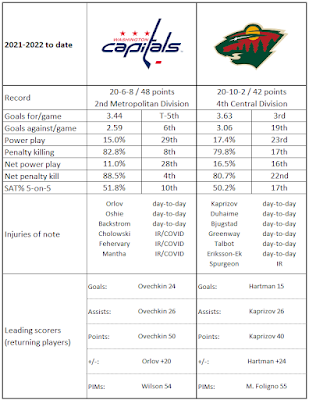
The Washington Capitals complete their back-to-back set of games for this week with a visit to Xcel Energy Center to face the Minnesota Wild.  As we pen this piece, the Caps are preparing for the first game of their back-to-back set in St. Louis against the Blues, trying to extend a three-game points streak (2-0-1).  The Wild have been like the little girl with the curl over the last six weeks, going 9-4-1, but they opened that run with an eight-game winning streak before posting a five-game losing streak (0-4-1).  They ended that losing streak with a 3-2 win in Boston against the Bruins on Thursday night.  It left them in fourth place in the Central Division, four points out of the division lead with three games in hand on division leader Nashville.

One would have to call the Wild a “veteran” team with six the 28 skaters to dress this season over 30, as are two of the four goaltenders they have employed.  Defenseman Alex Goligoski is the grayest of the graybeards on the team (36 years old).  Goligoski is in his 15th NHL season and, with his arrival in the Twin Cities last July as a free agent, is playing for his fourth NHL team (Pittsburgh, Dallas, and Arizona being the others). Goligoski has never been much of a goal scorer on his own (two seasons with 10 or more goals, an average of 7.3 goals per 82 games), but he has been a very good set up man.  Five times in 15 seasons he posted 30 or more assists; in six other seasons he recorded at least 20 assists (an average of 31.4 assists per 82 games over his career).  This season looks a lot like many of the others, with a 2-19-21 scoring line over 29 games, a 6-54-60 pace per 82 games.  Goligoski has been a consistent offensive producer so far, not going more than two consecutive games without a point through his 29 games played to date.  He has also been more productive at home so far, going 2-10-12, plus-11, in 13 home games versus an 0-9-9, plus-5, scoring line I 16 road contests.  Goligoski is 1-9-10, plus-8, in 23 career games against Washington.

Before this season, the label that might have best described right wing Ryan Hartman would have been “journeyman.”  He was a first-round pick of the Chicago Blackhawks in the 2013 Entry Draft (30th overall), but like many players in the lower half of the first round in that draft class, he underwhelmed when reaching the NHL.  He spent parts of four seasons in all with Chicago, a total of 141 games, and posted a 19-goal season in 2016-2017, his first (and as it turned out, only) full season with the club.  From there he moved on to Nashville, where he spent parts of two seasons, before moving on to Philadelphia for 19 games after a trading deadline deal.  After that brief stint with the Flyers, Hartman signed as a free agent with the Wild in July 2019.  He seems to have found a home, if his production is any indication.  He has 31 goals and 70 points in 153 games with the Wild, all highs among the four cities in which he has played. Wit a team-leading 15 goals in 32 games, he is on pace to surpass his career high in goals, that 19-goal season in Chicago in 2016-2017.  His goal-scoring pace has slowed somewhat, though.  Hartman had 13 goals in his first 23 games of the season, but he has only two in his last nine contests.  Hartman is 1-3-4, even, in 11 career games against the Capitals.

So far this season, 97 goalies have dressed for at least one NHL game.  Cam Talbot is the tenth-oldest of this group (34 years old).  And you have to go all the way to Robin Lehner, the 28th oldest goalie to dress this season, to find one who has appeared in more games (25) than Talbot (24). Talbot has been successful on a win-loss basis (15-8-1), but his underlying numbers have been less impressive – 3.00 goals against average (33rd among 52 goalies to log at leat 500 minutes), .909 save percentage (26th in the same group), .915 even strength save percentage (31st among 51 goalies playing in at least 10 games), .878 save percentage when shorthanded (17th among the same group).  The disconnect is more pronounced at home, where Talbot has an impressive 7-2-1 record, but also has a 3.23 goals against average and a .897 save percentage.  It is the profile of a goalie who looked ready to join the elite level of goaltenders back in 2016-2017 with Edmonton (a league leading 73 appearances, 42-22-8 (led the league in wins), 2.39, .919, seven shutouts, and a fourth-place finish in Vezina Trophy voting), but who has struggled to maintain that level of performance since.  In four seasons after that career year, Talbot was 73-66-12 (20th in wins over that period), 2.96 (53rd of 68 goalies with at least 2,500 minutes), .908 (48th among the same group), with six shutouts in 161 games with four teams (Edmonton, Philadelphia, Calgary, and his first season in Minnesota last year).  This year seems to be an extension of that trend.  Talbot, who is listed as day-to-day with a lower body injury, is 3-7-0, 2.77, .907 in 12 career appearances against the Caps.


1.  Since December 1st, only Montreal and Columbus have allowed more shots per game (36.0) than Minnesota (35.9).  It is worse at home (okay, it’s only four games), where the Wild have allowed 36.3 shots over the period, second most in the league (Chicago: 36.4).

2.  Only three teams this season have scored more first period goals than Minnesota (27) – Florida (40), Colorado (38), and Vegas (38).

3.  Bad news for Caps fans…The Wild are one of four teams not to allow an overtime goal this season (San Jose, Columbus, and Arizona are the others).

4.  The Wild lead the league in 6-on-5 goals (10).

5.  Minnesota is one of four teams in the league with 10 or more one-goal wins (Tamps and Nashville have 12 apiece; the New York Rangers have 11). 

1.  The Caps went into Friday’s game leading the league in games in which they scored first (23).  They have 16 wins under those circumstances (tied for third-most in the league).

2.  Last year, the Caps had 19 one-goal wins in 56 games, most in the league.  Through 34 games this season they have four one-goal wins, tied for fourth fewest in the league. 

3.  Last year, the Caps had five losses in extra time, tied for tenth-fewest in the league.  This year, eight such losses, most in the league.

4.  Last year, the Caps a minus-12 in net penalties (drawn minus taken) in 56 games.  This year, plus-16 in 34 games.  And, last year they had 19 majors in those 56 games.  This year, three in 34 games.

5.  Last year, the Caps lost nine games by three or more goals in 56 games.  This year, once in 34 games (5-2 to Seattle on November 21st).

The Peerless’ Players to Ponder

Minnesota: Kirill Kaprizov

Kirill Kaprizov will not play against the Caps on Saturday.   He was on the receiving end of this hit from Boston’s Trent Frederic on Thursday night in a 3-2 win over the Bruins in Boston.

It matters.  He has been one of the genuine surprises in his season and a half in the NHL since being taken as a fifth-round pick in the 2015 Entry Draft (135th overall) by the Wild.  In 87 career games to date he has 41 goals and 91 points. This season he already eclipsed his Calder Trophy-winning rookie season 24 assist total in 55 games with 26 helpers in 32 games.  Kaprizov opened this season with points in each of his first three games, all Wild wins.  He had a three games in four with points to open November, all Wild wins.  He had a remarkable 11-game stretch to end November and begin December over which he went 7-14-21, plus-16, including a pair of four-point games, and the Wild went 9-1-1.  He has had ten multi-point games this season over which the Wild went 7-3-0.  The Wild are 9-3-1 in game in which he posted at least one goal, 15-5-2 in games in which he recorded at least one point.  They are just 5-5-0 when Kaprizov failed to record a point.  Only Ryan Hartman has been on ice for more even strength goals (42) than Kaprizov (41), and Kaprizov is tied for fourth among Wild skaters in on ice even strength goal differential (plus-13). His contributions have matter and will no doubt be missed so long as he is out of the lineup.  This would have been his first career game against the Caps.

Washington: Vitek Vanecek

It has been almost three weeks since Vitek Vanecek saw game action for the Caps   Between COVID protocol, the league pause in its schedule, and the solid play of Ilya Samsonov in front of him on the depth chart, Vanecek as been accumulating a coat of rust.  He is another player who is unlikely to play in this game, unless his non-Covid illness clears up before game time on Saturday (Zach Fucale is currently serving as backup).  It is going to be important to get Vanecek playing time moving forward given the uneven season he has had so far.  Take save percentages.  He started the season with each of his first three games over .915 and .946 overall.  Then came a four-game streak with each game under .900, .861 overall.  That was followed by a four-game stretched over which Vanecek finished over .900 three times and was .922 overall.  That gave way to two games under .900 followed by two games over .930.  He wrapped up his season to date with a .875 performance in a 3-2 loss to Los Angeles on December 19th. 

Vanecek has appeared in 16 games this season, which is a lot for a “backup,” even given the unsettled roster over time as a result of COVID and injuries.  But going without work over a three-week period and likely to remain out of action until at least Monday at home against Boston is a situation the Caps must hope gets resolved sooner rather than later.  With apologies to Zach Fucale, who has a shutout in his lone NHL appearance this season, and Pheonix Copley, who has NHL experience, the Caps will be better off with Vanecek as backup and occasionally pushing Samsonov for ice time than with the other two goalies mentioned.  Vanecek likely will have to wait to face the Wild for the first time in his NHL career.

In the end…

Minnesota is a solid club and a dynamic one on home ice, where their 4.29 goals per game rank third in home scoring offense in the league.  But just as they score often at Xcel Energy Center, so do they allow goals, their 3.07 goals allowed per game ranking just 23rd.  The Caps are not a run-and-gun sort of team, and the trick here, even with Kaprizov (the second leading goal scorer and leading point producer) out, will be to keep this from becoming an 80’s style contest.

Capitals 4 – Wild 3