The Peerless Prognosticator is ON THE AIR!!!
ROAD TRIP! The
Washington Capitals head to the Midwest for a back-to-back set of games against
the teams that faced one another in the Winter Classic on New Year’s Day. The trip starts with a visit to Enterprise Center
in St. Louis to face the Blues, who trail the Nashville Predators by one point
for the top spot in the Central Division. They will head to Minnesota to face the Wild in the back end of the back-to-back on Saturday.
The Blues have been one of the better performing teams on home ice in the league, their 12-3-2 record at home ranking fifth in the league by winning percentage (.765). They have not lost a home game in regulation in their last ten outings, going 9-0-1, the .950 points percentage being second best in the league over that span (Colorado: 1.000/7-0-0). The Blues have been thoroughly dominating over this ten-game stretch at home, doubling up on opponents in goals scored (4.20 per game) and goals allowed (2.10 goals allowed per game).
Balance has been key for the Blues’ offense in that home game run, 18 skaters recording at least one goal and 23 of 26 skaters to appear in at least one game recording points. Ivan Barbashev leads the team in goals over those ten games (six). Barbashev, a former second-round draft pick of the Blues in 2014, has already set a personal bet in points in a season (27) and his 12 goals to date are within shouting distance of his best season – 14 goals in 80 games in 2018-2019. His 12-15-27 scoring line through 33 games to date is a considerable improvement over last year’s 5-7-12 line in 38 games last season, one in which he lost 18 games to an ankle injury. He has been on fire over the last six weeks, going 8-9-17, plus-4, overall and 6-3-9, plus-6, in seven home games over that same stretch. He had a string of four multi-point games snapped in St. Louis’ last game, a 5-3 loss to Pittsburgh on Wednesday. Barbashev does not shy away from the physical side of the game. He leads the team in credited hits (55) and is fifth among Blues players appearing in ten or more games in hits per 60 minutes (5.85). He is also third on the team in penalties taken overall (seven). Barbashev is 1-2-3, plus-2, in five career games against the Caps.
Jordan Kyrou had his breakout moment in the Blues’ 6-4 win over Minnesota in the Winter Classic with a pair of goals, the second of which was the game-winner, and a pair of assists. But Kyrou has had a breakout season. Now in his fourth NHL season after being drafted by the Blues in the second round in the 2016 Entry Draft, he was 19-28-47, plus-1 over his first three seasons combined. Through just 30 games this season he is 13-20-33, plus-7, posting the first two power play goals of his career in the process. His nine power play points (2-7-9) are already a career high. He is 12th in his draft class in career goals scored (32) and 17th in points (80). The odd ting about his profile this season is that he has been less productive at home, going 7-7-14, plus-4, in 15 home games while going 6-13-19, plus-3, in 15 road contests. These things are relative, though. Kyrou has points in ten home games to date, three of them multi-point games, including a three-point game against Edmonton (1-2-3) in his last game at Enterprise Center, a 4-2 Blues win on December 29th. Kyrou is without a point and has an even rating in his one career game against Washington.
St. Louis has already employed five goaltenders this season, but the clear leader of the pack is Jordan Binnington. After a spectacular 2018-2019 rookie season in which he received All-NHL, Calder Trophy, Hart Trophy, Vezina Trophy, and Conn Smythe Trophy votes, while leading the Blues to the Stanley Cup in 2019, he has been good, but not great. In the two and a half seasons since that breakout rookie year he has won 82 games, seventh-most among all goalies in that span, but his underlying numbers have been underwhelming relative to the expectations people might have had after that rookie season. Of 65 goalies logging at least 2,500 minutes over that span, Binnington ranks 11th in goal against average (2.50) and 20th in save percentage (.914). Of 64 goalies appearing in at least 50 games over that span, Binnington ranks 16th in even strength save percentage (.923) and 38th in save percentage when the Blues were shorthanded (.861).
These are the numbers of a number one goalie, to be sure, but he does not seem to have quite broken through to be a truly “elite” goaltender. But perhaps more disturbing, his numbers have deteriorated, season by season, since that rookie campaign. From a 1.89 goals against average in 32 games in 2018-2019, the numbers are, in order, 2.56, 2.65, and 3.00 this season. From a .927 save percentage as a rookie, the numbers slipped to .912, .910, and .908 so far this season. Binnington has not displayed much of a home-road difference in performance in 20 games to date this season, going 5-3-1, 2.88, .907, with one shutout at home and 5-4-2, 3.09, .908 on the road. More disturbing, his performance has slipped from a hot start that saw him win his first four decisions of the season (4-0-0, 2.75, .919). Since then, he is 6-7-3, 3.06, .904, with one shutout. He has faced the Caps only once in his career, dropping a 3-2 overtime decision at Enterprise Center on October 2, 2019.

1. St. Louis closes games on home ice. They have outscored opponents, 26-13, in third periods of home games (the 26 goals scored are tied with Vegas for second-most in the league).
2. Continuing in that vein, the Blues are 8-0-0 when taking a lead into the third period on home ice.
3. St. Louis simply does not carry deficits into third periods on home ice. They have trailed after 40 minutes at home only three times in 17 home games. Only Carolina and Calgary (twice apiece) have trailed after two periods in fewer home games.
4. The Blues are not a physically punishing team on home ice, their 17.96 credited hits per 60 minutes ranking 25th in the league.
5. The Blues have a better winning percentage when trailing first on home ice (.714/5-1-1) than they do when scoring first (.700/7-2-1).

1. The Caps have trailed first only five times in 16 road games. Only the New York Islanders have done so fewer times (four in 16 road games).
2. Washington is tied for the best winning percentage in the league when trailing first in road games (.600/3-0-2) and are the only team n the league not to have lost in regulation in a road game when allowing the first goal.
3. The Caps have the fourth fewest penalty minutes per game on the road (7:07).
4. Washington needs to improve its performance in one-goal decisions on the road. They are 2-2-3 in such situations, the sixth-worst winning percentage (.286) in the league.
5. The Caps are tied for the league lead in 5-on-5 goals scored on the road (44, with Calgary).
The Peerless’ Players to Ponder
St. Louis: Vladimir Tarasenko
One of the mysteries of recent seasons has been the regression of Vladimir Tarasenko as a goal scorer. From 2014-2015 through 2018-2019, he posted more than 30 goals in each season, and his 182-goal total was third-highest in the league over that span. But injuries, primarily shoulder problems, limited him to 34 games over the next last two and a half seasons, and his seven goals over that period were a significant drop off as a result. He has rebounded this season, posting 14 goals in 34 games (he has appeared in every Blues game to date), a 34-goal pace.
Tarasenko got off to a decent start this season, going 7-7-14, minus-1, in his first 17 games overall. But he has raised his game a notch in his last 17 games, going 7-13-20, plus-4, and posting seven multi-point games in the process. He goes into this game with goals in five of his last six games and a six-game points streak (6-5-11, plus-5). He has been especially dangerous on home ice so far this season with a 9-14-23, plus-5, scoring line in 17 games at Enterprise Center (5-6-11, minus-2, in 17 road games). He is 4-10-14, plus-5, in his last nine home games, including six multi-point games. Tarasenko is 8-2-10, plus-7, in 11 career games against Washington.
Washington: Connor McMichael
Caps fans might be forgiven for wondering what’s up with Connor McMichael. In spite of being the 25th overall draft pick in 2019, in spite of leading the Hershey Bears in goals (14) and points (27) last season, in spite of the injuries that kept the Caps from fielding a complete healthy complement of centers over their first 28 games this season, McMichael has seen his ice time “managed” quite closely (Caps fans might have another verb to insert there). Only once this season has he logged more than 15 minutes of ice time (a 3-2 overtime loss to Anaheim on November 16th). Only three other times did he record at least 14 minutes in ice time. Eight times in 32 games to date he finished under ten minutes of work.
His has been an odd season with respect to the relationship of ice time to performance. For instance, he did not have a goal in any of the ten games in which he skated more than 12 minutes, four goals in the other 22 games for which he dressed. He does, however, have points in two of the four games in which he logged fewer than eight minutes. Brett Leason has more games this season with fewer than ten minutes played by a wide margin (20 to nine for McMichael), but Leason is a second round draft pick who is getting his first taste in the NHL this season and does not project as highly as does McMichael. What makes this a stranger situation is that he and Minnesota’s Rem Pitlick are the only two rookies in the league averaging fewer than 11 minutes a game (McMichael averages 10:59) and have at least nine points (McMichael is 4-5-9). If there is something that one might notice in his underlying performance is that he has been on ice for 15 even strength goals against (ninth most on the team) despite getting only 10:51 in even strength ice time per game (third fewest among 21 skaters to dress for at least ten games). McMichael will be facing St. Louis for the first time in his career.
In the end…
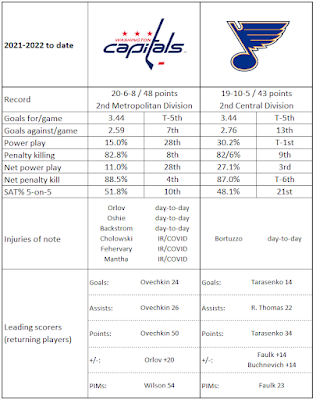
These teams have very similar profiles in terms of scoring offense and scoring defense, possession, and penalty killing. But St. Louis has a huge advantage in power play performance, their home power play ranked third in the league (29.4 percent), while the Caps’ road power play ranks 30th (11.9 percent). Narrowing the differences might be the key to this game. Call us a cockeyed optimist, but we think this is where the Caps will win this game.
Capitals 3 – Blues 2


