Sunday, November 27, 2022

Washington Capitals: That Was The Week That Was - Week 7

The Washington Capitals posted a winning record in Week 7, continuing their turnaround two-step over the last five weeks, alternating winning and losing weeks.  The Caps started well with a hard-fought overtime win over the Philadelphia Flyers and a shutout of the Calgary Flames, but playing a third game in four night wrapped around a holiday, playing the second of back-to-back games and against a hot team at that on the road, and the week ended in unfortunate fashion with a loss to New Jersey.


Record (2-1-0)

The Caps had their fourth winning record in seven weeks this season.  What was mildly disappointing was that the team had the chance to post their first week this season without a loss in regulation but came up short when they lost to the New Jersey Devils, 5-1, on Saturday night to wrap up the 2-1-0 week.  The loss to the Devils was just the fifth intra-divisional game that the Caps played through 23 games this season.  In posting a 2-2-1 divisional record, that 5-1 loss to the Devils was the second time in two regulation losses that the Caps lost by three or more goals (they lost to Pittsburgh, 4-1, on November 9th).  And, the loss to the Devils, in New Jersey for the second time this season, was the second time the decision was by three or more goals, the Caps winning the first meeting in Newark, 6-3, back on October 24th.  That loss to New Jersey brought an early-season problem in to focus – an inability to win on the road.  The Caps have played 11 road games through seven weeks and are 2-7-2.  Through their first 11 road games last season, Washington was 7-2-2 on their way to a league-best 25-10-6 record on the road.


Offense: 2.33/game (season: 2.70 / 26th)

It was not a prolific week on the offensive side of the puck.  The Caps scored three goals once in regulation, two goals in regulation in another, and were held to a single goal in their other contest.  The Caps output, such as it was, was balanced with six players recording the seven goals for the week (Alex Ovechkin had two).  Nine players recorded points, Ovechkin (2-2-4) and T.J. Oshie (1-3-4) leading the way.  The Caps ended the week having recorded more than three goals only once in their last seven games, and they lost in that instance (5-4 in a Gimmick to St. Louis on November 17th.  And the goal-scoring at home is something of an issue.  Although the Caps did score three goals in the two home games in Week 7, they have 21 goals in their last eight games on home ice (2.63 goals per game) after scoring 15 goals in their first four games at Capital One Arena (3.75 per game).  At least every one of the 18 skaters to dress in Week 7 recorded at least one shot on goal, Ovechkin (15) and John Carlson (14) leading the club.

Defense: 2.33 / game (season: 3.13 / 15th)

It was a good week on the defensive side of the puck, and it started with shots allowed.  Washington allowed 84 shots on goal for the week (28.0 per game) and held two of the opponents under 30.  The 23 shots they allowed the Flyers to open the week were the second fewest number of shots allowed by the team this season (they allowed 22 to Montreal in a 3-1 win on October 15th).  Even the loss to the Devils was impressive in a way, the Caps allowing the Devils only 38 shot attempts for the game.  The flip side of that, however, is that New Jersey managed to put 29 of those attempts on goal.  It was a bit of an odd week in one respect.  Three Capitals among the 18 to dress were not on ice for an even strength goal scored against.  However, none of Aliaksei Protas, Garnet Hathaway, or Nic Dowd averaged as much as ten minutes of even strength ice time per game for the week.

Goaltending: 2.33 / .917 / 1 shutout (season: 2.84 / .908 / 2 shutouts)

Overall, it was a decent week, but individually, it was Darcy Kuemper’s week to shine.  He stopped 53 of 55 shots in two games (a .964 save percentage) and posted his second shutout of the season.  That the victim of the shutout was the Calgary Flames should surprise no one.  It was his fourth career shutout of the Flames in 11 appearances against Calgary, and it left him with a 7-2-1, 1.61, .953 career record against the Flames.  What is more, Kuemper was reasonably consistent across games, but especially efficient early and late.  He had a .960 save percentage in the first periods of games (24 saves on 25 shots), .909 in the second periods of games (10-for-11), and a perfect 1.000 save percentage in the third periods of games (19-for-19). 

Charlie Lindgren got the call on Saturday night, and he probably deserved better.  Not that he played all that well (the goal from the goal line extended by Jack Hughes was ugly), but the Caps could not translate good underlying numbers into goals to give him more goal support.  Lindgren finds himself in a bit of a slump.  After stopping 151 of 165 shots in his first five appearances this season (.915 save percentage) in going 2-1-1, he stopped just 44 of 53 shots (.830) in his last two appearances, both losses (0-1-1).

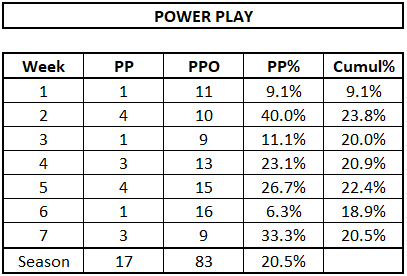
Power Play: 3-for-9 / 33.3 percent (season: 20.5 percent / 20th)

After going 1-for-16 in Week 6, a correction of sorts was, if not expected, at least not surprising.  The Caps had their fourth three-or-more power play goal week of the season and their best conversion rate (33.3 percent) since Week 2 (4-for-10/40.0 percent).  Marcus Johansson, John Carlson, and Alex Ovechkin potted power play goals for the week.  Seven skaters recorded at least one power play point with Ovechkin and Johansson each getting a pair.  Five Caps recorded power play shots, Ovechkin finishing the week with eight of the 20 power play shots recorded.  Four other skaters recorded three apiece.  Not that this will surprise any Caps fan, but through seven weeks, no skater in the league has skated a larger share of his team’s power play minutes than Ovechkin, and it is not close.  He logged 95.1 percent of the power play time on ice to date, almost 14 percentage points more than the next player in line, Edmonton’s Leon Draisaitl (81.4 percent).  It is worth noting as well that John Carlson is eighth on that list (77.5 percent), the highest ranking of any defenseman in the league.

Penalty Killing 8-for-9 / 88.9 percent (season:  percent 79.7 / 14th)

It was a good week on the other side of special teams as well.  The 8.9 percent penalty kill was second-best for the team this season (they were 7-for-7/100.0 percent in Week 5).  What was noteworthy about this week’s penalty kill was 11 skaters logging at least 90 seconds of shorthanded ice time for the week, with only Trevor van Riemsdyk getting more than ten minutes (10:25).  The Caps have also done a good job in holding down chances on home ice.  They faced only nine power play chances for the week, and the four they faced against Philadelphia in the first game of the week is the only instance this season in 12 home games that they faced more than three shorthanded situations in a game.  The efficiency of the penalty kill matters, too.  Overall, the Caps allowed at least one power play goal in 12 games so far, and the team is 1-8-3 in those games.

Faceoffs: 86-for-166 / 51.8 percent (percent 47.4 / 24th)

Another positive week in the circle.  One wishes the Caps would show improvement in other areas, but improvement in any area is welcome.  There was a team stat in this area that stood out.  Washington took 74 offensive zone draws in Week 7 and only 48 in the defensive zone, an indicator of ice tilting toward the Caps, at least for zone starts.  Now, if only their efficiency in the offensive zone matched the volume of faceoffs taken.  The Caps were underwater in the offensive zone for the week (45.9 percent), and only Lars Eller (9-for-13/69.2 percent) could be said to have a superior week on draws in the offensive end.  He also was the only Capital taking more than one defensive draw to finish over 50 percent (9-for-17/52.9 percent).  Washington managed, or at least had the good fortune, to have the right guys in the right zones taking faceoffs.  Nic Dowd, more a defensive oriented forward, took only one offensive draw for the week (a loss), and Evgeny Kuznetsov, who often struggles in this phase of the game, took only one defensive draw (he lost).  Of the five Caps to take at least ten draws overall, three finished over 50 percent – Eller (61.5 percent), Dowd (54.1 percent), and Dylan Strome (52.9 percent).

Goals by Period

The Caps showed some life in the first periods of games, something that has not come easy for them on offense this season.  The two goals they had in the first periods of games let them break even in the opening 20 minutes.  They struggled in the second periods, going minus-2 over the three games, but they did win the third periods overall and had the overtime goal against Philadelphia (their first OT goal of the season.  Despite the two first period goals, the Caps did finish the week 31st overall in first period goals scored (11), only Arizona scoring fewer (nine, in three fewer games).  And, despite allowing just the two third period goals, the Caps still were tied for having allowed the seventh-most third period goals for the season (29).


Year-over-Year

While there was some marginal improvement in some areas in Week 7, the Caps continue to lag significant behind last year’s performance through an equal number of games.  The minus-35 goal differential year-to-year (minus-20 scored, plus-15 allowed) remains a problem and must be improved considerably if the Caps are to contend.  It would be difficult to get that improvement on the offensive side from the power play, which has had more chances this season, more goals scored, and better efficiency than at the same point last season.  Reducing shorthanded situations (eight more this season than last through 23 games) would be a good place to start, despite the decent record in this area noted above.  Two things that stand out as indicators that the Caps are chasing games is the plus-103 in blocked shots over last year and the plus-37 in credited hits, both of which reflect the other team having the puck.  Reducing penalties would be welcome as well, the Caps having been hit with 19 more penalties through 23 games this year than last.

In the end…

You take the wins when and against whom you can get them.  And, you learn lessons from losses and apply them going forward.  The Caps played well enough to win all three games this week, but the New Jersey game looked from the start like one of those game any team in this league is bound to lose, not matter how well they play or how good their underlying numbers look.  It happens.  The object now is to take a mostly successful week and build on that momentum when the Caps head to the northwest in Week 8.

Three Stars

  • First Star: Darcy Kuemper (2-0-0, 0.99, .964, one shutout)
  • Second Star: Alex Ovechkin (2-2-4, even, one OT/game-winning goal, 15 shots on goal, 30 shot attempts, ten credited hits, 20:32 in ice time per game)
  • Third Star: T.J. Oshie (2-2-4, plus-2, one game-winning goal, seven shots on goal, 16 shot attempts, 12 credited hits, four blocked shots (led forwards))

Sunday, November 20, 2022

Washington Capitals: That Was The Week That Was - Week 6


The Washington Capitals suffered one of their worst weeks in recent memory, failing to win a game and performing poorly almost across the board in the top-end statistical categories.  It was a gloomy prelude to Thanksgiving week and an indicator that not only are the injuries this team has suffered continue to bite, but that the performance generally has deteriorated over recent weeks.

Record (0-3-1)

It is hard to find an adjective that encompasses Week 6 for the Caps.  Poor, ghastly, abysmal?  We really don’t want to hear “unacceptable,” because it is one of the most over-used and abused terms applied to a team suffering misfortune.  But this week was close.  Each of the three regulation losses were by three or more goals, and the Caps might have suffered a fourth if St. Louis didn’t collapse in the last five minutes, giving up a two-goal lead to allow the Caps to force extra time.  It has been a long time since the Capitals found themselves ranked 24th in the league in points (17) and 25th in points percentage (.425), but that is the hole from which the team must dig itself to get back into playoff contention.

Offense: 2.25/game (season: 2.75 / 26th)

John Carlson is a talented offensive defenseman, one of the best in this era of hockey, but if he is your leading goal scorer (three) and point producer (four) for the week, you have problems on offense.  And when it is Conor Sheary, a feisty sort, whose best features are effort and versatility more than pure offensive skill, who is second in goals scored (two), the problems accumulate.  Four other Capitals added one goal apiece.  Noteworthy among the Caps who did not were Evgeny Kuznetsov and Anthony Mantha, from whom more and more consistent contributions are vital to this club.  Of the 20 skaters who played in Week 6, 14 recorded at least one point, Dylan Strome and Alex Ovechkin adding three apiece to the four posted by Carlson.  As if to top off the misery, though, it was Matt Irwin, who did not record a point, who had the best rating for the week (plus-2).  Fifteen Caps were on the minus side of the ledger.

Defense: 4.75 / game (season: 3.25 / 18th)

The Caps did play three teams who finished the week in the top-11 in scoring offense in the league (Tampa Bay/10th, Florida/11th, and Colorado/sixth), but allowing 4.75 goals per game, and four to the 22nd-ranked offense in the league (St. Louis) just will not cut it.  It was not as if the Caps allowed a ton of shots, although they were all over the place with that statistic (a high of 43 shots allowed against Florida and a low of 24 against St. Louis).  And only against Tampa Bay did they allow more shot attempts at 5-on-5 than they had on offense.  In fact, the 27 shot attempts (not shots, shot attempts) at fives against St. Louis was a season low.  But this was a week that was generically bad in an important sense.  No Capital forward who played in more than two games finished the week with a positive goal differential at even strength (Connor McMichael was plus-1 in two games).

Goaltending: 4.26 / .868 (season: 2.91 / .907 / 1 shutout)

Whether it was the defense giving up too many quality chances, the goalies being off their game, or a combination of both, the goaltending numbers were entirely forgettable.  The big problem was an inability to stop puck early in games, at least consistently.  Cas in point, Darcy Kuemper.  He allowed four goals on nine shots in the first period against Tampa Bay before being relieved by Charlie Lindgren in a 6-3 loss, but then he stopped 21 of 22 first period shots against Florida in his next game.  Kuemper wrapped up his week stopping seven of eight first period shots in the 4-0 loss to Colorado to end Week 6.  Uneven would be perhaps the best way to describe his first periods.  Add Lindgren’s four saves on seven shots effort in the first period against St. Louis, and it made for a difficult week of first period goaltending – 37 saves on 46 shots (.804 save percentage).  A .925 save percentage in the second periods of games could not make up for the first period woes, and a .868 save percentage in the third periods of games guaranteed an unsuccessful week in goal and in the win column.

Power Play: 1-for-16 / 6.3 percent (season: 18.9 percent / 24th)

Do the Caps miss Nicklas Backstrom and T.J. Oshie that much on the power play?  Well, they are out, and there is only the glimmer of when either might return, so it is what it is.  And what the power play is, is awful, not “full of awe.”  The Caps ended the week ranked 24th in the league and sinking like a stone.  John Carlson had the only power play goal for the week, a week that is the worst week of the season, efficiency-wise.  It was especially discouraging given that the previous two weeks saw the Caps top 23 percent in power play efficiency.  Evgeny Kuznetsov had an especially frustrating week on the man advantage, failing to convert any of his team-high eight power play shots on goal.  It is also worth noting that the usual trigger man on the power play, Alex Ovechkin, finished fourth for the week in power play shots per 60 minutes, recording only four shots in four games.

Penalty Killing 7-for-12 / 58.3 percent (season:  percent 78.3 / 15th)

Inconsistency from week to week has been the most obvious feature of the Caps’ penalty kill this season, alternating good weeks (perfect weeks in Weeks 3 and 5) with poor ones (50.0 percent in Week 2 and 78.6 percent in Week 4).  Week 6 extended the misfortune of even-numbered weeks with a sub-60 percent performance.  That the Caps endured 3.00 shorthanded situations per game, tied for sixth-fewest in the league for the week, was a blessing.  The allowance of power play goals has become a problem.  The Caps have been unable to dig out from underneath the difficulties they create, posting a 1-7-3 record in the 11 games this season when they allowed a power play goal, including 0-3-1 this week, allowing at least one power play goal in each of the four games.

Faceoffs: 124-for-246 / 50.4 percent (percent 46.8 / 26th)

Well, they were over 50 percent on faceoffs.  And here there was another indicator of frustration for the Caps.  Washington took 34 more draws in the offensive zone – more than eight per game – than they did in the defensive zone.  One would think that territorial advantage would have led to more success.  But the Caps won just 46.2 percent of the 104 offensive draws they took.  Dylan Strome struggled quite a bit in the offensive zone, winning only 12 of 34 draws 35.3 percent.  Overall, of the four Caps taking at least ten faceoffs, all but Strome finished at 50 percent or better.


Goals by Period

Zero.  None.  Not one.  Not a single first period goal in four games for the week.  By the time the week was over, only Arizona had fewer first period goals (eight) for the season than the Caps (nine).  Only seven times in 20 games have the Caps posted at least one first period goal (they are 4-2-1 in those games).  They have one first period goal in three of their last 13 games.  Small wonder, then, that the Caps have taken a lead into the first intermission only four times in 20 games through six weeks (2-2-0 record).  Allowing nine goals in the first periods of games in Week 6 set in stone a poor week, record-wise.  There was too much having to come from behind in a league where that sort of thing is difficult.


Year-over-Year

The recent struggles of the Caps make this comparison hard to look at.  This year’s edition of the team pales in comparison to last year’s in far more categories than those in which they improved.  The power play is up marginally this year over last, as are faceoffs.  The Caps are the rare team this season that has more credited takeaways than giveaways.  But other than that, this team trails last year’s almost across the board, in many cases significantly, and is falling further and further behind.  It is not a good sign that the deterioration in performance is so broad and jeopardizes their playoff chances considerably.


In the end... 

It ain’t good.  Week 6 might have been the worst of the season, and just 20 games into it this team looks gassed and listless on too many nights.  The players asked to fill in and step up for those who are injured have not filled the gaps adequately, but it is not as if there are any healthy players who are in danger of having career-defining seasons at the moment.  The team doesn’t seem to have an answer for what ails them, and it is not clear that even the return of Nicklas Backstrom, Tom Wilson, and T.J. Oshie can raise the performance level of the team to make it a strong contender.  They are starting to lose touch with the division leaders, the Caps now five points behind the fourth-place New York Rangers in the Metropolitan Division with the Rangers holding a game in hand.  The Caps need a winning streak – a long one – to get them back in the chase, but right now, they give few signs of running off the sort of streak they need.  That has to change.  Quickly.

Three Stars

  • First Star: John Carlson (3-1-4, minus-4, played in his 900th career game, one power play goal, 19 shots on goal, 34 shot attempts, 25:00 in ice time per game)
  • Second Star: Alex Ovechkin (1-2-3, minus-2, 17 shots on goal 29 shot attempts, 22:58 in ice time per game)
  • Third Star: Conor Sheary (2-0-2, minus-2, nine shots on goal, 14 shot attempts, four takeaways/one giveaway)

PROGRAMMING NOTE... We will be off for the remainder of this week. We hope you and yours have a happy and safe Thanksgiving!

Friday, November 18, 2022

The Peerless Prognosticator is ON THE AIR!!! -- Game 20: Avalanche at Capitals, November 19

The Peerless Prognosticator is ON THE AIR!!!

The Washington Capitals reach the 20-game mark of the season a wounded team that is struggling more, perhaps, than at any time since they last missed the playoffs, in 2013-2014.  They fought hard to succeed in the face of season-opening absences among top players, going 5-4-0 in their first nine games, capped with a 3-0 shutout of the Nashville Predators on October 29th.  That looks like the high point of their season to date.  Since losing their next game, 3-2 in a Gimmick to the Carolina Hurricanes on Hallowe’en, their season has turned into one long “trick” with barely a treat in sight, going 2-5-3 since that win over the Predators.  And now, after a winless three-game road trip (0-2-1), they return home on Saturday night, but catching no break in a brutal stretch of the schedule.  The Caps get to host the defending Stanley Cup champion Colorado Avalanche.

After struggling with might have been a case of “Stanley Cup Hangover” to start the season, going 4-4-1 in their first nine games, the Avs come to town with a 5-1-0 record over their last six games.  The have done it on both sides of the puck, their 4.17 goals per game tied with Vegas for the second-best scoring offense over that span and the 2.17 goals allowed per game tied with New Jersey for fifth-best in the league.

Colorado has been led on offense by a trio of players who have ten or more points apiece over the six games.  Mikko Rantanen leads the threesome with seven goals and 14 points.  The eight-year veteran is among the least noisy scorers in the league.  But don’t be fooled by what might seem a lack of attention to his production. He is well on his way to posting his third straight 30-plus goal scoring season (and fourth of his career) with 11 goals in 15 games overall.  He seems a sure bet to going 7-for-7 in 20-plus goal seasons in the seven full seasons he has played in the NHL, including this one.  And, with those 11 goals and 25 points overall, he is on a 60-goal, 137-point pace that would obliterate the career highs of 36 goals and 92 points he set last season. 

Rantanen does seem to have a slowdown in his future, though.  The 11 goals on 47 shots works out to a 23.4 shooting percentage, which would be difficult to sustain, even if he does have history of shooting efficiency (five of his last six seasons at 15.0 percent or higher with a high of 17.8 percent in 2019-2020).  He has been a streaky scorer this season to date.  He posted points in hi first four games (3-6-9), including a three-point and a four-point game.  He followed that with a four-game streak without a point, but he then rolled on a six-game points streak (8-8-16), including a pair of four-point games and a three-point game before being shutout in his last game against Carolina.  If there is a plus for the Caps here, it is that his home-road scoring split is heavily weighted to home scoring (9-11-20 in seven home games and 2-3-5 in eight road games).  Rantanen is 6-6-12, minus-3, in nine career games against Washington.

It is not surprising that Nathan MacKinnon is a member of the double-digit scoring trio over the last six games for Colorado.  Where Rantanen has been the goal scorer, MacKinnon has been the set up man with 11 assists among the 12 points in his last six games.  MacKinnon was the prize of a loaded 2013 Entry Draft, the first player taken overall.  He had “future hall of famer” written in his journal from the moment he was selected by the Avalanche, but it took a while for him to start fulfilling his vast promise and be included in any discussion of best players in the game. He posted 24 goals and 63 points as an 18-year old rookie in 2013-2014, good enough for him to make the first team of the league’s all-rookie team and to win the Calder Trophy as the league’s outstanding rookie.   

But MacKinnon didn’t match either his rookie goal or point total in any of the following three seasons.  But in 2017-2018 he exploded for 39 goals and 97 points and followed that up with consecutive 35-plus goal/90-plus point seasons, the only player to pull off that double in all three of those seasons.  Since that 2017-2018 season through 15 games this season, MacKinnon has 171 goals (seventh among all skaters over that span), 295 assists (third), and 466 points (third).  His plus-97 rating is tied for sixth through Thursday night’s games.  He has only four goals in 15 games so far this season, but his 20 assists lead the league.  It seems as if he is due to break out in goal scoring, his four goals on 74 shots (5.4 percent) being very un-MacKinnon like.  Caps fans it does not happen on Saturday.  MacKinnon is 6-12-18, minus-1, in 15 career games against the Caps.

Cale Makar is the third member of the double-digit points trio.  Where Rantanen has been the goal scorer, and MacKinnon has been the playmaker, Makar has been Makar.  Three goals, most among Colorado defensemen over the six-game run, seven assists, leading all defensemen, and a plus-8 rating, tied with fellow defenseman Devon Toews for the team lead. In only his fourth NHL season and just having turned 24 years old in late October, he is arguably the top offensive defenseman in the game.  His 193 goals over his four NHL seasons lead all defenseman over that span, his 147 assists rank sixth, and his 198 points rank third.  He is the only defenseman to have played in more than five games over the last four years to average more than a point per game (1.04), his 18 power play goals are tied for first, and his 85 power play points rank second among all league defenseman over the four-year period.  Add a league-leading 14 game-winning goals over that span, and a 10.5 shooting percentage (one of two defensemen playing in at least 50 games to top 10 percent), and it is a solid case to make for Makar as the top offensive defenseman in the league.  He already has points in 11 of 15 games overall this season, and the Avs are 8-2-1 in those games.  Six of those games are multi-point games.  In four career games against the Caps, Makar is 0-2-2, minus-4.

1.  The 5-1-0 record that Colorado brings to town since November 4th is the second-best record in the league over that span, trailing only that of the New Jersey Devils (6-0-0, part of an 11-game winning streak on which the Devils find themselves).

2.  Although the Avs have that second-best scoring offense in the league over their last six games, their scoring seems a bit unbalanced.  Colorado had 24 skaters appear over those six games, but ten have goals, and 14 have points, which seems a bit light.

3.  Colorado has a 33.3 percent power play over their last six games, which is actually less efficient than their overall league leading 36.7 percent power play for the season to date.

4.  The Avalanche have three wins over their last six games settled by three or more goals, the most three-plus goal wins over that span.

5.  In five of their six games in the 5-1-0 run, Colorado scored first in five of them, winning four times.

1.  The Gimmick loss to St. Louis on Thursday night broke a streak of three three-goal losses for the Caps in their last three defeats (4-1 to Pittsburgh, 6-3 to Tampa Bay, and 5-2 to Florida).

2.  The Caps went to extra time for the third time this season on Thursday night in St. Louis.  They have lost all three times, twice in the Gimmick.

3.  The loss to the Blues was the sixth time in 19 games that the Caps scored four or more goals and the first time they lost in such games.

4.  Washington returns home having lost their last five games on the road (0-3-2).  They have won two of their last three contests on home ice, scoring five goals in each of the two wins.

5.  The Caps have allowed three or more goals in seven of nine home games this season and only one goal in the other two.

The Peerless’ Players to Ponder

Colorado: Alexandar Georgiev

When Darcy Kuemper left the Avalanche in free agency following their Stanley Cup win last season and replaced him with free agent Alexandar Georgiev (three years/$10.2 million) , some might have viewed the exchange as a down grade and a harbinger of a platoon system with Pavel Francouz.  So far, Georgiev has been lights out (quite literally, if one is speaking of red goal lights).  In ten appearances, Georgiev is 7-2-1, 2.70, .924.  Those goals against average and save percentage numbers are the best of his six-year career to date. 

Not only has Georgiev been effective in goal for his new club to date, he has been so in the face of heavy shot volumes.  He has faced 35.3 shots per game to date, seven times topping 35 shots faced and twice facing over 40 shots in a game.  His even strength save percentage (.942) ranks fifth among 62 goalies appearing in at least five games.

Georgiev’s home/road split for the season will not give comfort to Caps fans hoping to start their three-game home stand on a positive note.  In five home games he is 3-1-1, 3.01, .905.  However, in five road games, Georgiev is 4-1-0, 2.38, .938.  In four of those five games he posted save percentages of .920 or better, three times over .940.  He faced 35 or more shots on goal in four of those five road games, including a season-high 46 shots in a 3-2 win in New York over the Rangers on October25th.  Georgiev is 2-5-1, 3.62, .882 in eight career appearances against the Caps.

Washington: Darcy Kuemper

Charlie Lindgren got his chance to face a former team on Thursday night when he took the ice in goal against the St. Louis Blues.  Now, Darcy Kuemper seems likely to get his chance to face his old Colorado squad on Saturday night.  Kuemper has appeared in 14 games to date for the Caps, and his season so far seems to divide into two seven-game pieces.  In the first he went 4-3-0, 2.47, .919, capping the seven-game segment with a 3-0 shutout of the Nashville Predators on October 29th.  In seven games since, Kuemper is 1-5-1, 3.02, .902, and he suffered his first instance of being pulled from a contest, lasting 16 minutes and change against the Tampa Bay Lightning, giving up four goals on nine shots in a 6-3 loss on November 13th.

In those first seven games, Kuemper’s even strength save percentage of .932 ranked 13th among 54 goalies to appear in three or more games to that point.  In his last seven games since October 30th, his even strength save percentage of .908 ranks 30th among 53 goalies to appear in three or more games over that span.  His overall home/road split is not all that confidence inspiring going into Saturday’s game.  While he has an unfortunate win-loss record on the road (1-5-1 in seven games), he does have a save percentage of .921, which ranks 14th among 55 goalies to appear in at least three road games.  At home, Kuemper is 4-3-0, but his .899 save percentage ranks 28th of 46 goalies to appear in at least three home games.  He has allowed three of more goals in five of the seven appearances he made at Capital One Arena so far this season.  Kuemper is 4-1-2, 1.90, .928, with three shutouts in nine career meetings against Colorado.

In the end…

The Caps recent history of injuries is well-known to Caps fans.  But it is not as if the Avalanche haven’t felt some pain.  Gabriel Landeskog (knee) and Valeri Nichushkin (ankle) are and will be out for extended periods.  Landeskog has yet to play this season, and Nichushkin was on a blazing start through seven games (7-5-12, plus-1) before he went down.  But the champs are the champs for a reason; they are deep.  Deep in ways the Caps are not so that on paper, the Avs are still the better team.  But the Caps are not without weapons, and they are a veteran team hungry to end their recent slump.  It could make for an interesting back-and-forth contest.

Capitals 5 – Avalanche 3


Wednesday, November 16, 2022

The Peerless Prognosticator is ON THE AIR!!! -- Game 19: Capitals at Blues, November 17

The Peerless Prognosticator is ON THE AIR!!!

The Washington Capitals conclude their three-game road trip on Thursday night when they visit the St. Louis Blues at Enterprise Center in St. Louis.  The Caps will be looking to end their two-game losing streak and a 2-5-2 skid over their last nine games over which they find themselves increasingly unable to stop other teams from scoring, but we will get to that.

The Blues are a happier bunch these days, going into a contest with the Chicago Blackhawks on Wednesday night on a three-game winning streak after suffering an eight-game losing streak, all of the losses in regulation.  It is not hard to see what changed.  Over their eight-game losing streak they averaged only 1.50 goals per game, were held to two or fewer seven times (and they lost the only game they scored more than two goals), and were shut out once.  Over their last three games, though, they scored 11 goals while holding opponents to seven.

Jordan Kyrou has two goals in those three wins for the Blues, perhaps a sign that the slow start he had to this season (3-1-4, minus-17, and no, that is not a misprint… minus-17) is behind him.  It would be fair to say that much was – is – expected of Kyrou based on his NHL progress to date.  A second round pick for the Blues (35th overall) in the 2016 Entry Draft, he made the jump to the NHL in 2018-2019, appearing in 16 games with a 1-2-3, minus-1, scoring line.  In his sophomore season he played in 28 games, going 4-5-9, plus-1.  Kyrou made a big leap in 2020-2021 with 14 goals (including his first two career game-winners) and 35 points in 55 games.  Last year was another big leap in production for Kyrou, a 27-48-75, plus-10, season in 74 games.  The odd part of his season overall is that the Blues are 2-8-0 when Kyrou skated 17:50 or more in ice time, but they won all for games in which he skated less than 17:50.  Kyrou is 0-2-2, plus-2, in three career games against Washington.

Robert Thomas and Pavel Buchnevich are tied for the team lead in points over the Blues’ three game winning streak with four apiece.  Thomas (1-3-4, plus-1 in the last three games) has had an eventful career to date for one so young, and not all in a good way.  Thomas was taken in the first round of the 2017 Entry Draft (20th overall) after going 16-50-66, plus-41, in 66 games for the London Knights in the Ontario Hockey League.  He split the 2017-2018 season between London (20-26-46, plus-13, in 27 games) and the Hamilton Bulldogs of the OHL 94-25-29, plus-4, in 22 games).  He made the jump to the NHL in the 2018-2019 season, going 9-24-33, minus-2, in 70 games for the Blues.

But it was then that the injury bug would bite.  He missed seven games with a shoulder injury, then missed four playoff games with a wrist injury. He barely got out of the gate for the 2019-2020 season when he missed five games with an upper body injury.  In the 2020-2021 season he missed 18 games to a broken thumb,and then he missed four more with a shoulder injury late in the regular season.  Last season, Thomas lost seven games to a lower body injury, two games to illness, and another game to an upper body injury.  None of this string of injuries that limited Thomas to 241 games over four seasons kept the Blues from offering, or Thomas from signing, an eight-year/$65.0 million contract last July that will go into effect for the 2023-2024 season.  It is a risk, but a calculated one for the Blues, seeing his 42 goals and 164 points in those 241 games as indicators of promise as a reliable scorer, provided he is healthy.  This season, his performance and that of the team closely parallel one another.  In the Blues’ 3-0-0 start, Thomas was 0-4-4, plus-5.  In the eight-game losing streak, he was 2-1-3, minus-12.  But in the Blues’ current three-game winning streak going into Wednesday night’s action, he is 1-3-4, plus-4.  In three career games against the Caps, Thomas is 1-2-3, plus-2.

The Merriam-Webster Dictionary defines “flash in the pan” as “one that appears promising but turns out to be disappointing or worthless.”  It would be harsh to consider goaltender Jordan Binnington as worthless, but disappointing?  It might be a fair characterization.  Binnington was the sixth goalie taken in the 2011 Entry Draft, a draft that does not seem to have a very impressive goalie class.  He worked his way up the development ladder and finally broke through with a single NHL appearance in the 2015-2016 season (13 minutes, three saves on four shots faced, a no decision).  But then came the 2018-2019 season.  Binnington exploded on the scene – 32 appearances, 24-5-1, 1.89 (best GAA in the league), .927, five shutouts.  He was the first team goalie on the All-Rookie Team, finished second in Calder Trophy voting as top rookie, finished tenth in Hart Trophy voting for MVP, and finished fifth in Vezina Trophy voting for top goaltender.  But he saved the best for the postseason; he was 16-10, 2.46, .914, with one shutout, backstopping the Blues to the Stanley Cup.

But then he had a bizarre sophomore season.  The regular season was impressive – 30-13-7, 2.56, .912, with three shutouts. It was good enough to finish seventh in Vezina Trophy voting.  And when he finished the regular season on a 6-2-0, 1.75, .931, two shutout record in his last eight games, he looked to be in position to lead the Blues deep into another postseason.  But after a 36-save effort in a 2-1 loss to Colorado in the round robin prelude to the 2020 postseason, the bottom dropped out of his game.  He made four more appearances, losing all of them, and stopping just 84 of 103 shots, a ghastly .816 save percentage.  He really has not been the same since.  In two seasons following that 2020 postseason debacle, he is 36-28-12, 2.87, .906, with two shutouts.  He has not shaken out of that fog this season – 6-5-0, 3.07, .904, with one shutout – 35th in goals against average (of 57 goalies with at least 250 minutes), 33rd in save percentage.  However, he has won his last three decisions, stopping 106 of 113 shots along the way (.938).  Binnington is 0-0-1, 2.86, .912 in his only appearance against the Caps to date, a 3-2 overtime loss to the Caps on October 2, 2019.

1.  The Blues have allowed 4.17 goals per game at home, the 30th ranked scoring defense on home ice this season.

2.  Beware the St. Louis power play on home ice, it is the sixth-ranked power play in the league at home (29.4 percent).

3.  On the other side of special teams, the 66.7 percent penalty kill is the third-worst in the league on home ice, but no team has deployed it less frequently at home than the 2.00 shorthanded situations faced by the Blues per home game.

4.  First periods in St. Louis have not had much in terms of goal scoring action – four goals for the Blues and four by opponents in six home games.

5.  Over his first 11 games this season, Jordan Kyrou did not have a “plus” rating in any of them.  He was as high as “even” only twice, going minus-17 in the other nine games.  However, he is even in his last three games overall.

1.  Over their 2-5-2 slide, the Caps have seen there scoring defense deteriorate.  Over the first four games of the slump, the Caps held opponents to three goals three times and two goals once, but they lost all four games (0-2-2).  They beat Edmonton to end that skid, but they allowed four goals in doing so in a 5-4 win.  Starting with that game, the Caps have allowed 20 goals in four games, four or more four times (they beat Tampa Bay, 5-1, in that 2-3-0 run).

2. We mentioned the 2017 Entry Draft in the context of the development of Blues forward Robert Thomas.  But the 2017 draft was noteworthy for the Caps as well.  It was a disaster.  It is the oldest draft class for which no player has dressed for an NHL game. Granted, the Caps had only four picks and none until the fourth round (120th overall). The Caps’ first round pick was traded with Zach Sanford, Brad Malone, a conditional seventh-round pick in 2017 or 2018, a conditional second-round pick in 2019 to St. Louis for Kevin Shattenkirk and Pheonix Copley.  The second round pick went to Montreal as part of the trade in June 2016 that brought Lars Eller to Washington in exchange for a second-round pick in 2018 and this second rounder.  The third rounder was sent to Buffalo in February 2016 for defenseman Mike Weber.

3.  The Caps have been creamed in third periods in road games, getting outscored, 14-6, in nine away contests.

4.  Washington has taken a lead in a road game to the first intermission only twice in nine road games.  Only Chicago and Detroit have led fewer times after 20 minutes (once apiece).  The Caps lost both games and are one of five teams without a win when leading after one period.

5.  From the symmetry file, the Caps took a lead into the third period of their nine road games only twice as well.  They won both of those contests.

The Peerless’ Players to Ponder

St. Louis: Ryan O’Reilly

A walk-year for a player – that last season of a contract with the possibility of a big free agency payoff looming – can bring out the best or the worst in a player.  The jury is deliberating the case of the Blues’ Ryan O’Reilly.  The 31-year old is in his 14th NHL season, O’Reilly is off to a slow start with three goals and five points with a minus-12 rating in 14 games.  His production on home ice has been especially disappointing – 1-0-1, minus-6, in six home games through Tuesday.  And now, trade rumors are swirling. 

What is confounding, and perhaps merely a slump, is his assist total. In 13 seasons leading into this one, O’Reilly finished with fewer than 30 assists only three times (all with Colorado) – 18 in 81 games in his rookie 2009-2010 season, 13 in 74 games in his sophomore 2010-2011 season, and 14 in 29 games in 2012-2013.  So far this season he has only two assists in 14 games, none in six games on home ice.  He has yet to post a power play assist, even though he does average 2:01 in power play ice time per game.  O’Reilly might be emerging from his early season slump.  He is 2-2-4, even, in his last four games going into Wednesday’s action, although his ice time is down about a minute per game (17:31 in those four games) from that of his first ten games (18:28 per game).  O’Reilly is 1-13-14, plus-3, in 21 career games against Washington.

Washington: Connor McMichael

If Rod Serling was alive today, he would be hunched over his typewriter clicking away on his typewriter keyboard (hey kids, remember typewriters?) penning a screenplay for “The Twilight Zone.”  The episode might have the working title, “The Connor Conundrum.”  It is the story of a hockey player who was a high draft pick, but who rarely plays; a player who has consistency issues (especially on defense), but whose numbers are not as bad as his perceived shortcomings would suggest; a player thought of as a core element of the future Capitals, but a player who might not be a Capital when the inevitable rebuild takes place a few seasons from now.

Caps fans might be forgiven for thinking that McMichael has been a part of this organization for years and years, but the fact is that he was drafted by the Caps 25th overall in the 2019 Entry Draft, just three years and change ago.  Although he has had difficulty breaking into the lineup on a regular basis, he will turn just 22 years old on January 15th.  By that time, he could pass former Caps Brooks Laich, Richard Zednik, and Jason Allison in games played by their 22nd birthdays (McMichael has 74; Laich and Zednik had 77, Allison had 86).  He has already passed Laich and Allison in goals scored before age 22, having scored nine career goals thus far to Laich’s and Allison’s seven apiece.  The Caps are 39-24-11 in games in which McMichael has played to date, a respectable 99-stnadings point rate over 82 games.  If he has been a liability, it has not been an influencing element in team results to a serious degree.

Which is not to say there haven’t been of are not problems that need attention.  Despite not getting scoring line minutes to a large degree, McMichael’s strength would appear to be less as a high-end scorer and more as an all-around player who plays with skill and consistency in all three zones.  However, he is a minus-3 in career goal differential at even strength.  For a successful Caps team, a McMichael who gets consistent middle-six forward playing time is going to have to turn that minus into a plus.  McMichael has also held his own in the turnover area, although takeaways and giveaways are recorded with some level of ambiguity and arbitrariness.  He has 16 career takeaways (13th among Caps forwards over his three seasons) and 10 giveaways.  His positive takeaway-to-giveaway ration holds its own over that period with veteran Caps forwards such as Conor Sheary (75/29), Nic Dowd (74/35), Nicklas Backstrom (58/37), T.J. Oshie (54/48), and Garnet Hathaway (39/33).

The point is that Connor McMichael occupies his own corner of hockey’s Twilight Zone, and his search for an exit is one of the continuing subplots of Capitals hockey.  He is without a point and has a minus-1 rating in one appearance against the Blues.

In the end…

The Caps will be catching the Blues in a vulnerable position on Thursday night.  Even though they seem to have righted themselves, St. Louis will go into the game fresh off a three-game road trip, playing the second of a back-to-back set of games, and skating in their third game in four nights.  Those are usually the hallmarks of a team that an opponent can wear down, even in their own rink.  But the Caps have had their own issues since Halllowe’en and are looking for a win by any means possible.

Capitals 4 – Blues 3

Monday, November 14, 2022

The Peerless Prognosticator is ON THE AIR!!! -- Game 18: Capitals at Panthers, November 15

The Peerless Prognosticator is ON THE AIR!!!

The Washington Capitals wrap up their trip to Florida on Tuesday night when they visit the Florida Panthers at BB&T Center in Sunrise, Florida.  The Caps will be hoping for a better result than the egg they laid at Amalie Arena in Tampa in a 6-3 loss to the Lightning on Sunday night.

Florida comes into this contest having a season similar to that of the Caps in that they cannot seem to establish any winning momentum.  They won consecutive games on the road to start the season, but since then they are 6-6-1 and have consecutive wins only once in that span, wins over Anaheim and Carolina last week before losing their last contest, a 4-2 loss to Edmonton on Saturday.

It is quite a difference that a year has made for the Panthers, who were 10-2-3 at the 15-game mark last season.  One problem the Panthers have had is in putting pucks in the net.  Not that their 3.13 goals per game is bad, although as the 15th ranked scoring offense, they are mediocre.  It is that the scoring offense is down by more than half a goal per game from last season through 15 games (3.73, ranked second at the time).

When looking for reasons the scoring offense is down, one might start with the performance of Matthew Tkachuk so far this season.  Last year, Tkachuk posted a career-high 42 goals in 82 games with Calgary.  And then he was traded.  Last July, Tkachuk was sent to Florida with a fourth-round draft pick in 2025 for a first-round draft pick in 2025 (subject to lottery results), Jonathan Huberdeau, Cole Schwindt and MacKenzie Weegar.  He immediately signed an eight-year/$76.0 million contract with the Panthers.   Whether he is struggling under the weight of that contract or getting used to a new city, Tkachuk is off to a bit of an uneven start.  He has 17 points in 13 games to date, which is excellent.  However, embedded in that scoring line are five goals on 68 shots, a 7.4 shooting percentage that is the lowest of his career to date (he was at 9.2 percent as a rookie with Calgary in 2016-2017).  His production is not the problem, but it has been a bit uneven.

Those shots on goal for Tkachuk are a matter deserving attention.  Tkachuk is averaging 5.23 shots on goal per game, more than two shots on goal per game than his previous career high (3.09 last year with the Flames).  Is he assuming too much of a burden to produce and being indiscriminate in his shot selection?  His assist rate (0.92 per game, highest of his career) would suggest otherwise; he is not being a puck hog in the purest sense.  His overall production has been consistent, a good sign for the Panthers.  He has points in ten of 13 games, and he already has five multi-point games.  His reputation of orneriness has accompanied him to Florida, with whom he has 30 penalty minutes in 13 games and has been charged with at least one penalty in six of 13 games to date.  Tkachuk is 1-4-5, even, in nine career games against Washington.

When one things of defensemen among the Panthers, one immediately focuses on Aaron Ekblad, but he has been limited to four games so far this season, having sustained a groin injury in Boston on October 17th for which he was placed on long-term injured reserve (he was just reactivated and played on Saturday in the loss to Edmonton).  With Ekblad’s availability limited, has anyone stepped up on the blue line?  Brandon Montour has.  Playing for his third NHL franchise (Anaheim and Buffalo being the others), the seven-year veteran is building off a solid 2021-2022 season in which he was 11-26-37, plus-15, in 81 games for the Panthers.  So far this season, Montour leads the defense in goals (four), assists (11), and points (15).  Those 15 points almost equal the combined output of the other seven Panther defensemen to dress this season (18).  Montour has two of the three game-winning goals by Florida defensemen, and his 26:12 in ice time per game leads the team and ranks third among the league’s defensemen overall.  He is averaging 4:56 in power play ice time per game, which leads all NHL defensemen. Montour has three three-point games in his last seven contests.  Oddly enough, those happen to be the only games over that span in which he recorded any points – October 29th vs Ottawa (1-2-3), November 6th at Anaheim (1-3-4), and November 9th vs Carolina (0-3-3).  Montour is 1-2-3, minu-s9, in 17 career games against the Capitals.

With Sergei Bobrovsky off to a slow start (3-4-1, 3.29, ,897), Spencer Knight is making a case, at least for the moment, to be the Panthers’ number one goalie.  He goes into Tuesday’s contest with a 5-2-0, 2.31, .922 record with one shutout in seven appearances.  It is not as if his performance should be a surprise.  The 21-year old was the first goaltender taken (13th overall) in the 2019 Entry Draft after going 15-1-0, 2.21, .903, with one shutout for the US National Under-18 Team and being ranked as the top North American goaltender by the Central Scouting Bureau. 

Knight went on to play two seasons with Boston College in Hockey East, posting a 39-12-3, 2.05, .931 record with eight shutouts.  In the second of those seasons at BC, he made his NHL debut with the Panthers upon the completion of his collegiate season, winning all four decisions he had while posting a 2.32 GAA and a .919 save percentage.  He split time between Florida and the Charlotte Checkers in the AHL last season, going 19-9-3, 2.79, .908 with two shutouts in 32 games for the Panthers.  And now, seven games into this season, he seems poised to fulfill his considerable promise as a goaltender in the NHL.  Even the losses in his 5-2 record to date have been more a case of lack of goal scoring support than poor performance on his part.  He stopped 18 of 20 shots in a 3-1 loss to Arizona on November 1st, and he stopped 28 of 31 shots in the 4-2 loss to Edmonton in Florida’s last contest.  Knight has faced the Caps twice in his career to date, losing his only decision with a 5.59 GAA and .861 save percentage.

1.  Of 22 skaters to dress for the Panthers this season, 17 have at least one goal and 19 have at least one point.

2.  In ten seasons before this one, former Capitals defenseman Radko Gudas never averaged as many as 20 minutes per game.  This year is different; he is currently averaging a career high 20:39 in ice time per game.

3.  If Florida beats the Caps, it will be the 56th win in their all-time series against Washington, tying the number of regulation losses they have against the Caps in their all-time series.

4.  Things happen in the third periods of Panther games.  Florida is one of five teams to have scored and allowed at least 20 goals in the third periods of games this season (22 for, 20 against) – Buffalo, Arizona, Vancouver, and the New York Rangers are the other teams.

5.  the Panthers are one of four teams to have scored fewer than ten power play goals (nine) and not yet score a shorthanded goal – San Jose, St. Louis, and Nashville are the others.

1.  The Caps rank 28th in the league in scoring offense on the road (2.38 goals per game).

2.  The Caps have allowed four goals at 6-on-5 on the road this season, tied with Nashville for most in the league.

3.  Washington scored first in three of eight road games played, but their record is just 1-2-0.

4.  The Caps’ .313 points percentage on the road ranks 28th in the league.

5.  Washington’s road power play (12.5 percent) ranks 29th in the league, although they are getting 4.00 chances per game, sixth-best in the league.

The Peerless’ Players to Ponder

Florida: The Brothers Staal

While Jordan Staal is skating in his 11th season with the Carolina Hurricanes, the other brothers of the Staal family in the NHL are playing for the Florida Panthers these days.  Defenseman Marc Staal spent his first 13 seasons with the New York Rangers before playing for two seasons with the Detroit Red Wings.  Last July, he signed a one-year contract with the Panther paying him $750,000.  At age 35, it would not be unreasonable to think it could be his last NHL contract, and going out with a contender after two seasons with a struggling Red Wings team would not be the worst way to wrap up a distinguished career.  Staal is currently ninth among active defensemen in games played (1,034).  Never a particularly prolific offensive player (he has never recorded ten goals or 30 points in a season), he is an excellent example of a defensive defenseman who lends a stabilizing influence to his team.  However, this season his offense has dried up to the point of being virtually non-existent (one assist in 15 games), which might explain in part his career low 17:09 minutes of ice time per game.  Staal logged at least 20 minutes in four of his first six games this season, but he topped that total only once in nine games since (20:58 in the Panthers’ loss to Edmonton last Saturday).  He is 1-10-11, minus-1, in 45 career games against the Caps.

Eric Staal is on what looks like the last lap of what seems likely to be a Hall of Fame career.  But the end has not been entirely pleasant to watch.  Eric went 19-28-47, minus-9, with the Minnesota Wild in 2019-2020, the last time he recorded double digits in either goals or assists.  He followed that up with five goals and 13 points in 2020-2021 playing for Buffalo and Montreal.  That looked like the end when Staal, an unrestricted free agent after the 2020-2021 season, remained unsigned for the 2021-2022 season, although he did agree to a professional try-out contract with the Iowa Wild of the AHL in January 2022.  He lasted four games with the Wild, going 2-3-5, but he was released from his tryout contract at that point.  Last July, he was tendered a professional tryout contract with the Panthers, and he was subsequently signed to a one-year/$750,000 deal last month.  It is hard to see how he will extend his career, based on his performance to date.  He does not yet have a point in eight games and has not yet logged as many as 13 minutes in any game this season, four times skating less than ten minutes.  Eric is 32-44-76, minus-4, in 85 career games against the Capitals, more games against one team than he has against any other opponent.

Washington: Lars Eller

Lars Eller’s career has taken an odd turn in recent years.  When you score the Stanley Cup-clinching goal, as he did in Game 5 of the 2018 Cup final against the Vegas Golden Knights, you buy a lot of goodwill.  Yet there seems to be an attitude among some Caps fans that Eller has been a disappointment since.  In five seasons since his Cup-winning heroics, he has 53 goals and 136 points in 283 games, a 15-24-39, even, scoring pace per 82 games.  Compare that with the 18-20-38, minus-6, scoring line he posted in the Cup winning 2017-2018 regular season.  Eller had at least 30 points in three of the last four seasons preceding this one and posted at least 13 goals three times, including 16 in the abbreviated 2019-2020 season (69 games). 

Part of the problem might be his consistency.  He’s been a “teens” goal scorer his whole career (seven times in the last 11 seasons posting 13-19 goals), and he has been a reliable 30-40 point player.  That didn’t change with a Cup winning goal; he had a postseason to remember in 2018 (7-11-18, plus-6, with three of his four career postseason game-winning goals, including the Cup-clincher), but that is not really the player he has been, and one might interpret his regular season performance since the Cup-winning season as “mediocre.”  But there is also the matter of age and contract for Eller.  He would turn 34 years of age if the Caps extend their season past a first playoff round (May 8th), and his five-year/$17.5 million contract expires at the end of this season.  Connor McMichael has not yet demonstrated he is ready to assume Eller’s role as primarily a third-line center who can fill in on other lines in a pinch, but that is not to say that youngsters are not pushing for a roster spot (Aliaksei Protas seems to be a bit ahead of schedule in his development, for example).  But if Eller is to go at the end of this season, he is not going quietly.  He is 3-4-7, plus-2, in 17 games, a 14-19-33, plus-10 scoring line per 82 games.  He might have to at least sustain that pace for the Caps to challenge for a playoff spot in the spring.  Eller is 7-12-19, plus-9, in 35 career games against Florida.

In the end…

The Caps might not have the depth on their current roster to build and sustain winning momentum.  There are just too many pieces missing.  But that also puts a premium on avoiding losing streaks.  And while the Caps are treading water at 7-8-2 overall, they have only one streak this season with consecutive losses after they opened the season with a pair of defeats (an 0-2-2 losing streak to close October and open November).  Extending that trend of avoiding losing streaks is essential to keeping playoff hopes alive, even if you think it is still early.

Capitals 3 – Panthers 2
