Showing posts with label Michael Latta. Show all posts

Monday, May 23, 2016

Washington Capitals: 2015-2016 By the Tens -- Forwards: Michael Latta

Michael Latta

“The best work is not what is most difficult for you; it is what you do best.”
-- Jean-Paul Sartre


Michael Latta has played in 113 regular season games for the Washington Capitals, 150th in all-time games played, nestled between Joel Kwiatkowski and Greg Smith on the all-time franchise list.  There are 215 players with more points in Caps history than the 17 he has over three seasons.  The task of his making a durable mark in the history of the franchise is a difficult one, but it is not unlike the majority of players who play in the NHL.  Not everyone is Alex Ovechkin or Peter Bondra or Olaf Kolzig.

Latta did appear in 43 games in the 2015-2016 season and set personal highs in goals scored (3) and points (7) despite playing in fewer games than he did in the 2014-2015 season (53).  In fact, he was scoring at what was, for him or a fourth-liner in general, a pretty good clip.  He had his three goals for the season by the time he finished playing in his 22nd game.  He had his seven points after he finished playing in 41 games.  Both were pretty good 82-game paces.  But he played those 41 games in the Caps’ first 58 games of the season.  Latta appeared only twice in the team’s last 24 games, those coming in Games 79 and 82 of the season.

In fact, it would appear entirely likely that Latta’s effective end to his season might have come sooner had not Jay Beagle been injured.  Mike Richards agreed to a one-year deal with the Caps on January 6th but did not appear in a game until ten days later.  Beagle was out with an injured hand and would not return until late February.  Richards might have taken Latta’s spot in the lineup, but the injury to Beagle ensured that Latta remained in the lineup, appearing in 13 of 17 games until Beagle was healthy enough to return to the lineup on February 28th.  

As it was, he did have respectable possession numbers in limited minutes.  His 51.29 percent Corsi-for at 5-on-5 overall was 10th among 15 forwards with at least 100 5-on-5 minutes (numbers from war-on-ice.com).  His CF%/Relative of plus-1.62 ranked seventh in that group.  His score adjusted numbers were better -- 52.62 percent Corsi-for (seventh) and CF%/Relative of plus-1.85 (fifth).


Fearless’ Take… There is primary scoring, there is secondary scoring, and there is tertiary scoring.  Or maybe quaternary scoring.  It’s sort of a scale of “have to have” to “nice to have.”  Getting points from Michael Latta was nice to have.  The Caps were 5-0-1 when he recorded a point this season.  In fact, the Caps are 11-2-2 whenever Latta scored a point in his career with them.  There was another odd aspect to his in-game performance and results this season.  The Caps were 5-1-2 in games in which he had a fighting major.  All-in-all, in games in which Latta had a point, a fight, or both, the Caps were 9-1-3 (he had a point and a fight in one game).  The Caps were 7-1-1 in games in which he had three or more credited hits, 15-0-2 when he was over 50 percent on faceoffs.  An active Michael Latta appears to have some relationship, if only coincidental, with winning.

Cheerless’ Take… The Caps were 2-3-2 in the seven games in which Latta had more than ten minutes of ice time, and he had only one point in those seven games (a goal against Calgary in an overtime loss in November).  They were 11-1-3 in games in which he had fewer than seven minutes of ice time.  Seems that there are limits to the benefits of his activity.

Odd Latta Fact… Coming into this season, the Caps had not lost a game in regulation when Michael Latta skated 15 or more shifts in a game (7-0-1, regular season and playoff games).  They were 1-3-1 this season when Latta had 15 or more shifts.

Game to Remember… December 16th versus Ottawa

Coming off consecutive road wins in Tampa Bay and Pittsburgh, the Caps returned home in mid-December to face the Ottawa Senators.  The visitors were in something of a rut, having lost five of nine games going into their appearance at Verizon Center.  The Caps added to the Senators’ woes, largely in part to Michael Latta.  The Caps broke on top late in the first period, taking advantage of a sloppy line change by the Senators.  While the Senators were slow to sort things out, Latta split the defense to gather up a loose puck, break in on goalie Andrew Hammond, and roof the puck over Hammond’s glove into the top of the net. 


In the sixth minute of the second period, Latta moved the puck from the center red line up to Justin Williams, who carried into the offensive zone and was hooked by Curtis Lazar.  With a delayed penalty coming, Williams slid the puck off to John Carlson for a one-timer that beat Hammond for what would be the game-winning goal in a 2-1 win.  For Latta, it was his only multi-point game of the season, the second multi-point game of his career.

Game to Forget… October 30th versus Columbus

The basic currency in which any professional athlete trades is playing time.  Getting it and keeping it is the first order of business.  A player cannot produce without it.  This is true for stars, and it is true for grinders.  For Michael Latta, the game against the Columbus Blue Jackets on October 30th was one of those games of which it might be said they didn’t have to launder his jersey after the game.  He had already been out for the previous six games after getting a sweater for the first two games of the season.  He got his first shift against Columbus before the game was two minutes old, and it would end up being his longest shift of the game at 58 seconds.  When the final horn sounded he had only seven shifts and by far the least ice time of any Capital with 3:55 (Andre Burakovsky skated 7:09).  He did manage a shot on goal and a hit, and he won both faceoffs he took, but it was the quietest night of the season for Latta as far as ice time was concerned.

Postseason:  no games played

In the end…

It could not be called a good season for Michael Latta, but it was not a poor one, either.  If the season was a movie, his name would appear in the credit roll as a minor character than had a line or two early in the film.  But in a way, that is the point.  There are a variety of roles to be played on a 20-man roster over 82 games.  Some are starring roles, others are not.  Latta played a comparatively minor role in the 2015-2016 season, but that is one that he is equipped for.  It gives him an opportunity to display skills that others who get more ice time frankly are not paid to display – hitting, being an agitator, providing energy.  It is not necessarily a set of unique skills, but they still put him among the best there are that are employed to play professional hockey.  They should not be dismissed easily.

Grade: B-

Photo: Patrick Smith/Getty Images North America

Tuesday, October 06, 2015

Washington Capitals: Five Questions for 2015-2016, Part IV

The fourth of the questions we are looking at is one that the Washington Capitals did not have to address often last season, or at least as often as some teams. 


The 2014-2015 season was a relatively healthy one for the Washington Capitals.  The team dressed a total of 29 skaters over the course of the season, well below the average across the league of 32 skaters employed over the course of the season.  Only six teams used fewer skaters in 2014-2015.  The following chart illustrates the range of skaters employed across the league in 2014-2015 (ranked by number of skaters; note: total is greater than the number of skaters participating in league play due to players skating for two or more teams as a result of trades/other transactions):


What is more, the Capitals were able to ice a consistent lineup.  Only two teams had more players appearing in 70 or more games than the 13 who skated for Washington (the New York Islanders and Los Angeles Kings, with 14 apiece), and no team had more skaters appear in all 82 games than the Caps (seven).

Already, though, health is an issue for the team.  Every team gets nicked up along the way through a season, and some clubs go into the postseason with players that are playing through injuries that would otherwise put them on the bench.  What that means is that an off-season is often time for those issues to be addressed, for players to undergo treatment or surgery, and to rehabilitate themselves.  Sometimes, the issues carry over into the next season.

That is the case for the Capitals as they prepare for the season opener on Saturday.  When they take the ice, two important parts of the team could be on the bench with injuries that were dealt with over the summer.  Nicklas Backstrom is still rehabilitating his surgically repaired hip, which could keep him out of at least four games to open the season, and Brooks Orpik had wrist surgery last July that might or might not render him unavailable for the opening of the new season.  On top of that, Jay Beagle sustained what was called a “slight lower body injury (no doubt a new NHL injury category)” in the Caps’ last preseason game that Beagle might have played through had it been a regular season game,  but given this team’s history with “lower body injuries” of any sort, slight or otherwise (see: Mike Green, Brooks Laich, Tom Poti), those three words are always a bit ominous.

Health and success do seem to go hand in hand, to a point.  Looking at the last ten Stanley Cup champions, there seems to be no magic bullet as far as number of skaters employed is concerned.  The ten clubs averaged 30 skaters in their respective championship years, ranging from 25 (the Los Angeles Kings in 2013-2014) to 36 (the Pittsburgh Penguins in 2008-2009).

Having a significant number of skaters dress for all 82 games appears helpful.  Six of the ten champions had four or more skaters appear in all 82 games, the Anaheim Ducks of 2006-2007 having eight such skaters.

However, there does seem to be something to the idea of dressing at the very least a consistent lineup.  In no instance did any of the Cup winners have fewer than 11 skaters dress for at least 70 games, averaging 12.2 per club (a range of 11, by five winners, to the 14 that Chicago had in 2009-2010 and Los Angeles had in 2013-2014).


Note: Chicago in 2012-2013 prorated to 41 games as proportional to 70 game threshold, 48 games for full season

It is hard not to think of things like injuries snowballing.  It is as if bad luck takes over a team and chokes the life out of it.  The Columbus Blue Jackets and the Pittsburgh Penguins were two clubs that were hit by an avalanche last season, and we don’t mean the hockey team from Denver.  One club was able to deal with it and reach the postseason, but it was a somewhat damaged team that could not advance past the first round.  The other club – one that reached the postseason the previous year for just the second time in franchise history – did not have the depth to overcome the plague of injuries. 

Capitals fans might remember the 1998-1999 season, the one immediately following their Stanley Cup final year, when the club lost 511 man games to injury.  We will be rubbing a rabbit’s foot, knocking on wood, and keeping a four-leaf clover in our wallet to guard against the Caps or their fans having to endure a season such as that.  Because, if the Caps are healthy, the rest will take care of itself.


Monday, October 05, 2015

Washington Capitals: Five Questions for 2015-2016, Part III

In looking at five questions about the 2015-2016 edition of the Washington Capitals, we turn to a sometimes overlooked part of the club…the bottom six forwards.


A lot of attention has been paid to the additions the Washington Capitals made to bolster the right side of their top-six forwards – T.J. Oshie and Justin Williams. However, the Caps did lose Joel Ward and Eric Fehr in free agency this past summer, and it raises the question of what the bottom six forwards will look like and whether they can be a contributing force in the season ahead.

It was an unsettled enough function that the Caps held what amounted to a casting call during the preseason.  Derek Roy, a player with almost 800 games of regular season and playoff experience, was brought to camp on a professional try out.  Sean Collins, who played parts (small ones) of three seasons with the Columbus Blue Jackets, was signed as a free agent in July and given a long look in training camp. Chris Bourque was signed to a contract in July for what would be his third tour with the organization.  Liam O’Brien, who surprised many by making the Caps roster for Opening Night in 2014-2015, was in camp competing for a spot.  Chandler Stephenson, a 2012 draft pick and with barely a season at Hershey, went deep into training camp.  Chris Brown, who appeared in five games with the club last season, was making his way through camp until a hand injury set him back for what is expected to be several weeks.  Stanislav Galiev, a 2010 third-round draft pick who appeared in his first two NHL games late last season, was getting a shot to make the club on a permanent basis.

This was in addition to returnees Jay Beagle, Michael Latta,  who might be expected to get third or fourth line minutes, and Brooks Laich and Jason Chimera, who might at one time gotten second line minutes but are likely to find homes on one of the bottom two lines.

Then there is the matter of the depth the Caps have at scoring line forward.  There are seven players fighting for six spots.  Suffice it to say that it would seem likely that when Nicklas Backstrom returns to the lineup, then one of Marcus Johansson or Andre Burakovsky is going to be on the third line.

As we write this, Roy has been released from his try out.  Of the others, O’Brien, Bourque, and Stephenson will start the year in Hershey.  Brown is injured and will be out for some time yet.  This leaves Collins and Galiev as the 13th and 14th forwards for the moment, although with Backstrom still out for at least the first four games, one of them appears slotted to get a sweater for Opening Night. 

Compare last season’s bottom six to what might be this season’s group, once the Caps are healthy at forward (for purposes of discussion...no lines are ever permanent):


A third line of Brooks Laich (or Jason Chimera; they might be interchangeable at this point), Andre Burakovsky, and Tom Wilson would be something of a departure from a conventional checking/shut-down line pitted against, where possible, an opponent’s top line.  It would be a third scoring line, potentially.  The difficulty, at first blush, is that Burakovsky would have spent so little time with any of these three players at 5-on-5 last season (combined, about 112 minutes).  And while Burakovsky’s Corsi-for with Laich and Wilson were more than adequate (56.8 percent and 60.9 percent, respectively; numbers from stats.hockeyanalysis.com), there is too little experience there to draw much in the way of conclusions. 

There is an odd upside to a line such as this, though.  Both Burakovsky and Wilson are at the beginning of their respective development curves.  The best that might be said for such a line is that it could be better late than it is early.  They could start the season as the youngest players on the roster (20 and 21 years old, respectively).  There is room for improvement, room for them to grow together.  This applies perhaps more to Wilson, who has not yet demonstrated that he can be a contributor in the offensive end of the rink.  The improvement angle would be the optimistic view for this line.

Then there is Laich, should he get the nod to take the left side of such a line.  If there is a player who has something to prove this season, it might be Laich.  Hounded by injuries the last three seasons, he is very much removed from the solid even strength and power play contributor he was five or six years ago.  He has as many goals over the last three seasons combined (16) as he recorded in 2011-2012.  While he remains versatile, capable of playing any of the three forward positions, he needs to demonstrate productivity.

For Jason Chimera, his motivation is a bit more straightforward.  He is in the second year of a two-year deal with the Caps and is looking at unrestricted free agency at the end of the season.  A productive campaign would add to his earning potential in what could be his last NHL contract (he could be the oldest skater on the team this season at age 35).

Laich and Chimera being suited for either the third or fourth line on the left side brings us to the other two positions on the fourth line.  Jay Beagle will eventually center this line, in all likelihood, once Nicklas Backstrom returns as the top line center and moves everyone else down a rung on the ladder.  He is coming off a career year of offense (10-10-20), is a superior faceoff performer (54.7 percent in 254 career games), and he has a new contract to show for it (three years/$5.25 million).  Those are the kinds of things that can lead to a letdown if the player gets caught up in trying to do too much to maintain the career best production and/or justify the contract.

On the right side of this line could be Michael Latta.  There really isn’t a delicate way to say this, but Latta is something of a liability in the offensive end.  He has one goal on 30 shots in 70 games.  No forward played in 70 or more games and took 30 or fewer shots except for Latta.  He does try to contribute in other ways, mostly as an “energy” player (the sort who annoys and agitates, and who can and will drop the gloves when circumstances dictate). 

In Beagle and Latta, the Caps have something akin to the days when Boyd Gordon and Matt Bradley played for the club.  Gordon was a very good defensive player and was adept in the faceoff circle, Bradley was a heart-and-soul guy who led with his chin (and other parts of his face) on a lot of nights.  Beagle is perhaps a better offensive player than Gordon, who has never had a 10-goal season (but he does have three 20-plus point years), while Latta is not as competent as Bradley in the offensive zone (37 goals in 427 games with the Caps).

If, however, the third line is going to be as much, if not more of a scoring line than one might associate with a third line, then the fourth line might be expected to pick up more of the defensive burden as opposed to being merely an “energy” line.  This might argue more for Laich playing on this line, he being a superior possession player and probably a better pure defender than Chimera.

This is the point where we bring up the depth forwards.  To start the season it would appear as if those spots would go to Sean Collins and Stanislav Galiev.  Neither player has much in the way of NHL experience (Collins has 19 games over three seasons, Galiev had two games last year).  And they arrive at their roster spots from very different directions in training camp.  Of Collins, head coach Barry Trotz likened him to departed winger Joel Ward and said:
“He’s not a big body. He’s not going to blow you away with blazing speed or these fantastic hands or anything, but if you watch him closely, he will make you like him as a coach, because he does a lot of those things that are hard to do all the time.” 

On the other hand, Trotz was not as sanguine about Galiev’s progress and situation with the club before the team’s last two preseason games:
“There’s no question, he hasn’t stood out right now at all to me.  He’s got to play better... We’re pretty well out of time. We’ll make a decision on him very shortly.” 

The decision, for now, appears to keep him in Washington, but his stay might be limited to how long Nicklas Backstrom is on the shelf.

The third and fourth lines are, and will be an issue as the season gets underway.  The Caps are dealing with a retooled third line and an uncertain fourth line.  One can see a path for each improving over the course of the season in what might be unconventional roles.  On the other hand, one can just as easily see either (or both) being a substantial drag on the Caps’ performance.  This is a question that is not going to be answered in a week, in a month, or even by New Years.  It had better have an answer by the spring, though, of all this talk of the Caps going deep in the postseason might be just that.


Tuesday, September 15, 2015

Washington Capitals 2015-2016 Previews -- Forwards: Michael Latta


Michael Latta

“People sleep peaceably in their beds at night only because rough men stand ready to do violence on their behalf.”
-- George Orwell


Lost in the prodigious pile of PIMs that Washington Capitals’ forward Tom Wilson compiled last season (172, fourth in the league) was the fact that Michael Latta finished second on the club in penalty minutes (68) despite appearing in only 53 games.  He was one of a dozen players last season to have appeared in fewer than 60 games and logged at least 60 minutes in penalties.  He earned 40 of his 68 penalty minutes as fighting majors, the eight infractions he recorded being second on the club (to Wilson) and tied for 13th in the league.  Latta also happened to be the only forward in the NHL who appeared in more than 50 games that did not record a goal last season, the only one who skated more than 425 minutes without lighting the lamp.

Latta’s presence in the lineup did not leave much of an impression.  The Caps were 29-17-7 in games he played (1.23 standings points per game), 16-9-4 in games when he was out of the lineup (1.24 points per game).  But it pays to dig a little deeper here.  In those games in which Latta recorded ten of more minutes of ice time, the Caps were 9-0-2.  And, there were the penalties.  When he recorded at least five minutes of penalty time in a game, the Caps were 7-3-0 (the Caps are 9-3-0 in Latta’s career when he has five or more PIMs).  The former might be a product more than a cause, his getting more than ten minutes of ice time reflecting the Caps rotating four lines more in wins than they might in losses (seven of the nine wins were by multi-goal margins).

By the time the postseason rolled around, Latta was a player whose ability to agitate and provide energy was not a commodity as prized as providing some offensive punch or defensive stopping power. He appeared in only four games (all in the first round series against the New York Islanders) and missed the last three games of the second round due to illness.

Fearless’ Take…

Michael Latta has one goal in 70 career games and 575 minutes of ice time.  It would be fair to say he has a limited offensive skill set.  That means he has to contribute in other ways.  He is that “energy” player (another way of saying he plays on the edge of the rules), but he is not altogether a liability in a limited role.  His top end possession numbers last season were respectable (51.0 percent Corsi-for at 5-on-5), this despite a relative zone start differential of minus-2.1 percent.

Cheerless’ Take…

The Caps do not need their fourth line to be a scoring line, but they have to get something out of it.  Since the 2004-2005 lockout, only 15 forwards have played in more than 50 games in a season and recorded no goals.  And it is not as if he was like one of those position players in football who never gets a snap from scrimmage except for special teams.  He averaged only six seconds per game killing penalties last season.  The best thing that might be said here is that Latta was playing in what was his first full season in the NHL.  He was the second youngest of those 15 forwards on that “no goals” list and had the best plus-minus of any of them (plus-4).  There might be some room to grow here.

The Big Question… Does Michael Latta get a sweater on a regular basis?

Latta appeared in 53 games last season, as Cheerless noted his first full season in the NHL.  Is there any reason to believe he will top that number in 2015-2016?   If Derek Roy makes the roster on his professional try out audition, Latta would appear to be the 13th forward.  And, with a full complement of forwards as deep as it is, it is hard to see who he would replace in the lineup absent injury or utter lack of performance among the bottom-six. What’s more, the Caps took on a similar player in the off-season in Zach Sill, formerly of the Pittsburgh Penguin organization.  They play the same position – center – with similar size (Sill: 6’/202; Latta: 6’/209), similar experience (Sill: 83 games; Latta: 70 games), similar offensive production (Sill: 1-3-4; Latta: 1-9-10), similar penalty minutes (Sill: 1.16/game; Latta: 1.14/game), and similar salary cap burdens (both at $575,000/year).  We suspect Latta has the inside position on that 13th forward spot (or 12th, if Derek Roy does not make the roster), but he will be getting only intermittent duty this season, especially after the forward ranks are made whole when Nicklas Backstrom returns full time to the lineup.

In the end…

Michael Latta is the last remnant of the trade in what was the Filip Forsberg-for-Martin Erat trade in 2013.  The trade is, and will be for quite some time, a sore spot among Capitals fans.  However, Latta is the kind of player one instinctively roots for.  He does not play as if he takes the sweater for granted, bringing a genuine energy to the ice when called upon, as opposed to the manufactured “energy” that is too often synonymous for “fighting.”

However, his skill set is, at this point in his career, limited.  He will not turn 25 years of age until next May, so there is that hope that there is some filling out of his game.  But on a team that looks built to win in the near term, getting ice time will be a chore.  When he does, though, he’ll help his teammates rest easier for the intensity he brings to the ice.

Projection: 30 games, 1-3-4, plus-1

Photo: Bruce Bennett/Getty Images North America

Wednesday, June 10, 2015

Washington Capitals: 2014-2015 By the Tens -- Forwards: Michael Latta


“If the power to do hard work is not a skill, it's the best possible substitute for it.”
-- James A. Garfield


If you hear the words, “Last Man Standing,” you might think of a television sit-com.  However, if you are a fan of the Washington Capitals, you might think, “Michael Latta.”  As in, the last man standing in Washington after the Great Train Birdbrain Lamebrain Featherbrain Bloodstain Disdain Impossible-to-Explain Excruciating-Pain Scatterbrain Painful-Eye-Strain Robbery of 2013.  Washington prospect Filip Forsbrg was sent to Nashville in the trade, Martin Erat (the principal object of return for the Caps in the deal) lasted 66 regular season and playoff games over two seasons before being shipped off to Phoenix for a defenseman (Rostislav Klesla) they quickly trade for a goalie (Jaroslav Halak) that they subsequently lost in free agency, and a prospect who is still in the AHL (Chris Brown).

So much noise, so little music.

Except that Michael Latta is the type of player who can make a lot of noise, of the sort that clanging pots make or cartoon explosions.  He is, to be polite about it, a feisty sort.  In 70 games over two seasons with the Caps, he has 80 penalty minutes, 50 of those minutes coming in ten fighting majors.  In 2014-2015 those numbers were 68 minutes in total, 40 of them coming on eight bouts.

To call Latta a “role player” is perhaps a bit generous.  Among 13 Capitals forwards appearing in at least 50 games, Latta had the lowest ice time per game (8:44).  That level of participation was not conducive to big numbers.  For example, among those 13 forwards, Latta finished…
  • 13th in goals (0)
  • 13th in assists (6)
  • 13th in points (6)
  • 9th in plus-minus (plus-4)
He was one of two Capitals forwards in that group without a game-winning goal (Tom Wilson was the other).  He was one of three forwards without a special teams point (Wilson and Jason Chimera were the others).  That ice time was a factor.  His 42 games logging 10 or fewer minutes almost doubled the next highest total on the club (Wilson: 26).

We do not mean to denigrate Latta’s performance or his game.  Like the closing line in Milton’s sonnet, “On His Blindness,” they also serve who only stand and wait.  The Caps did have a 4-1-0 record when he recorded a point and a 9-0-2 record when he skated 10 or more minutes. 


Fearless’ Take: Latta's contributions in the rougher edges of the game had some meaning.  The Caps were 6-2-0 in games in which he had a fighting major, and they were 8-3-2 in the 13 games in which his hits differential (hits recorded less hits taken) was plus-2 or better (numbers from war-on-ice.com).

Cheerless’ Take: Better watch the tire pressure, cuz.  You're pumping them a bit too much.  In the 53 games Latta played, the Caps were 29-17-7.  That’s 65 of 106 potential standings points (61.3 percent).  In the 29 games he did not play, the Caps were 16-9-4; 36 of 58 potential standings points (62.1 percent).  His presence was not of the difference-making kind.

Odd Latta Fact: 357 forwards appeared in at least 50 games in the NHL in 2014-2015.  Only Michael Latta among them did not record a goal.  Only Columbus' Corey Tropp recorded fewer shots on goal (22) than Latta (24) in that group, but he did have a goal.  Latta had to close with a rush (that term being relative) to get to “24” (a "meh" week's worth of shots for Alex Ovechkin).  He had six shots over the last ten games in which he appeared.  He did not record a shot in 34 of his 53 games. Maybe Marcus Johansson can give him tips.

Game to Remember: December 18th versus Columbus.  When the Capitals headed to Columbus for their December 18th contest, they were fresh off a 20-round shootout loss to the Florida Panthers.  While it was just their second loss in their previous six games, neither of them in regulation, getting back on a winning track was the goal.  Washington split their first two meetings with the Blue Jackets, but this would be the first meeting of the season in Ohio.  It would end up being something of a wild and woolly affair.

Washington opened the scoring mid-way through the first period on a Joel Ward goal.  In the last minute of the period the Caps doubled their advantage on what was a play by Latta worthy of Nicklas Backstrom.  Just after the Caps killed a Columbus power play, the Caps had a faceoff in the Blue Jackets’ end.  Latta won the draw from Ryan Johansen back to John Carlson.  A shot from Carlson was blocked, but the puck came out to Brooks Orpik at the left point.  He one timed a shot-pass to Latta, who set up at the top of the crease to goalie Sergei Bobrovsky’s right.  In one motion, Latta accepted the pass, then backhanded the puck across the crease to Jason Chimera for a tap-in goal.

Columbus took a 3-2 lead early in the third period and had the Caps on their heels.  The Caps tied the game on a somewhat accidental play involving Latta.  Chimera took a pass from Jay Beagle in the Caps’ end and skated the puck up the left wing.  As he was approaching the Columbus blue line, he laid it off to Latta in the middle.  Latta skated in and tried to curl off, but he had the puck poked off his stick when three Blue Jacket defenders converged on him.  With that many defenders on one player, the loose puck was in open ice where Karl Alzner picked it up, skated in, and fired it past Bobrovsky.  The Caps would need those two points from Latta – his first two-point game in the NHL – in what would end as a 5-4 Gimmick win.

Game to Forget: January 16th versus Nashville.  When the Caps flew into Nashville on January 16th, it would mark the first opportunity for Latta to face the team that traded him away.  It did not go nearly as well for Latta, coach Barry Trotz (also facing the Predators for the first time since he left as head coach), or the Caps.  Latta had barely eight minutes of ice time and only two shifts in the third period.  The Caps blew a 3-2 lead in the last five minutes after spotting the Predators two goals to open the game, the dagger coming off a brutal giveaway by Matt Niskanen with less than two minutes left.  The Caps lost, 4-3.

Postseason: 0-0-0, minus-1

There really is not much to say here.  Latta appeared in only four games – all in the first round – and had a total of 27:42 in ice time (John Carlson skated 29:10 in Game 7 of the second round against the New York Rangers).  Part of his absence was due to illness in the second round, but it was an iffy proposition on a night-to-night basis whether he would be called upon to skate.

In the end…

One cannot say it was an especially noteworthy year for Michael Latta.  Then again, of how many fourth liners might that be said in any year?  Last January, a famous hockey analyst and fashion icon called the New York Islanders’ fourth line “maybe the best fourth line ever in hockey.”  They were eliminated in the first round by the Capitals.  There are limits to what a fourth liner is going to contribute, just as there are limits in Latta’s game, at least in this, the early stage of his career.  What he does not possess in skill, he is going to have to replace with hard work.  Hard work is something that can be said to occupy Latta’s game this season.

Grade: C+

Photo: Bruce Bennett/Getty Images North America


Saturday, September 20, 2014

Washington Capitals 2014-2015 Previews -- Forwards: Michael Latta

Michael Latta

“Nature always wears the colors of the spirit.”
-- Ralph Waldo Emerson


At the risk of taking Emerson a bit too literally, it is probably fitting that Michael Latta wears red in his occupation as a hockey player.  He was not the headline player in the trade that sent Filip Forsberg to Nashville for Martin Erat, but he is the player coming from Nashville who remains with the club.

The role he seems likely to play with the Caps is the epitome of the “energy player.”  To the extent he plays, it will be confined almost entirely to fourth line minutes.  He will agitate, disrupt, annoy, aggravate, and exasperate (434 penalty minutes in 183 career regular season AHL games).  He will provoke (37 fights in those 183 career regular season AHL games).

Yes, red seems to be an appropriate color to wear as a reflection of his spirit.

That said, the extent to which he passes Jay Beagle on the depth chart as fourth line center is going to hinge at least as much on his performance numbers.  Twice he has posted 14-goal seasons in the AHL, both times doing so in fewer than 55 games.  Then again, Jay Beagle had 19 and 16 goal seasons with Hershey with game totals in each season in the mid 60’s.

Fearless’ Take…

The Caps were 9-6-2 in the 17 games in which Latta played last year.  Records like that aren’t attributable to the difference making capabilities of a fourth line center, but he was on ice for only five goals against in those 17 games, too, four at even strength.  He was 52.2 percent on draws.  He was charged with just two giveaways in 131 minutes of ice time.  He committed only one minor penalty.  He was not what you would call a liability out there.

Cheerless’ Take…

Twice in 17 games he played more than 10 minutes.  He averaged less than eight minutes a game.  The Caps were 5-4-2 in games in which he played over seven minutes.  There is just so much a guy playing that little ice time can do to influence an outcome for the better.

The Big Question… Is Michael Latta a diamond in the rough?

Michael Latta is only 23 years old as he heads into the upcoming season, so it is still difficult to project just what his upside is.  Just keep in mind that he was taken in the 2009 draft ahead of Cody Eakin (72nd overall; Eakin was taken 85th), and Caps fans probably still remember Eakin, a prospect traded with a draft pick for Mike Ribeiro back in June 2012.  We cannot say with much conviction that Latta is going to become the scoring forward that appears to be slotted for in Dallas, but he might have more upside than Jay Beagle, which is not to denigrate Beagle.  Latta just has not yet had much playing time, and he seems likely to make a battle out of the fourth line center position.

In the end…

To us, Michael Latta impresses us in his limited exposure to date with the Caps as a stockier version of former Capitals forward Matt Bradley.  He does not seem to be the sort to contribute a lot at the offensive end, but he might pot the occasional goal.  He plays at  a high energy level.  He is not shy about settling matters on the ice on his own (two fights in 17 games with the Caps, 11 in 52 games at Hershey last season).  He has not yet revealed any particular liabilities on defense, although 17 games is not much to go on in that regard.

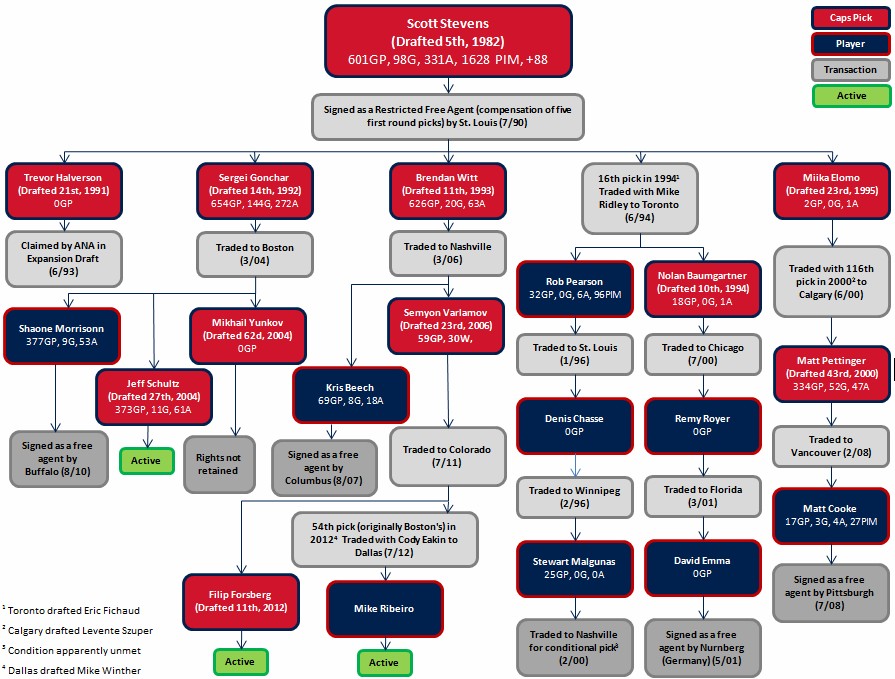
Michael Latta is the last remnant of the Forsberg-Erat trade and the end of a line in the legacy of the selection of Scott Stevens in the 1982 draft (the “Brendan Witt/Filip Forsberg” line in this chart).  Latta represents the last active line in that legacy.  Caps fans will be hoping it does not end for a while yet.

Projection:  26 games, 1-5-6, even

Photo: Patrick McDermott/NHLI via Getty Images


Tuesday, May 27, 2014

Washington Capitals: 2013-2014 By the Tens -- Hope


“All human wisdom is summed up in two words; wait and hope.”
-- Alexandre Dumas

Those are the last words of Dumas’ “The Count of Monte Cristo,” a story of perseverance and hope.  For the Washington Capitals, “hope” was personified in three players with three very distinct sets of expectations attached to them.  In 2013-2014 Caps fans were given their first glimpse at what each player might bring to the club on a more regular basis in the future.

Evgeny Kuznetsov

In “The Count of Monte Cristo,” the hero – Edmond Dantes – spent six years in the Chateau d'If, a prison from which no prisoner had ever escaped.  Caps fans did not have to wait quite as long to see Evgeny Kuznetsov in the flesh after he was drafted in 2010, and an island prison in the Mediterranean Sea in the early 19th Century is not Russia in the early 21st Century, but Kuznetsov did spend more time in Russia than the Caps or fans might have thought when he was taken with the 26th overall pick of the 2010 entry draft.  His choice.  When Kuznetsov chose to make the journey to North America he gave indications that the wait would be worth the trouble.

Fearless’ Take… There were 21 forwards in their first season in the NHL who recorded nine or more points and played in 17 or more games.  Kuznetsov was that 21st forward, having played in 17 games.  Of that group, the forward with the next fewest games played was Pittsburgh’s Jayson Megna, who played in 36 games and recorded nine points as well.  Of 69 first-year forwards playing in at least 17 games, Kuznetsov had the ninth-highest points per game.  Seven of the eight players ahead of him played in at least 20 more games.  The Caps also happened to be 8-5-4 in the 17 games in which Kuznetsov played.

Cheerless’ Take...  Some players drive play with possession, others are passengers.  Evgeny Kuznetsov was stuck in the bed of the pick-up truck.  A Corsi-for percentage at 5-on-5 of 42.3?  Fenwick-for percentage of 40.9?  Okay, okay.  A lot of that is playing so much time with Tom Wilson (37.7 percent of his 5-on-5 time) and Jay Beagle (26.4 percent),  but still. 

Peerless’ Take... That Kuznetsov averaged more than a half-point per game with such poor possession statistics might be evidence of the raw talent he possesses, an ability to make something of not much.  But that is not a strategy going forward.  His performance suggests that he will, at least for a while, be the sort of player who electrifies for stretches, makes one long to be electrocuted for others.  But he will be fun to watch develop.

Michael Latta

Michael Latta is the only remnant of the trade that sent Filip Forsberg to Nashville and that brought Martin Erat to Washington.  Erat finished his 2013-2014 season in Phoenix, while Forsberg has played only 18 games to date for the Predators.  Who would have thought that Latta would play more games with his parent club this season (17) than Forsberg (13)?  Or score as many goals (one) and almost as many points (four, versus five for Forsberg)?

Fearless’ Take… If Michael Latta ends up playing more games than Filip Forsberg or scoring almost as many points, it will say far more about Forsberg than Latta.  That, however, is Nashville’s concern for the time being.  In Washington, Latta played in 17 games and was that rare breed of Capital.  He was not a “minus” player.  He was decent (do not read that as “good”) in his possession numbers: seventh among 17 Caps forwards playing in at least ten games in Corsi-for percentage at 5-on-5, tied for 11th in Fenwick-for percentage.  The Caps were 9-6-2 in games in which Latta appeared. 

Cheerless’ Take… Less than eight minutes a game, only twice getting more than ten minutes, no games registering more than one shot on goal.  Among first-year forwards, his 1-3-4, even, 7:42 in average ice time over 17 games profile is almost indistinguishable from that of Darren Archibald (1-2-3, plus-1, 7:47 in 16 games) or Jerry D’Amigo (1-2-3, minus-1, 8:02 in 22 games).  Let’s just call him a work in progress, okay?

Peerless’ Take… If the Caps find a serviceable fourth liner in the mold of, say, a Matt Hendricks, in Michael Latta, they will have salvaged something out of one of the more perplexing trades and aftermath in club history.  If there is something intriguing about his game, it was in his Hershey numbers.  With the Bears he was 14-20-34, plus-14 in 52 games.  On a per-game basis, that’s better than the best seasons Jay Beagle had in Hershey.  Just something to think about.

Patrick Wey

If you were going to write a manual on how a defenseman might work up the developmental ladder, Patrick Wey might be the model.  USHL program, drafted by the Capitals, enrollment at Boston College, four years under one of the flagship programs in collegiate hockey (including two national championships while he played there), eight games in Reading with the Royals in the ECHL, then up to Hershey, and finally – last December – called up to the big club.  Okay, so he only played in one game before being reassigned, but he was recalled on two more occasions, playing in nine games and recording his first three NHL points (in consecutive games played).

Fearless’ Take…  Wey is not going to be an offensive-minded defenseman, but three assists in his first four games with the Caps at least hints he will not be totally silent at that end of the rink.  His test drive might have lasted longer but for a fight with Nashville’s Rich Clune on March 30th.  It ended unpleasantly for Wey in what would be Wey’s last game with the Caps and his last game of the season.  The Caps were 5-1-3 in the nine games in which Wey appeared.

Cheerless’ Take… Those three points in his first four games were pretty much offset by his minus-4 in his last four games.  Yeah, it was pretty stiff competition (San Jose, Los Angeles, and Boston among the teams), but he was on ice for seven of the 13 goals the Caps allowed in those four games.  It was an indication that more seasoning is needed before he’s ready to come to the table.

Peerless’ Take… In Patrick Wey’s last game with the Caps, on March 30th against Nashville, the Caps dressed a defense that included Julien Brouillette and Dmitry Orlov, in addition to Wey.  Those three defensemen had a combined 121 games of experience going into that game, and Orlov had 111 of those.  For the season the Caps dressed 14 defensemen, among them Wey, Brouillette, Cameron Schilling, Alexander Urbom, Nate Schmidt, Steve Oleksy, and Connor Carrick, only Oleksy (61) with more than 35 games of NHL experience at the end of the season.  Wey was part of a mixed green salad of sorts, the “green” being inexperienced defensemen.  Getting injured in a fight did nothing to help in Wey’s development, but playing in Washington at all in the 2013-2014 season probably would not have occurred had the Caps been deeper at the position.  That suggests that if a new management team does anything with respect to firming up the blue line, Wey will get a chance to continue his development in Hershey in 2014-2015.

In the end…

Scorer, grinder, stay-at-home defenseman.  Given their respective ages, Evgeny Kuznetsov (22), Michael Latta (23), and Patrick Wey (23) might be expected to play significant minutes in perhaps three to four years (sooner in the case of the gifted Kuznetsov).  With varying frequency this past season, each gave an indication that they could contribute those minutes.  Each of them had their shortcomings as well, though, suggesting that they have much work to do to get those significant minutes and make significant contributions to the big club.  For these three players, it is “wait and hope” for Caps fans.

But hey, we’re used to that by now, aren’t we?


Photos:

Kuznetsov: Bruce Bennett/Getty Images North America
Latta: Elsa/Getty Images North America
Wey: Patrick Smith/Getty Images North America

Tuesday, September 03, 2013

Countdown to Opening Night by the Elements: Number 27

Another day, another element ticked off Fearless’ walk through the periodic table…


Cobalt

Cobalt derives its name from the German, “kobold,” which means “goblin.”  It is another of those elements that was “known” before it was “discovered.”  In ancient civilizations of Egypt and Mesopotamia minerals that contained cobalt were used to give glass a deep blue color.  As time went by there were those who thought the element giving glass that blue color was bismuth.

Georg Brandt, a Swedish chemist (we seem to have come across a number of Swedish chemists in this review), had other ideas.  Brandt would become the first to be attributed with the discovery of a new metal, all the ones known to that point in time (the mid-1730’s) having been long ago used by humans, their discoverers lost to history.

Cobalt in its free and most stable form is an element formed in the furnaces of supernova creation.  It is not native to earth, being deposited on the planet by meteor strikes.  In addition to its stable form, it has 22 radioisotopes.  One of them – Cobalt-60 – is a gamma-ray radiation source that has been used in a variety of medical and health applications: radiotherapy, sterilization of medical supplies and medical waste, cold pasteurization. 

Cobalt is also essential to healthy bodily function.  It is the central metal ion in vitamin B-12, which is vital in the normal function of the brain and central nervous system.  It is also a substance involved in DNA synthesis and a variety of metabolic processes. 

Among its other uses, cobalt can be found in lithium and nickel-cadmium batteries, metal alloys that need to stand up to stress (gas turbine and jet aircraft turbine blades, orthopedic implants, high-speed drill bits), and in steel-belted radial tires to improve their gripping performance.  And, there is still its long time use as a pigment – cobalt blue and cobalt green – often in glass or with porcelain.

What you have is an element that is uncommon, even unnatural (given its production in stars), but one that is essential for good health.  In some forms in is a high-energy substance owing to its radioactivity.  And, in its more stable form has applications in which it responds reliably to stressful situations.  It might be like a hockey player coming from another organization who might be characterized as something of a goblin (an evil or mischievous creature of legend), who is strong and energetic (perhaps even colorful), and who stands up for teammates when things get stressful on the ice.

Cobalt…the “Michael Latta” of the periodic table of the elements.