Sunday, May 24, 2009

A Happy and Safe Memorial Day


"The 30th day of May, 1868, is designated for the purpose of strewing with flowers or otherwise decorating the graves of comrades who died in defense of their country during the late rebellion, and whose bodies now lie in almost every city, village, and hamlet church-yard in the land. In this observance no form of ceremony is prescribed, but posts and comrades will in their own way arrange such fitting services and testimonials of respect as circumstances may permit..."

Saturday, May 23, 2009

The 2008-2009 season, by the "tens" -- Centers: Michael Nylander


Michael Nylander


Theme: “Paradise Lost”

Michael Nylander played in 72 games this year. That is not a misprint, but it had to be the most anonymous 72 games perhaps ever logged by an NHL player, certainly among those who make almost $5 million a year. When the season started, we thought Nylander would bounce back – somewhat – from last year’s season lost to injury…


Here is a player who, coming into this season, averaged 19-43-62 per 82 games over an NHL career that spanned 848 games. 72 games later, he was an afterthought on a team with hopes of competing for a Stanley Cup…


What happened?

After scoring six points in his first four games of the season (2-4-6, +2), he went 25 games without a goal with only nine assists. He went 36 games with a total of only two power play points (both assists in a game against Anaheim on November 19th). By appearances, the Caps had changed their basic philosophy in Nylander’s absence the previous year, relying on a north-south, high-tempo style of attack that was at odds with Nylander’s more deliberate, east-west, curl-off and find the trailer sort of approach to offense. In a real and in a figurative sense, Nylander never caught up.

Looking at the ten-game segments one can see a slow descent into irrelevance. His scoring started in a manner consistent with his career trend (eight points in his first ten) games, but he’d never reach that mark again, getting more than four points in any ten-game segment only once. He had a total of seven multi-point games for the season (by way of comparison, Brooks Laich had 11; Eric Fehr had five), four of them before Thanksgiving.

In other areas, he was worst on the club in faceoffs among players taking at least 200 draws (perhaps a lingering effect of his shoulder injury). He took as many shots per game (1.2) as defenseman Milan Jurcina. He was ninth on the team in power play scoring (4-6-10), but had only five power play points in the 2009 portion of the season. This is a guy who was 18th in the entire league in power play scoring (14-23-37) in the year before he rejoined the Caps. Among the Caps’ centers, only David Steckel and Boyd Gordon averaged fewer points per 60 minutes at even strength, and Steckel and Gordon are defense-first players. That might not be true of Nylander, who was on ice more frequently for goals scored against at even strength per 60 minutes than any other center on the club.

Statistically, stylistically, whatever – this season was largely a disaster for Nylander. Whether this is a lingering product of his injury in the 2007-2008 season or his playing a style incompatible with that currently employed by the Capitals, there are some important decisions with respect to Nylander’s future on the club – decisions that are difficult to separate from Sergei Fedorov, who had his own production problems (perhaps a combination of age and health issues).

Nylander has two more seasons at $4.875 million a year to go on his contract. A 13 minute a night, 35-point center earning that sort of money is a substantial drag on the Caps’ payroll and their flexibility to make roster moves. His offensive production (9-24-33 in 72 games) was approximately equivalent to Columbus’ Manny Malhotra (11-24-35 in 77 games), a player who earns less than one-fourth what Nylander does ($1.2 million).

We said that Nylander’s season was a slow descent into irrelevance. Here is one way to look at that. He only dressed for 35 of 44 games in the 2009 portion of the season and skated for more than 15 minutes in only five of them. In his last year with the Rangers before signing with the Caps he had only five games all year out of 79 in which he played in which he skated less than 15 minutes.

It would be easy to forget that Nylander was 5-14-19 in 21 games with the Caps before Bruce Boudreau took over early in the 2007-2008 season. If anything, this lends weight to the argument that Nylander has not so much forgotten how to play hockey as much as he is a bad fit for this particular team. On teams that play the equivalent of a half-court offense – such as that which the Rangers played when he and Jaromir Jagr skated for the Rangers—Nylander has been, and would appear still to be, an effective player. On this team? It would not seem likely.

Nylander’s problems are not necessarily of his making as much as they might be the status of his physical recovery and the style the club plays. Still, he did not perform well within this structure, and for that…

Grade: C-

The 2008-2009 season, by the "tens" -- Centers: David Steckel


David Steckel

Theme: “blooming late”

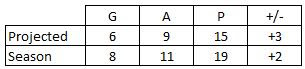
Here we have our preseason projection and the actual season numbers for David Steckel...


There was an odd consistency in David Steckel’s game this year that isn’t entirely reflected in his season by the tens…


If you look at his scoring by month, he averaged three points a month (not including April), not scoring fewer than two or more than four in any month. He went 6-8-14 in 59 games against team in the East and 2-3-5 in 17 games against the West (approximately the same scoring rate over comparable numbers of games). He was 4-6-10 in 39 games at home, 4-5-9 in 37 games on the road. Only three times in 76 games was he on the minus side of the ledger in consecutive games, and never more than two games in a row. And, only five times in a total of 76 games did he go consecutive games losing more faceoffs than he won (three games was his longest streak), only once after December.

And if another thing remained constant, it was his ability to score against Tampa Bay. In 2007-2008, Steckel was 4-2-6 in six games against the Lightning. This year, he was 2-3-5 in six games, making him 6-5-11 in 12 games against Tampa Bay the last two years, while going 7-13-20 in 131 games against everyone else the past two seasons.

And looking at other numbers from his ten-game segments, he looks just as consistent… six of eight with at least ten shots on goal (but more than 20 only once)… only once in eight instances with more than ten penalty minutes… six times with at least ten hits (never more than 20).

What he wasn’t, though, was especially effective on weekends. His Friday-Sunday production ended 2-4-6, -6 in 36 games. Compare that to 6-7-13, +8 in 40 games on weekdays.

Steckel could become the sort of third line center the Caps need. He shows promise of becoming an anchor in the middle among the lower half of the forward lines – consistent, able to win faceoffs consistently, defense-minded (fewest goals scored against per 60 minutes among centers), effective in penalty killing, and he has an ability to chip in some scoring (he scored goals more frequently per 60 minutes of ice time at even strength than Nicklas Backstrom).

But he’s not there yet, not when you consider that this is a team that finished 19th in goals allowed per game and tied for 17th in penalty killing, even though Steckel was by far the least likely (among Caps center playing at least 60 games) to be scored on at even strength and was most likely to be the center on the bench when opponents scored in those situations.

At the age of 27, Steckel is blooming perhaps a bit later than one might have expected for a former first-round draft pick (30th overall in 2001), but by the same token, what is past might be prelude. For example, under coach Bruce Boudreau at Hershey in the AHL, Steckel showed an ability to score shorthanded goals. He had five such goals in his last regular season campaign with the Bears and another three in the Calder Cup playoffs in that 2006-2007 season. This year, he scored his first two shorthanded goals in the NHL. He had 30 goals in his last year with the Bears, following up on a 14-goal season he had in 2005-2006. This past year, his goal output increased from five to eight, and he had another three in 14 playoff games, including a game-winner against Pittsburgh.

Steckel has fewer than two full years of NHL game experience (155 games). This was only his second full season with the Caps, and in just about every statistical category you’d care to name, he improved on his first full season. He did show an ability to score at the AHL level, and one might hope that he continues improvement along those lines next year (he is signed through next year at a $725,000 salary). He’s been consistent, but perhaps needs to raise the production level at which he is consistent for the Caps to make the next step. For this year, though, he took a step forward one would expect for an inexperienced, if late-blooming, forward…

Grade: B

Friday, May 22, 2009

"His will was stronger than the enemy in his head"


Photo: Vladimir Rys/Bongarts/Getty Images

Robert Müller lost his long battle with cancer, yesterday. A 2001 draft pick of the Capitals, Müller was diagnosed with a brain tumor in late 2006, yet still managed to play the entire 2007-2008 season as a goaltender in the Deutsche Eishockey Liga.


Photo: Getty Images

Tuesday, May 19, 2009

The 2008-2009 season, by the "tens" -- Centers: Sergei Fedorov


Sergei Fedorov

Theme: “Is that all there is?”

Sergei Fedorov is hockey royalty. He is a certain first ballot hall-of-famer. He is also the second-line center on a team that was not especially deep at center this year. Here is perhaps the one number that reflects his age (39) and the Caps’ problems at this position…

Two


In only two of the eight ten-game segments did Fedorov skate in all the games (although he did play in the last 11 games of the year). His longest consecutive games-played streak this year was 25. He played in only 52 games this year, which is unfortunate, because if you look at those pair of ten-game segments in which he played in all the games he was rather effective. In the first ten games of the season he was 3-5-8, +6, and in the ten game segment (the sixth) from February 1st through February 22nd he was 1-7-8, +6.

But take those away, and Fedorov was 7-10-17, -8 in 32 games. It wasn’t quite the performance one might expect out of a second-line center. The best one might say is, “when he did play…”

As in, when he did play, he seemed to save his best performances for the best competition. Against Atlantic Division teams, Fedorov was 1-8-9, +8 in 10 games. Against the Northeast, he was 3-7-10, +2 in 13 games. His results against the Southeast, however – 3-5-8, -5 in 16 games – was somewhat lackluster. One thing to note, though. He had one third of his points against two teams – Ottawa (1-6-7, +2 in four games) and Pittsburgh (1-3-4, +4 in four games). Against the rest of the league, he was 9-13-22, -2 in 44 games.

If there was a disturbing trend in Fedorov’s play as the season wore on it was this – starting with the fifth ten-game segment through the end of the year (spanning 29 games played), Fedorov earned 34 minutes in penalties. He had 16 of those minutes in his last six games.

There were other numbers that fell onto the negative side of the ledger late in the season that were – and are – worrisome. For example, he was minus-7 in his last ten games (plus-4 for the season) and didn’t have consecutive games on the plus-side of the ledger after February 18th. He had a total of 11 even strength points in 32 games after January 19th.
Here is a comparison…


Player 2 in this instance is the Islanders’ Frans Nielsen. We’re not making the argument that Fedorov and Nielsen are interchangeable parts, but it does suggest the need to look at Fedorov’s performance in the cold light of day (or, in this case, “days after” playoff elimination). Is Fedorov a second-line center at this point in his career? If he is a third-line center, what do you pay such a player for that level of performance and the “intangibles” he brings to the team? If you’re wondering, Nielsen’s cap hit is $525,000.

But there is a special consideration here. If the Caps were to re-sign Fedorov, does the 2009-2010 regular season matter? Well, you could argue that while his performance in playoffs hasn’t been especially noteworthy (2-11-13 in 21 playoff games with the Caps over two seasons), he has been , in a manner of speaking, “clutch.” Both goals were scored in elimination games (one against Philadelphia in Game 5 last year and, of course, the series-clincher against the Rangers this year). And while 13 points in 21 games might not sound like a lot, if you look at 2007-2008 total playoff scoring it would have been in the top-20 overall point totals.

Re-signing Fedorov, more than most players perhaps, is going to come down to price. If one didn’t see the name plate, “FEDOROV,” on the back of his jersey, you’d have been hard put to see how he was worth $4 million last year. He didn’t play in enough games, he wasn’t especially productive when he did play (certainly not what one would expect of a second-line center on an elite team), and it isn’t readily apparent that the Caps should expect better numbers next year.

Yet, there are those intangibles he brings. One can’t be too dismissive of a player with Stanley Cups on his resume and almost 1,200 points to his credit. He knows how to play the game, even if his body doesn’t respond as it did ten years ago. This will be one of the interesting plots to follow as the summer moves on, but in terms of his performance this year, it was somewhat disappointing. In terms of value, we can’t conclude that the Caps got value commensurate with his contract, and it might have bound them in ways not unlike the contract held by Michael Nylander, since the club couldn’t trade prospects for a rental at the trading deadline that would have added salary (there was also that matter of the club being at its limit for players under contract).

The opportunity to see Sergei Fedorov play in a Caps uniform has to be a thrill for any Caps fan. However, whatever novelty attaches to that has faded. Fedorov has his Cups; it is time for the Caps to earn theirs. Whether Fedorov is a part of that is a future consideration, but for this year…

Grade: B-

Monday, May 18, 2009

The 2008-2009 season, by the "tens" -- Centers: Nicklas Backstrom


As has been the case from time to time in this space, we like to divide elements of the season into “chewable bites.” That means taking a look at players and the team “by the tens.” We look back on the 2008-2009 season in ten-game bites, starting with the players.

Nicklas Backstrom

Theme: “Jinx?...What jinx??”

The “sophomore jinx.” For those not familiar with the concept, it refers to the second act of a player, a student, a musical group, etc., that fails to live up to the promise of their first effort. In this instance, it is the second year of an athlete that fails to live up to the production and the promise reflected in his first year.

Backstrom certainly had the opportunity to be the latest victim of the “jinx,” and if you look at his performance by the tens, he started off the season as if he might in fact be that latest victim…


After an opening night assist in Atlanta, he would go another five games without a point and would finish his first ten games with a sluggish 0-4-4. And, that would include no even strength points, all of his assists coming on the power play.

After that, though, Backstrom had an extremely productive 30-game stretch that coincided with perhaps the most productive stretch for the Caps of the 2008-2009 season. From November 4th through January 3rd, Backstrom scored 11 of his 22 goals for the season and registered 29 of his 66 assists. His 11-29-40, +6, went a long way toward the Caps’ 21-7-2 mark over those 30 games.

There was a remarkable symmetry to Backstrom’s year. Although he had his ups and downs through the eight ten-game segments, ranging from a low four points (in that first ten games) to a high of 15 (in his second), his first 40 games left him with an 11-33-44, +6 mark, while in his last 42 games he went 11-33-44, +10. He had 85 shots on goal in those first 40 games, 89 in his last 42. He had seven power play goals in his first 40 games, seven in his last 42… 14 power play assists in his first 40 games, 14 power play assists in his last 42 games.

There were two aspects of his play that reflected perhaps the experience he gained in his rookie year. First, his shots were up by 21 over his rookie year. It might no sound like a lot – about a quarter of a shot on goal per game – but it was almost a 14 percent jump. It was reflected in an eight-goal increase over his rookie total (from 14 to 22), even as his shooting percentage improved (from 9.2 to 12.6 percent).

If anything, that goal scoring number might yet increase in the years to come. It is worth noting that Backstrom scored 14 of his 22 goals on the power play, good for third on the team behind Alex Ovechkin (19) and Mike Green (18). He had fewer even strength goals this year (eight) than last (11). With experience, that even-strength goal number might grow. He could be a 25-30 goal scorer, but given the nature of his game – more of the traditional playmaker – that might be the upper limit of his goal-scoring production.

And in that playmaking vein, it is also worth noting that Backstrom raised his assist total by 11 from his rookie year. What might be a bit disappointing in that is that he had his best 10-game stretches early in the season, putting up 12 assists in the ten games from December 13th through January 3rd, and 11 assists (a mark that would be tied later) in the ten games from November 4th through November 22nd.

There was another aspect of his game that emerged later in the year that did not appear in either his rookie year or early in the 2008-2009 season – penalties. In his rookie campaign, Backstrom logged a total of 24 minutes in penalties, and only once did he draw more than a single minor infraction in any one game. This year, Backstrom continued on a similar pace until an odd stretch from February 15th through March 12th. In the space of 13 games, Backstrom earned 16 of the 46 minutes he would earn for the year. It didn’t seem to affect his scoring – 5-9-14 in the 13 games, and he was 2-6-8 in the seven games in which he took penalties. One might say that with experience has come a bit more of an edge to Backstrom’s game, although these things are relative.

What he has been is durable. The jokes about “Fat Nicky” at the start of the year aside, Backstrom registered his second 82-for-82, as in games played. And, for what it’s worth, he surpassed the pair of Blackhawks he shared the Calder Trophy dais with in 2008 – his 22-66-88 eclipsed Jonathan Toews (34-35-69) and Patrick Kane (25-45-70). He was plus-16 to Toews’ plus-12 and Kane’s minus-2. We’re sure, though, that Backstrom would trade places with the Chicago pair, which is now in the midst of a conference final matchup, while Backstrom contemplates his summer plans.

All in all, though, it was a “build-on” season for the second year center. He built on a solid rookie year by becoming a more productive playmaker, despite a revolving door of wingers playing along side of him. He became more of a goal-scoring threat, especially on the power play. He maintained a sense of responsibility at both ends, as reflected in a plus-16 for the year (he was plus-13 in his rookie year). While he needs improvement in the faceoff circle, he did improve on his rookie production, winning 48.7 percent of his draws versus 46.3 percent in his rookie year.

Last year we wrote of Backstrom…

"Improvement and consistency. These are precisely the things one might ask for in a student. Nicklas Backstrom came a long way this year, and while he has a long way to go, he learned his lessons well."

We’d write the same thing this year…

Grade: A-

Sunday, May 17, 2009

Your Peerless Prognostos for the Western Conference Final -- Detroit (2) vs. Chicago (4)


And now, for the western half of the finals…

Why Detroit can’t lose…

Experience. Coming into these playoffs, the Chicago Blackhawks who have skated thus far in the post season had a total of 197 games of playoff experience among them, and 64 of that came from Samuel Pahlsson – a late season pick-up from Anaheim. For the Red Wings, defenseman Nicklas Lidstrom came in with 214 games of experience… himself. Of the 22 skaters for the Red Wings thus far in the playoffs, six had more than 100 games of playoff experience coming into this year's tournament (Lidstrom, Tomas Holmstrom, Brian Rafalski, Kirk Martby, Kris Draper, Chris Chelios).

Why Detroit can’t win…

Chicago has no fear of the Red Wings. They fought them to a draw in six regular season games (2-2-2) and won the last two contests of the season. And, there is the matter of the grueling seven-game series the Wings played against Anaheim, perhaps the most physical team in the final eight. If Chicago – a younger, high-octane team – can steal a win out of Detroit from the first two games, it might be just the crack the Blackhawks can exploit. Chicago certainly poses a different set of challenges for a team that had goaltending issues in the regular season – they can score goals (3.17/game in the regular season, 4th in the league). Chris Osgood wasn’t facing the 1984 Edmonton Oilers in the first two rounds. Anaheim finished 14th in scoring, Columbus finished 21st.

The Peerless’ Player to Ponder

Johan Franzen

Franzen scored more points against only one team (St. Louis) than he did against the Blackhawks in the regular season (3-2-5) in six games. He is the leading scorer for the Red Wings so far in the playoffs (8-7-15 in 11 games). He has the sort of size that can pose problems for the Blackhawks down the middle, and he has the hands to finish. He has points in 10 of 11 playoff games thus far. He hasn’t gone more than two consecutive games without a point since early January.

Why Chicago can’t lose…

No worries. They weren’t supposed to get this far, even as a fourth seed. And now, they get to skate. The first two rounds – against Calgary and Vancouver – were probably more physical than anything the Red Wings are likely to throw at them. And, the Blackhawks lit up two goaltenders that, on paper, are far higher in class than what they’ll face in Chris Osgood. 19 goals against Miikka Kipprsoff (3.52 GAA) and 21 against Roberto Luongo (also a 3.52 GAA). The Blackhawks can score with anybody.

Why Chicago can’t win…

They can’t score if they don’t have the puck. Detroit has allowed the third fewest shots on goal in the playoffs (27.5). Chicago is second, you say? Well, yes, they are. But what favors Detroit here is how they got to their number. Their shot differential of +12.7 is, by far, the best of any team advancing this far. This sort of thing has the effect of choking the life out of an opponent. In the last two seasons, the Red Wings have played nine games past Game 4 in a series. They are 6-3 in those games. Do the Blackhawks have the stuff to last?

The Peerless’ Player to Ponder

Nikolai Khabibulin

Among the goalies playing in the final eight, Khabibulin has the worst save percentage (.896, the only sub-.900 in the group). Good thing Chicago has allowed the second fewest shots on goal per game. Detroit will test Khabibulin in ways that Calgary and Vancouver didn’t. He had a superb save percentage against the Red Wings in three games this year (.932), but the Blackhawks allowed him to face 133 Red Wing shots in those games (39.7 shots-per-60 minutes). If Detroit is getting those kinds of shot totals in this series, it could spell doom for the Blackhawks, unless Khabibulin steps up his shot-blocking production.

In the end…

The young and the old – the Red Wings were the oldest team in the final eight, the Blackhawks were the youngest. Guess the questions are, “are the Blackhawks too young?” and “are the Red Wings too old?” Well, we don’t think it will come down to that. The common thread between these teams is that both have done very good jobs at masking otherwise pedestrian performances in goal, given the settings (yeah, Chris Osgood has a .921 save percentage, but we’re not thinking Columbus or Anaheim are offensive juggernauts, either). Both have managed to do it by their parsimonious allocation of opponents' shot opportunities. But Detroit’s result is more a product of the style of play they impose on games – keeping the puck and overwhelming teams with their own shot volumes (40.2/game is by far the highest total in the final eight).

This argues for Detroit being able to cobble together four wins faster as a product of the comfort level and consistency they have in playing the style they play. They will be better able to impose a style on games, even if the Blackhawks want to play an up-tempo pace of their own.

Detroit in 6

Your Peerless Prognostos for the Eastern Conference Final -- Pittsburgh (4) vs. Carolina (6)


The Caps-less round three begins…

Why Pittsburgh can’t lose…

Sidney Crosby is on a mission. 12 goals in 13 games. Now, he didn’t do it against the sturdiest defensive squads in the East, but he’s not playing against such a group in the conference final, either. In fact, Carolina’s defense might resemble Washington’s a little too much for the Hurricanes’ tastes for this series -- not physical enough down low. And Crosby had eight goals against the Caps. As if we needed another Crosby nugget, he went 1-6-7 in four games against Carolina this year.

Marc-Andre Fleury had the curious propensity this year to be either very good against a team, or rather poor. For every 2-0-2, 1.69, .955 against New Jersey, there seemed to be a 1-2-0, 4.50, .881 against Toronto. He was 1-1-1, 2.00, .937 against Carolina this year.

Looking for someone to come out of the blue? Ruslan Fedotenko was 3-1-4 in four games against the Hurricanes this year. And, he had points in four of his last five games against the Caps in the second round (3-2-5).

Why Pittsburgh can’t win…

The Penguins did not play formidable teams in the first two rounds, at least in terms of their recent play, respectively. Philadelphia finished the season 11-10-1 after the end of February, leading up to their first round loss to the Penguins. The Caps – if you buy into the “Southleast” Division description of where they play – played a bunch of patsies the last month (10 of their last 13 games were against Southeast Division teams, against which they went 7-3-0) and struggled against a punchless Rangers team in the first round. This won’t be the case with Carolina – 13-3-2 since the end of February in the regular season and victors over two higher-seeded teams (New Jersey and Boston) in the first two rounds).

The Peerless’ Player to Ponder

Evgeni Malkin

Malkin has 19 points in 13 games, but his performance has the curious look of the underperformer through the first two rounds, perhaps not befitting a Hart Trophy finalist. He came on late in the second round, going 1-6-7 in the last three games against the Caps, including the game-winner in Game 5. He was 2-3-5 in four games against the Hurricanes this year. He’ll need to be at least as productive.

Why Carolina can’t lose

Here is what we said at the top of round two…

"On February 17th, the Hurricanes lost a 5-1 decision to Boston in an especially ugly fashion. Playing at home, they scored first, then watched as the Bruins stormed back for five unanswered goals, three of them in the third period, all of them in the last four minutes of play. Since then, the Hurricanes went 17-5-2 to close the regular season, then they vanquished the New Jersey Devils in the opening round with a pair of lightning bolts in the last 90 seconds of Game 7 against Martin Brodeur in Newark. They have played like and have had the look of a team of destiny the last two months."

Add to this the fact that they defeated the presumptive Vezina Trophy winner in round two – Tim Thomas. Think they’ll fear Marc-Andre Fleury? Yeah, me neither.

Why Carolina can’t win…

Pittsburgh was actually a hotter team after February 17th than the Hurricanes (18-3-3 to finish the regular season). This will be a step up in class in opposition for the Hurricanes, as one expects at this time of year. What might work more insidiously against the Hurricanes here is that they are, (a) the second oldest team in average age among the final eight in the playoffs, and (b) they are coming off two seven-games series, both of which involved winning a Game 7 on the road.

The Peerless’ Player to Ponder

Rod Brind’Amour

Brind’Amour was off to the worst season of his career through February 17th. He was 8-21-29, -30 in 56 games, and you’d have to be forgiven if you thought that at age 38 the end was in sight. But he was 8-14-22. +7 in his last 24 regular season games. He had a similar slow start in the playoffs, going scoreless in his first ten games. He did have points in two of his last four games, but his importance in this series is going to be to a large extent his defense. If he can be effective against either Crosby or Malkin, perhaps Pittsburgh won’t have enough underneath support to advance. Hurricane fans hope that puck to the face in overtime of Game 7 against the Bruins won't ruin his movie star good looks... or keep him out of the lineup.

In the end…

These were the best two teams in the East down the stretch in the regular season. Both have struggled in the playoffs to get this far – one team needing 14 games, the other 13. Pittsburgh might be expected to suffer a bit of a let down after “the circus” that was the Washington series. But then again, they’ve been this far before. And, as we said, Sidney Crosby is on a mission.

On the other hand, Carolina has been this far before, too. They are not that far removed from having won a Cup. And, goalie Cam Ward has not yet lost a playoff series in his career. He might not have the star wattage of a Martin Brodeur or the quirky appeal in style of a Tim Thomas, but all he’s done is stop pucks… and he’s still playing, unlike the other two.

In the end, we’re left with a simple credo… “go with the best player.” That’s Crosby.

Pittsburgh in 7

Saturday, May 16, 2009

The Long View

In 1986, the Detroit Red Wings won 17 games.

That isn’t a misprint, and it wasn’t an abbreviated season. The Red Wings won 17 games in an 80-game season. Their best player was a 20-year old who managed to dress for only 51 games that season. You might have heard of him – Steve Yzerman. But let’s leave him out of this conversation. We’re looking at teams, not players.

The Wings followed up that abysmal season with some wandering in the desert, achieving a level of mediocrity that saw them average 38 wins a year over the next nine seasons, making the playoffs eight times, but not winning a Cup and getting to a Cup final once.

Then in 1996 they won 62 games, to this day a franchise and league record. They also lost in the Western Conference final. One might call that “disappointing.” But in 13 seasons since, including that 62-win campaign, the Red Wings have reached the 50-win mark six times (the last four in a row), the 100-point threshold 11 times (the last nine in a row), and have won the Stanley Cup four times (this year’s outcome for a fifth still in doubt).

The Wings did it with an elite player subordinating personal statistics for team success (that Yzerman guy) and developing a system that identified talent, nurtured it, and sent it on a conveyor to the parent club that replenished it and made it a perennial championship contender, even when that Yzerman fellow hung up his skates.

*****

On November 19, 1983, the Edmonton Oilers defeated the New Jersey Devils, 13-4.

That’s not a misprint, either. The loss dropped the Devils to 2-18-0 on their way to their own 17-win season. It prompted the Oilers’ Wayne Gretzky to remark that “it's time they got their act together, they're ruining the whole league. They had better stop running a Mickey Mouse organization and put somebody on the ice.”

It took awhile. It would be nine more seasons before the Devils reached the 40-win mark in their history. But even doing that, it would be another two years before they would win their first Stanley Cup, in 1995. In the 14 seasons starting with that first Stanley Cup win , the Devils have had fewer than 40 wins once (not including the 22 wins in a 48-game season 1995 before winning the Cup). They’ve had fewer than 100 points only three times (not including that 1995 season), and they’ve won three Stanley Cups with another Stanley Cup finals appearance on top of that.

They did it by developing a system and building it around a player – a goaltender in this instance (Martin Brodeur) – making them one of the most consistent of teams over the past 15 years, one that is always mentioned among Stanley Cup contenders.

*****

In 1990, the Quebec Nordiques won 12 games.

Nope, not a misprint, and that was an 80-game season, too. If the New Jersey Devils were “Mickey Mouse,” it would be hard to find a cartoon character that could have accurately resembled the Nordiques. Shoot, they only won 16 games the next year and 20 the year after that. But after that 20-win season in 1992, the Nordiques consummated what is one of the biggest heists in trade in NHL history. They traded Eric Lindros to Philadelphia for five players, a first round draft pick, $15 million (when $15 million was real money in sports), and future considerations that might have included the future rights to Pat’s King of Steaks, for all we know.

Adding assets to a team that already included a 22-year old phenom by the name of “Sakic,” the Nordiques won 47 games the following year. But playoff success would be longer in coming. It took them three more years before they won a Stanley Cup (unfortunately for the fine people of Quebec, they did it in Colorado in their first year after having moved the franchise). But starting with that Stanley Cup year, they would win at least 40 games in 11 of the next 12 seasons, reached the Western Conference finals six times, and won two Stanley Cup. While their star appears to have faded, the Colorado Avalanche was also one of those teams on most experts’ short list of Stanley Cup contenders for a dozen seasons.

They did it by making a shrewd decision with respect to personnel when they were at their lowest. Joe Sakic and Peter Forsberg were the cornerstones of those perennial contenders from Denver (not to mention another move later – that for Montreal goaltender Patrick Roy).

*****

The point is that these things take time, even under the best of circumstances. A lot of experts, so-called, didn’t expect the Capitals to make the playoffs last year, especially after their awful start. That made making them something of a bonus and a playoff loss in the first round less painful. The team had the look of overachievers.

This year, the expectations brought on by that playoff performance in 2008 were higher – much higher. And that makes this year’s second round exit bitter in a way that last year’s wasn’t, tainted with the whiff of disappointment, of – yes – underachievement.

But this is a team two years removed from back-to-back 70-point seasons. Detroit waited 11 seasons after that 17-win debacle before winning a Cup. It took New Jersey 11 seasons to go from “Mickey Mouse” to the penthouse. It took Quebec six years and a move to Denver to win the prize. Folks forget that once upon a time, these teams were truly, epically, legendarily bad.

There aren’t any guarantees here. The Capitals could become the perennial disappointment that are the San Jose Sharks – a team of immense talent and promise that goes quick and quiet every spring. Or they could be the modern reincarnation of the St. Louis Blues that made the playoffs every year for a quarter century (from 1980 through 2004), but which never won a Cup and advanced to a conference final only once.

But there isn’t anything about this team to suggest that it will not be better next year, even with the difficult personnel decisions that lie ahead. The Caps have a good core group, they have role players who contribute, and they might have the deepest pool of goaltending prospects in the league. If these Caps realize their promise, build on their disappointments, and win a Stanley Cup (or two, or three) while being a perennial contender, these days – not to mention the 70-point seasons – will be a dim memory, if not forgotten all together.

Like that 17-win season for those Red Wings…

Thursday, May 14, 2009

It's my fault...

Let me start this by going back to 1988.

I’d already been hooked by a team that already showed a propensity for struggling in playoff situations. Two years earlier, the Capitals lost to a New York Rangers team to which they had no business losing. And the year earlier, “PING!” Pat Lafontaine ended the Caps’ season in an instant early on an Easter Sunday morning.

In 1988, the Caps fell behind the Philadelphia Flyers, three games to one, in their best-of-seven first round playoff series. Then, the Caps won Game 5, a 5-2 win at Capital Centre. Then, they went into Philadelphia and flattened the Flyers, 7-2, setting up a Game 7 that would surely propel the Caps to a win over the orange and black.

We were pumped for the game. Unfortunately, something was being pumped into me – some weird virus that flattened me on the day of the game.


I could barely get out of bed. But being the faithful fan of the red, white, and blue, we scraped ourselves out of the sack, slithered into the car, and drove from Alexandria to Landover determined not to miss the Caps sticking a fork in the Flyers.

Well, things didn’t go according to the script in that game, at least early. The Caps fell behind, 3-0, and looked for all the world like I felt – sick, tired, and spent. Sure in the knowledge that the Caps would fall for the third straight year in ignominious fashion to a hated Patrick Division rival, we took our beaten, broken body and trudged to the parking lot for the long drive home and the comfort of a warm bed and a hot bowl of soup.

Well, you know how the game ended. The Caps roared back, scoring four goals before the Flyers tied the game once more. Then, Dale Hunter won his immortality as a Capital with an overtime winner past Flyer goalie Ron Hextall.

Fast forward to yesterday…

Once more, the Capitals had come back, this time from a three games to two deficit to force a Game 7, and once more we were pumped at the prospect of joining the sea of red for a Game 7 that we knew would go – finally – the Capitals’ way over a hated former Patrick Division rival that tormented the home team for years.

And once more, we were smacked down by some odd bug that left us, if not for dead, then certainly in bed for most of the day. Up until the last minute, we were convinced that we just weren’t going to be able to answer the call and resigned ourselves to watching things unfold on television. But at that last minute, we felt just well enough to make the trek to Verizon Center.

The game did not unfold as we expected or hoped. The Penguins scored two goals in the first period, and we were considering whether or not to leave for the comfort of a recliner and high-definition television. We didn’t – we stayed for the second period, only to watch the horror of a three-goal Penguin onslaught. Alex Ovechkin scoring a goal late in the period to spoil a shutout was small comfort, and at the end of the second period, we surrendered. We packed up, trudged to the car and made the long drive home. Listening to Steve Kolbe on the radio on the way home, we knew there would be no magic, no Dale Hunter moment, no Marc-Andre Fleury lying on his back, staring into the lights in the rafters as Ron Hextall did 21 years ago.

We couldn’t help but think, “if only we left after the first period,” just as we had done in the Game 7 against the Flyers way back when.

It’s a silly thought, we know, but we’ll take the blame for this one. The boys certainly don’t deserve it, not after the season they had, not after coming back not once, not twice, not three times, but four times from elimination this spring. Not after scraping themselves together from a myriad of injuries suffered along the way. Not after riding the sublime play of a goalie who had – and this never ceases to amaze me – a half dozen games of experience in the NHL before stepping onto the ice in the playoffs. Not after grabbing Washington sports by the throat with their combination of style, resilience, and talent over the last month.

Guys, don’t worry about it. It’s my fault.

Wednesday, May 13, 2009

Midnight...


And the coach that carried a resilient bunch of precocious kids, led by a scruffy-bearded world-class talent and a goalie who was equal parts spell-binding and spectacular through the first 12 games he played in the playoffs, turned into a pumpkin that carried a young (second-youngest average age among the eight surviving teams in the second round) collection of talented kids not quite ready for the biggest stage, backstopped by a goalie who finally showed the cracks you might have expected to see earlier on in a just-turned-21 year old.

The better team won. There is no other argument to be made here, not after a 6-2 pasting of the Caps by the Pittsburgh Penguins in a Game 7 that never matched the pre-game hype after the first few minutes. The Penguins showed considerable resiliency of their own, having come back from an 0-2 deficit in games, having lost a tough overtime decision in Game 6, and having lost their best defenseman for almost three full games, yet they still came out on the long end of the seven game series.

The Penguins were deeper, stronger on the puck, more aggressive, and more able to impress their will on games. That they won this series is no fluke, not the product of officiating or bad bounces. They were simply – and ultimately – better.

And the Caps? Their goalie of the future in the present – Simeon Varlamov – finished the game on the bench, and their Norris Trophy candidate defenseman finally went as far as he could go. All that is left with respect to Mike Green is an announcement of what injury he had that all but crippled him in this series. We suspect he suffered a shoulder injury in the Ranger series that affected everything from his shooting, to his passing, to his ability to carry the puck. He played only one shift in the third period and did not play in the last 17:58 of the contest. All the Caps had left was Alex Ovechkin, but not even his broad shoulders could carry the load against a Penguin team that had contributions from up and down the roster.

So, the Caps can take their razors out of their medicine cabinets, and the Penguins can contemplate facing Boston or Carolina. One gets the feeling that this is only the first of what will be many meetings between these clubs in the playoffs over the next decade. All other Eastern Conference teams are now on notice that hereforth, any road to the Stanley Cup finals goes through Pittsburgh and Washington.

But this was Pittsburgh’s night and Pittsburgh’s series. To the Penguins and their fans, congratulations and good luck in the weeks ahead.

The Peerless Prognosticator is ON THE AIR!!! -- Eastern Conference Semifinals, Caps vs. Penguins...Game 7

The Peerless Prognosticator is ON THE AIR!!!

It’s Game 7… but you already knew that. It will be the only NHL game played this evening, so you can bet that all of the eyes of the hockey world in North America – and a lot of other places – will be trained on what is unfolding in Verizon Center this evening.

And if you’re looking for motivation on the part of the Caps, look no further than that quote machine that is Brooks Laich…

"When (Joffrey) Lupul scored I sat on the bench and it honestly felt like someone had just ripped my heart out. We had been on such a run for two or three months leading up to that. We had won our last seven in a row to get into the playoffs. We had battled back from down 3-1 (to the Flyers) and all of a sudden it just felt like we died. It was the worst feeling and I don't wish it upon anybody. Your season crashes and it's all over, and that's why you fight so hard to avoid it."

There are 20 Capitals and a legion of fans who are, in fact, wishing it on someone – anyone who wears black and Vegas gold. Two of those Caps fans are right here…

Cheerless? Fearless? What are the keys here?

"Shots, for one. The Penguins enjoy an 11.2 advantage in shots per game in this series (37.7 to 26.5). The advantage is a little narrower in Verizon Center – 8 shots a game in the three games there (38-30). The Caps getting 30-plus shots could be telling, because Marc-Andre Fleury has been very ordinary in this series. Semyon Varlamov has the higher GAA (3.33 to 2.17) but Fleury’s save percentage has been much worse -- .874 to .907."

Cheerless, you have a response?

"If the Caps haven’t outshot the Penguins in any game in this series, what makes y’all think they’re gonna do it now? But here’s the thing… I did some arithmetic on this…"

Here we go…

“Yeah, I passed arithmetic in grade school…”

“It took you four tries…”

“Well, whatever…if the Caps can keep the shot differential under ten in the Penguins favor, Fleury’s save percentage works against him. For example, at their current save percentages, if Varlamov faces 40 shots and Fleury faces 30, each team would end up with four goals.”

Hockey games don’t generally play out that way, cuz…

“Yeah, well, let’s put it another way… if the Penguins are lighting the Caps up for 40-45 shots, ya gotta wonder if the kid, who has already faced 226 shots in six games, has enough in the tank to pull this one out.”

“That’s why this one is probably going to be decided at the other end of the ice. If the Caps can get a few more of those 54 chances they had in Game 6 on net (they had only 24 shots on goal, along with 19 attempts blocked and 11 misses) in Game 7, then the cracks in Fleury’s game might look a little wider.”

Good point, Fearless. But what about the skaters? Crosby and Ovechkin have largely cancelled one another out in this one…


“Yes, cousin, they have, but there is something of an ominous number you didn’t include there. Crosby has 29 shots on goal, while Ovechkin has 38. But 21 of Ovechkin’s shots came in Games 1 and 2. He’s had 17 in the last four. That’s a lot for your normal NHL player (over 82 games, it would have been the fourth highest total in the league this year). But it is a reflection of the job the Penguins – and Hal Gill and Rob Scuderi in particular – have done in limiting Ovechkin’s chances.”

So, if the Caps can get more favorable matchups – spring Ovechkin loose against other defensemen – it could play in the Caps’ favor?

“You’d think so…”

Is Evgeni Malkin the “X” factor in this one?

“Shoot, cuz… the only thing I know about ‘X’ is that it’s how I sign my name. But that Malkin fella is 2-6-8, -2 so far in the series. But he’s only 1-2-3, +2 in the three Penguin wins. If yer lookin’ for an ‘X’ factor, maybe you oughtta be lookin’ at that Fedotenko guy. He has a goal in each of the three wins the Penguins have in this series.”

“And David Steckel has one in each of the Capitals’ wins in this series.”

So, like we’ve been saying, it’s the support guys who might be the ones telling the tale, despite all the hype on the big guys.

“Hockey’s a team game, cuz…”

Right you are, Cheerless. OK, guys, let’s get to the bottom line here. Who wins?

“The Caps have been resilient in the face of elimination, they’ve had a successful season at home. And then there’s the karma of that Hershey win last night to eliminate the Baby Pens…


...so you know who we like.”

Cheerless?

“I still don’t know who this Karma lady is, but I like the Caps… why? Cuz if they win, you’ll keep invitin’ me here and giving me free beers.”

Well, there it is, but if the fans need some inspiration to get them going tonight, The General gets the final word one more time…


Caps 4 – Penguins 3

Monday, May 11, 2009

Eastern Conference Semifinals Game 6: Caps 5 - Penguins 4 (OT)


There will be hockey in Washington on Wednesday.

David Steckel deflected a drive by Brooks Laich past Pittsburgh Penguin goalie Marc-Andre Fleury 6:22 into overtime to give the Caps a 5-4 win, their first overtime playoff win since Jeff Halpern scored a game-winner in the same arena in 2001.

The story in the major press will probably be Alex Ovechkin’s three assists and the Caps persistence, but the back story here is what the Caps need and haven’t received in this series – secondary scoring…

Viktor Kozlov: 2-0-2, +2
David Steckel: 1-0-1, +1 and 11 wins in 15 draws
Brooks Laich: 0-2-2, +2
Tomas Fleischmann: 1-0-1, +1

And even outside of that, you had some players who needed to step up playing with the desperation you would associate with an elimination game. Alexander Semin notched a goal and an assist and created a bushel of chances. Brooks Laich did what he had to do – get dirty. It was his screen on Fleury less than a minute after Pittsburgh took the lead in the third period that allowed Semin to find a crack and deposit the puck behind Fleury to tie the game for the third time. It was Laich collecting the puck off a faceoff win by David Steckel and maintaining control, then sending the shot to the net that would be deflected in for the win. Matt Bradley didn’t show up in much detail on the score sheet, although those four hits left a mark, but he was all over the place in this game causing a ruckus.

Statistics can be misleading, and there are two related ones that bear notice. The first is shots. The score sheet will show that the Penguins outshot the Caps, 42-24. The chances, however, were more even – 59-54, in favor of Pittsburgh, when misses and blocks are considered. While the territorial domination by Pittsburgh was in evidence in this game, as it was in the last three games of the series, it was not quite as lopsided as it was in the three Caps losses.

The second is those shots. Semyon Varlamov allowed four goals, and except for the first – a goal by Bill Guerin than Varlamov looked indecisive in defending – he could not be faulted too much. A shot that was sent top corner by Kris Letang, a screened shot from Mark Eaton, and a “hands” goal by Sidney Crosby (with no Caps defensemen in a position to defend) were the only others to dent Varlamov. At the other end, though…

Marc-Andre Fleury is not having a very good series – not a bad one, just not very good. Let’s leave five goals on 24 shots out of it for a moment. The first Kozlov goal (another top corner over the glove that Fleury didn’t have much of a chance on) and the Semin goal through a Laich screen were goals that goalie can be forgiven for letting slip through. The Steckel game-winner was a superior play – Fleury had that shot tracked, it appeared, until Steckel got a stick on it.

But the second Kozlov goal was rather ugly. Did Hal Gill kick Fleury’s right skate out and block his path to the post as Kozlov was spinning around the Penguin net? Perhaps, he looked to be reacting poorly to the play unfolding, too, appearing not quite sure where the puck was. It happened again on the Fleischmann goal, when he was caught down and out, swimming for his life as the puck shot by Sergei Fedorov popped up and over a sprawled Fleury into open ice where Fleischmann could flick it into the net. He has been good, but having faced so few shots – barely 26 a game in this series – his play has been somewhat masked.

- 29-20 in hits, 37-27 in faceoffs. Little things. And if you don’t think faceoffs matter, well, that was how the winning play got started. Textbook – win the draw, head to the net, get a deflection. That was the basic play David Steckel made, one that makes fans want to gag when they see all the cutesy-pie crap that often passes for Caps offense.

- Six games, six times the team scoring first couldn’t keep a lead. It’s a measure of just how much spine both teams have. They don’t give up.

- Think Steckel’s made up for not potting that goal into an open net in overtime in Game 5? Yeah, we do, too.

- Boyd Gordon, 5-for-5 on draws against Sidney Crosby, 3-for-3 in the defensive zone.

The NHL has had its best young teams giving their all in this series, and it has been a series for the ages – five one goal games, three overtime games, the big stars – Sidney Crosby and Alex Ovechkin dueling to a draw in putting their teams on their respective shoulders. But there is another side of that coin. And it is an embarrassment to the league. The officiating in this series has been, to be charitable, awful. We don't suspect it's been any better in the other series, but this is the one we've been paying close attention to.

A blind call made by the trailing referee with 2:02 left in regulation putting the Penguins on a power play (a slashing call on Brooks Laich that clearly looked wrong based on replay evidence) is the sort of thing that could only bring a smile to the faces of Gary Bettman and Penguin fans. And this does not even include the hauling down of Alexander Semin when he had a scoring opportunity earlier in the game – a play similar to that which gave the Penguins a power play in overtime in Game 5, one on which they scored the eventual game-winning goal (by the way, as we pointed out in our post-game of that contest, the correct call). And yes, we did see that swipe that Sidney Crosby took to his head on the end of his shift shortly before a Caps goal than probably merited a penalty.

How unfortunate. These two teams put on a show that should be an NHL instant classic. It was Creed versus Balboa, Ali-Frazier, “Hell-in-Mellon,” haymakers traded across more than 60 minutes. And there are at least 60 minutes left. But here is the last number you need going into game 7…

Zero

The Pittsburgh Penguins have led a series 3-2 and lost Game 6 four times in their history. They have never won a Game 7 in such a circumstance.

See you Wednesday.

The storm is coming…

The Peerless Prognosticator is ON THE AIR!!! -- Eastern Conference Semifinals, Caps vs. Penguins...Game 6

The Peerless Prognosticator is ON THE AIR!!!

The first day of the season for the Caps was way back on October 10th in Atlanta, 214 days ago. If today isn’t to be the last day of the season, the Caps have to win. That’s about it.

Can they? Sure. Why?

- The Caps are 5-1 in elimination games under Bruce Boudreau, 2-0 on the road.

- The Caps have won two games in Mellon Arena this year, scoring ten goals in the process. Those ten goals were scored by seven different players… they could use some of that sharing of the wealth tonight.

- The Caps, who have lost their last two games at Mellon, have not lost three road games in succession since November. They haven’t lost three consecutive road games to Eastern Conference clubs since November 2007.

- The Caps are 2-0 in Monday playoff games the last two years (a 4-2 win in Game 6 of last year’s opening round series against the Flyers and a 4-0 win against the Rangers in Game 3 of this year’s first round series).

- The Penguins have played only one Monday night home game this season, a 4-3 loss to Buffalo on December 8th.

- In games following back-to-backs (that is, when the Caps then get a day to rest), they are 8-5 this year.

- Although he’s struggled in this series, Alexander Semin has not gone consecutive games without a point in this year’s playoffs.

- Although he’s struggled in this series, too, Mike Green has points in seven of his last eight games.

- Nicklas Backstrom has points in eight straight games and in ten of 12 in the playoffs so far (19 of his last 22 games dating back to March 19th)

“Yer reachin’ cuz…”

Cheerless… I thought you’d be stopping by. Guess you have the Caps to lose tonight.

“Nope… too easy a pick. Besides, if a horse named ‘Mine that Bird’ can come in at 50-1 in the Derby, I like the chances for the Caps to ‘mine that bird’ tonight.”

Karma?

“Who’s she?”

Never mind. Fearless, you got a pick?

“The Caps have played to their opponent’s level all year. Sometimes, that hasn’t worked out well – giving up 24 goals to Atlanta in six games this year comes to mind. But that means the Caps have been at their best when facing their toughest opponents this year, too. They were 14-2-4 against Atlantic Division teams this year – the best winning percentage against a division of any team in the East – and have already beaten the Rangers. The Penguins are a step up in class, but they can do this.”

Even in Pittsburgh?

“Even in Pittsburgh.”

What’s the formula?

“The game on January 14th holds a clue… persistence. Even after allowing an early goal, the Caps tied, tied again (after the Penguins regained the lead), then pulled away after the Penguins tied the game in the third period. So, what are you looking for, cousin?”

Splits. For example, in the regular season Mike Green was 22-34-56, +33 in 43 games the Caps won in which he played this year. On the other hand, he was 9-8-17, -9 in 25 losses. It would be hard to find more disparity between performance in wins and losses anywhere on the Caps’ roster.

“Oh yeah? I’ve got one for you.”

Who?

“Ovechkin… 46-37-83, +30 in 49 wins, 10-17-27, -22 in 30 losses.”

Well, there is Nicklas Backstrom, too… 15-48-63, +32 in 50 wins, 7-18-25, -16 in 32 losses. Clearly, the big guys have to be there. But there is an odd one in here, too. Viktor Kozlov has been invisible in losses. In 24 losses in which he’s played, he went 2-7-9, -22. He doesn’t have a point in any of the last three games, all Washington losses. Monday was also the only day of the week on which Kozlov did not have a point in the regular season (0-0-0, -2 in four games). A trend?... or is he due?

There isn’t any mystery here. Statistics look better in wins than in losses. But what it suggests is that the guys who carry the biggest burden now have to have their biggest game (until Wednesday night, that is). But guys who haven’t chipped in need to be heard from, too (remember, in that January 14th game – a 6-3 win – the Caps got goals from Kozlov, Tomas Fleischmann, and Jeff Schultz; and they got a pair of assists from Brooks Laich).

We are reminded of the speech given by Washington Sentinels' coach Jimmy McGinty after halftime of a big game against Dallas…

“Up until now Dallas hasn't been afraid of you, and they should be because you have a powerful weapon working for you. There is no tomorrow for you, and that makes you all very dangerous people!”

No one seems afraid of the Caps now, losers of three straight and seemingly in the clutches of The Penguin Curse one more time. And there is no more powerful weapon than the realization that if you lose, the next time you lace up the skates in anger won’t be until October.

Guys, you can do this.

Caps 3 – Penguins 2

Sunday, May 10, 2009

Well?

The Hershey Bears won tonight, defeating the Wilkes-Barre/Scranton Penguins 3-0 to force a Game 7 on Tuesday night. The series between parent and affiliate have pursued similar paths...


...your turn Caps.

Eastern Conference Semifinals Game 5: Penguins 4 - Caps 3 (OT)


So, here we are after five games of this entertaining – in a car wreck sort of way, if you’re a Capitals fan – series with the Penguins, and in an odd way, the Caps lead it, four games to one. “How so, Mr. Peerless,” you ask?

Well, four games have ended with the winning goals scored off Capitals’ sticks. Twice, they resulted in finishes that had the Caps with more goals on the scoreboard than the Penguins had, and twice they resulted in the opposite. That “opposite” ending crushed a late comeback by the Caps as they lost Game 5 to the Penguins in overtime, 4-3, on a goal scored when a shot by Evgeni Malkin was deflected by a lunging Tom Poti, trying to block the shot, and through goalie Semyon Varlamov’s pads with one second remaining on a Penguin power play.

About that power play. Let’s get this out of the way… the call putting the Penguins on the man advantage was the correct one. Malkin was carrying the puck to the Caps net – something seen rarely from the Caps on this night – and was tripped by Milan Jurcina. If the play happens at the other end of the ice, it might not be called. But when it occurs in the midst of a scoring opportunity, it is a call that has to be made.

A trip, a deflection… for the newest generation of Caps fans, welcome to our hell. Those of us who have been Caps fans for more years than mental health specialists would consider healthy, it is the latest insult to our sense of even-handedness and fair play from Fate. From Lafontaine’s post ringer, to Verbeek’s skate on Langway’s leg, to Nedved’s floater, to Tikkanen’s open net whiff, to Jason Doig hopping off the bench too early in a third overtime, we’ve seen it all… and we see nothing that surprises us when it comes to this franchise’s unique talent for losing playoff games in the most heart-wrenching ways.

No Caps fan over the last 25 years would read that last paragraph and not know the situations of which we write… they can probably still see all of them in their minds.

But the Caps certainly had their chances…

- The Caps had eight shots on goal before the Penguins registered their first, 5:16 into the first period. None of those eight shots found the back of the net. It is worth noting that the Caps would record only 23 more shots in the last 59:04 of the game, including overtime. We keep pounding on this. Marc-Andre Fleury is the second best goaltender in this series – by quite a margin. He has not come close to stealing a game. But if the Caps aren’t going to test him, then he’s going to escape to another round.

- The Caps were treated to, if not a bad night by Sidney Crosby, then an inconsequential one. No points, 9-for-23 in the circle, and a minus-2. He’s not going to have many nights like that. A lot of that, though, was a product of the play of Boyd Gordon.

- Before the overtime penalty, before the game-winning deflection, David Steckel had the game on his stick 18 seconds into overtime and an open net in front of him with Fleury on the ice swimming desperately for shore. If his shot is six inches more to the inside, six inches higher, it is the Penguins facing elimination this morning… see all the years of this you’ve missed, young Caps fans?

Some other stuff…

- To the winners go the stars, apparently, who had to have been picked by the Versus studio guys. The best two players on the ice on this night, in order, were Nicklas Backstrom and Alex Ovechkin. In two years of watching him, I don’t think I’ve ever seen Backstrom play with such singular purpose. He didn’t lack for effort or intensity on any shift. Even though he was on the ice on the Ruslan Fedotenko goal that tied the game early in the third period, he played Malkin into dropping a pass for Fedotenko – he was the only forward back.

- We said it in the pregame, and we believe it still… this series hasn’t turned and won’t turn on the play of the stars. Ovechkin had a big night for the Caps with a pair of goals, Backstrom had another. It is the support guys that will tell the tale here. Fedotenko roofing one off the crossbar and in from long range sucked the air out of the building early in the third. And if there is an unsung hero for either team in this series, it is Rob Scuderi. Even though he was on the ice for two Capitals goals, he has blunted many an Ovechkin rush in this series, usually with a well timed poke check.

- The Caps have two very skilled wingers in Alex Ovechkin and Alexander Semin (although it would be hard for someone watching hockey for the first time in this series to see just what skills Semin has). They’d like to think they have another skilled winger in Tomas Fleischmann. No shots, no points, no hits, no takeaways. He doesn’t have a point since the game-winning goal in Game 1 and hasn’t had a shot on goal in either of the last two games (both losses).

- If one is going to excuse Fleischmann’s performance, it would be on the basis of youth and inexperience. But while he’s done a good job of lugging the puck into the offensive zone to get things started, the Caps have gotten almost no production out of Viktor Kozlov (two assists in the series, only one shot on goal in each of the last three games).

- Mike Green has to be injured. If one watches him taking shots, that’s about all one can conclude. The lollipops he’s sending up there wouldn’t dent tissue. It also seems to be affecting his play in the corners, where he’s turning away from hits, and in carrying the puck, which has been, as a NASCAR driver might put it, “loose in the turns.”

- If you look at this in terms of “tier” scoring, things went like this…

Ovechkin/Semin: 2-1-3, +1, 6 SOG
Crosby/Malkin: 1-1-2, -1, 11 SOG

Backstrom: 1-1-2, +1, 7 SOG
Staal: 1-1-2, +2, 4 SOG

The Other Caps: 0-3-3, -7, 23 SOG
The Other Penguins: 2-5-7, +4, 27 SOG

For the series to return to Washington, this can’t just be The Alex Ovechkin Show for the Caps. Not all the time, anyway. Nicklas Backstrom stepped up in a big way last night. In his own way, so did Boyd Gordon, who played a fine game against Crosby. Semyon Varlamov’s record will show that he allowed four goals, but he was for the most part brilliant.

However, the Penguins have gotten more from their “support” players than have the Caps, and in that respect, Pittsburgh has been the better team in this series. It has been the difference. If the Caps don’t find a way to reverse that, then we’ve seen our last game at Verizon Center this year.

If the series does not return to Verizon Center for a Game 7, it will mark the third consecutive time that the Caps’ home season will have ended on an overtime power play goal for the opponent – Martin St. Louis (in a third overtime in 2003), Joffrey Lopul (2008), and Evgeni Malkin (2009).

The burden we bear as Caps fans.

Saturday, May 09, 2009

The Peerless Prognosticator is ON THE AIR!!! -- Eastern Conference Semifinals, Caps vs. Penguins...Game 5

The Peerless Prognosticator is ON THE AIR!!!

As we kill two birds (get it?... birds… penguins) with one puck, we first look back on last night’s game and take note of Grabel’s Law…

2 is not equal to 3 - not even for very large values of 2


So, no matter how big last night’s 5-3 Pittsburgh Penguin win over the Washington Capitals will be described, the fact remains that the series is tied, 2-2. Each team has tended to business in its own rink, and if that trend continues, it will be the Capitals who advance to the next round.

But last night’s defeat did raise some concerns for the Caps…

Was it a “bad game?” If you have to ask for whom, you weren’t watching. OK, given as many as there were for the Caps, maybe you can be forgiven for asking…

Simeon Varlamov… five goals on 28 shots. And there were those in there – Gonchar’s drive for the Penguins’ first goal (even if Milan Jurcina provided a screen), the Fedotenko goal off the tip of his glove… probably the killer goal (since it put the Caps behind the eight ball with the first two goal deficit they’ve had in this series), and even the Talbot goal to ice things looked like a case of losing focus just long enough to let the puck sneak through on the short side.

Alexander Semin…an assist on the Nicklas Backstrom goal to start things off, then he wasn’t heard from again (even with eight shot attempts). And, a minus-3.

Mike Green…who gets an assist (for getting the puck to the cage so Chris Clark could bang it in), but he doesn’t have a goal in this series, was minus-2 last night (minus-3 in his last two games)

Alex Ovechkin…who pretty much shut down after his knee-on-knee hit on Sergei Gonchar that put the Penguin defenseman out for the night. He had one shot on goal after the incident, none after the first period. Perhaps more telling, he had only two hits recorded for the night. As for “supplemental discipline,” if a cross check to the throat merits a $2,500 fine and no games, then Ovechkin might find himself lighter in the wallet, but he won’t be missing tonight’s contest.

Brooks Laich…if not a “bad” game than a largely absent one. Good things happen when he’s plastered across the score sheet, but his line is oddly white. No points, even, no shots on goal (one attempt), one hit, one takeaway, one blocked shot, one facoff (a win).

For the fourth time in four tries in this series, the team scoring first lost. Not that we advocate the Caps giving up the first goal, but the point is that teams – both of them – have the capacity to erase leads in this series and do it quickly.

Despite the grand save on Fedorov, it’s not as if Mar-Andre Fleury had a game for the ages in this one, either. Three goals on 22 shots makes three of four games in this series and five of his last six in which he’s been below .900 in save percentage. The trouble for the Caps – and it dates back to the end of the Ranger series – is a lack of shots. Only once in the last seven games have the Caps topped 30 shots on the opposing team.

One guy who deserved better than to be held off the scoresheet and take a minus-2 was Sergei Fedorov, against whom the post had another good game for the Penguins. If his drive hits the post and goes in with just over five minutes gone in the first and the score still tied at 1-1, well…on such things games turn. Then there was the save made on a shot ticketed for the top corner over Marc-Andre Fleury’s glove that Fleury somehow gloved down. It was Fleury’s save of the series.

Which brings us to…tonight.

Games 5 have not been kind to the Caps in their history. The Caps have an all-time record in Games 5 of 8-17. In those eight wins, they have gone on to win the series in which they played six times, including this year’s win over the Rangers in Game 5 of the first round. In the 17 losses they have in Games 5, they have gone on to lose the series in which they played 14 times. It gets worse… the Caps have played the Penguins seven times in Games 5 in a series. They’re record… 0-7. Four of the last five of those losses were by one-goal, the last two of them in Washington (both by 2-1 scores). Guess that makes tonight’s game critical.

And as if the mind games haven’t reached stratospheric levels, there was this after last night’s game…

"Everyone likes to play hard, and play physical. But there's a line you can't cross, and a lot of guys in our room felt like the last couple games [Alex Ovechkin] was taking shots where he was trying to hurt guys."

That quote comes from Brooks Orpik, who once broke a player’s neck in a game by hitting him from behind into the boards. We don’t believe either Orpik or Ovechkin intended to injure either Erik Cole (in 2006) or Sergei Gonchar (last night). But the irony fairly drips in that comment.

The best thing that can be said for the Caps is that there isn’t any time to think about last night’s game – no off day to sit around and ponder this or that. It’s off to the rink to set things right, that being the home team winning. What might work against the Caps here is carryover, and we’re thinking about Ovechkin in this respect. Clearly, his collision with Gonchar last night affected the rest of his game. He was tentative for the remainder of the evening. If that carries over into tonight’s game, let’s face it, the Caps will almost certainly come up short here. That’s not to put all the burden on Ovechkin (we’d still like to hear from Alexander Semin and Mike Green, and maybe a little Brooks Laich, too), but he can’t have a repeat of last night, even if he doesn’t show up on the scoreboard. He has to be fully engaged to get the rest of the team energized.

As for Varlamov, he’s shown an ability to shake off bad goals, often coming up with spectacular saves in their aftermath. Now, we’re going to see if he can shake off a bad game. Five goals allowed matches his season/career high (in an overtime loss to Buffalo). The thing is, after he allowed those five goals back on April 3rd, he went ten consecutive games without allowing more than three, and he had a pair of shutouts thrown in to boot.

Some other things to think about…

- This is the first time in the eight times these teams have met in the post-season that the home team has won each of the first four games.

- The Caps are undefeated since the lockout in Games 5, beating the Flyers last year (3-2) and the Rangers this year (4-0). Please note…both games were played at Verizon Center.

- The Caps are 9-6-1 in games following those in which they allowed five or more goals this year (Varlamov is 1-0-0).

Look, neither of these teams has looked unbeatable in any game of this series. Two evenly matched, not to mention similar teams can do that to one another. There have been bad goals, there have been great saves. The superstars have come out to play, and they’ve had their struggles. What we still think it’s going to come down to is not necessarily the play in goal Simeon Varlamov (unless Cinderella’s coach has turned back into a pumpkin after all) or Marc-Andre Fleury (unless the Caps can find a way to get a dozen or so more shots on him). It won’t be Sidney Crosby (unless he’s kidnapped) or Alex Ovechkin (unless he’s suspended). It’s going to be guys like Ruslan Fedotenko and maxime Talbot (both of whom scored for Pittsburgh last night) and Brooks Laich and Tomas Fleischmann (who did not – Fleischmann has the only goal by this pair in the series, a game-winner).

It’s time for guys to take the next step up. We’re guessing they will…

Caps 4 – Penguins 2

Friday, May 08, 2009

Remember...

"The Carolina Hurricanes barely had finished off the New Jersey Devils by scoring two goals in the final 1:20 of Game 7 of their series to determine the second-round matchups when Crosby started texting teammates...


'Good ... We get the Capitals.'"

Beware what it is you wish for.

The Peerless Prognosticator is ON THE AIR!!! -- Eastern Conference Semifinals Game 4: Caps vs. Penguins

The Peerless Prognosticator is ON THE AIR!!!

We’ve arrived at “hump game” – Game 4 in this seven game series between the Capitals and the Penguins.

Oh… you think “hump game refers to the middle game, like Wednesday being the “hump day” of the week. Not so. This is “Hump Game” as in “get over the hump,” the “hump” being this notion of the inferiority complex that always seems to attach itself to the Capitals and their fans whenever we get to this point of a Capitals/Penguins series…”the Penguins have played better,” “they hit harder,” ‘they hustled more,” and the be all and end all thought that came out of the last game…

“They deserved to win.”

The Peerless considers this “UFB.” That’s right “utter f*cking bullsh*t.” There is no “deserved” to win crap at this time of year. You win, or you don’t. How, or whether you did it with style points, or if you “deserved” to win, whatever that is supposed to mean, doesn’t mean a thing.

You win, or you don’t.

“But you know, anything that can go wrong, will go wrong…”

And who are you?

“You’ve heard of ‘Murphy’s Law?’”

Uh-huh…

“I’m ‘Murphy.’”

I see… and let me guess, you think that anything that can go wrong for the Caps will go wrong?

“What can I say?... I’m a Caps fan.”

And you think your law applies to the Caps?

“Oh, not just that… there is ‘Murphy’s Law of Thermodynamics.’”

I can’t wait for this one…

“Things get worse under pressure.”

Is that all?

“Nope… there is ‘Murphy’s Extension’… everything goes wrong all at once.”

Sort of like Game 3?

“You’d like to think so…”

Do you have any laws from a positive perspective?

“Well, there is ‘Murphy’s Paradox’… doing it the hard way is always easier.’”

Which means?

“Maybe the Caps just need to get back to hard work and having faith in their philosophy?”

Sounds like a plan…

“And there is ’Pierson’s Law of Momentum.’”

Which is…

“If you’re coasting, you’re going downhill.”

There seems to be a theme emerging here…

“Yeah, it goes with ‘Maugham’s Talent Maxim’…Only a mediocre person is always at his best.”

And the Caps were pretty mediocre on Wednesday…

“Yup, there are nights like that… they can be a lot better.”

Any law’s for Caps fans tonight?

“Hmmm…. Well, there is the ‘Paul’s Law of Drinking…’”

There is a law for such things?

“Oh, yeah…”

OK, what’s this one?

“You can’t fall off the floor.”

Any last law’s you’d like to leave us with?

“Weinberg’s First Law…progress is made on alternate Fridays.”

Well, the Caps didn’t play last Friday, so you know what that means…

…just win the damned game.

Caps 4 – Penguins 2


Thanks to The Complete Edition of Murphy's Laws

Thursday, May 07, 2009

Eastern Conference Semifinal Game 3: Penguins 3 - Caps 2 (OT)


So…You’re outshot, 42-23, including being outshot 34-15 in the last two periods and overtime. You’re outhit, 44-31. You had to skate off ten more minutes in power play time, 14-4. You are skated, outchanced, out…well, just about everything.

And all in a hostile rink.

And still, in the end, it took a deflection off a stick for your opponent to skate off with a win, escaping sure doom had they fallen behind 3-0.

That was the story last night as the Pittsubrgh Penguins rode home on a slapshot from Kris Letang that deflected off the shaft of the stick of Washington Capitals defenseman Shaone Morrisonn and off a post behind goalie Semyon Varlamov in a 3-2 Penguin victory.

Let’s face it, the Caps didn’t play a very sound game. Too timid, too indecisive, too passive… it was as if their car had only one gear all night – reverse. If not for the play of Varlamov, who stopped 39 of 42 shots in what might have been his best performance of the playoffs, the Caps would have been out of this early. That they weren’t is illuminating. If they showed up, maybe it would have been the Penguins who would have been out of it – the game and likely the series – early, especially after the freakish goal scored by Alex Ovechkin 1:23 into the game, a product of Marc-Andre Fleury misplaing a puck behind his own net, losing his stick, then getting back in front of his net too late to stop an Ovechkin drive.

But the combination of Penguin persistence and Capital absence was enough for the Penguins to escape with this being a series once more.

Some numbers…

1 – Chris Clark’s had a quiet night on the scoresheet in 6:35 of ice time. One shot was all that marked his line. No other shot attempts, no hits, no takeaways, no giveaways, no blocked shots. Oddly, perhaps, he was on the ice for the Letang winner. Rough night.

7 – Milan Jurcina was pretty much a guided missile all night. He had eight hits on seven different players, lighting up Evgeni Malkin twice, including one slobberknocker.

2 – Delay of game penalties. If you’re going to go a man down, you’d like to exact a pound of flesh in doing so. But these kinds of penalties are like leadoff walks in baseball – a cheap disadvantage that usually comes back to bite a team in the backside. That it didn’t on this night (although it contributed to all the energy that had to be expended killing 14 minutes earned in penalties), the Caps should consider themselves fortunate.

8 – If we were to have told you in the pre-game that a Penguin would have eight hits, how many of you would have raised your hand if you thought that Penguin would be Brooks Orpik. Way wrong answer… it was Ruslan Fedotenko, who had only 14 (in eight games) going into last night’s action.

0 – the number of hits Hal Gill had.

0 – We can’t expect the Laich/Steckel/Bradley line to score every game. That really isn’t their primary job. And we did get and Ovechkin goal (again) and a Nicklas Backstrom sighting. But neither Alexander Semin, nor Mike Green have a goal in the three games of this series (Green has only two shots on goal). They have five assists between them, but these are guys who averaged more than a point a game in the regular season, and both scored goals at better than a 35-per-82 game pace. They will have to be heard from sometime in this series for the Caps to advance.

1 – David Steckel won 13 of 21 draws. Sidney Crosby lost 18 of 31. But Crosby beat Steckel on the one that mattered, the one that led to the game-winning goal.

38 – the average number of shots per game faced by Varlamov. Caps fans would breathe a lot easier if that number was shaved by ten (the Rangers averaged only 24 in the first round series).

7 – We know that Ovechkin is going to get his. We’re pleasantly surprised by the production of the Steckel line. We know Semin and Green need to increase their production. But seven is the number of consecutive games, and counting, that Brooks Laich has gone without a goal. It is his longest streak since going 13 games without a goal from January 1st through February 1st.

4 – You just get a feeling that a fourth line of Clark, Boyd Gordon, and Michael Nylander should be more productive, or at least energetic, than it appeared to be last night. One shot on goal, no hits, no takeaways. Gordon did, however, win seven of nine draws and logged 6:25 of penalty killing time during which the Penguins did not score.

The theme this morning is equal parts the Penguins dominating play and that this is a competitive series once more. Both are true to a point. Neither team has had a game yet in which all cylinders were firing, but this was the first one in which the Caps effort level didn’t really match the Penguins. Part of that might have been desperation on the part of the home team (only twice has a team come back from a 3-0 hole in NHL history, and the Penguins were the victim of the most recent occurrence, against the Islanders in 1975). But part of it, too, might have been the Caps playing more passively than they should have, allowing the Penguins too much freedom and chasing themselves into a series of bad penalties.

It argues for a better result for the Caps in Game 4, if they show up. Whether they exert their will on the Penguins will go a long way toward that end. Last night, we saw what happens when they don’t… but still, it took a deflection and a post in overtime for the Penguins to finally pull out the win.

Gotta be better in Game 4, because Pittsburgh was in Game 3…

…and they’ll be better in Game 4.