Tuesday, September 23, 2014

Washington Capitals 2014-2015 Previews -- Forwards: Aaron Volpatti

Aaron Volpatti

“Baseball is a red-blooded sport for red-blooded men. It's no pink tea, and mollycoddles had better stay out. It's a struggle for supremacy, a survival of the fittest.”
-- Ty Cobb


What Ty Cobb said about baseball a century ago can be said for hockey today.  While there is a privileged place at the table for the player of skill and imagination, there is also a place for the player who struggles and survives.

This explains how it is that a player with fewer than ten career points in more than 100 career games can have a place in the lineup for a National Hockey League team.  It explains the Washington Capitals’ Aaron Volpatti.

Aaron Volpatti has played in parts of four NHL seasons, never appearing in more than half his team’s games in any of them.  He appeared in precisely that many games – 41 of 82 – for the Capitals last season.  It was arguably his best season in his still young career.  In addition to setting his career high in games played, he set a career high in goals scored.  OK, so two goals is a modest career best, but they all count, and you have to crawl before you can walk, let alone run.

What makes Volpatti’s presence in the league, not to mention his modest progress, more interesting is the fact that it was not as if he was a hot shot amateur who had to re-tool his game for the NHL.  He had just 13 goals in 137 games over three seasons with the Vernon Vipers of the BCHL, followed by 32 goals in 123 games over four years at Brown University (17 of those goals coming in his senior season).  After signing as a free agent with the Vancouver Canucks following his senior year at Brown, he played in 61 games over two seasons with the Manitoba Moose and scored just three goals. Nine amateur seasons, 321 games, 48 goals, more than a third of those in one season.  He was not coming into the NHL as a sniper.

What he was, though, was a scrapper.  There were 279 penalty minutes in 137 games with the Vipers, 236 penalty minutes in 123 games with Brown, then 91 penalty minutes in 61 games in the AHL.  It didn't stop in Vancouver.  In two-plus seasons with the Canucks, Volpatti managed only three goals in 54 games, but he had 81 penalty minutes, 55 of those minutes coming in 11 fights.  This was a player who, when traded to the Caps in March 2013, took a fighting major on the fourth shift of his first game with the club.   Volpatti was not, and almost certainly will not, make his living in the NHL be being an offensive threat.  He has had to, and almost certainly will have to, scrap for every minute of ice time he gets.

Fearless’ Take…

The Caps were 22-12-7 in games in which Volpatti played last season, 16-18-7 in those he did not. In 2012-2013 the Caps were 12-3-2 in games in which he appeared after arriving in trade from Vancouver. A 34-15-9 record when he dresses?  That’s a 48-21-13 pace per 82 games (109 points). Some things are hard to explain.

Cheerless’ Take…

So, in your world the sun rises because the rooster crows? In those 58 games Volpatti had three points and was a minus-5 while averaging less than eight minutes of ice time.

The Big Question… Is there a roster spot in his future?

There could be something of a log jam on the fourth line for the Capitals, and Volpatti would appear to be in the mix for it. Jay Beagle, Chris Brown, Tim Kennedy, Michael Latta, Casey Wellman, and Volpatti. It could be quite a competition. On the other hand, no one stands out in any particular way. It presents an opportunity for Volpatti, since he and Kennedy are the left wingers by position in that mix.

But here is the steep climb Volpatti has.  Over the last four seasons, only three forwards have appeared in as many or more games than Volpatti (112) and have as many or fewer points (7): John Scott (165 games/3 points), Colton Orr (149/7), and Volpatti.  Even on a fourth line, the Caps need more production.

In the end…

The Caps are not awash in options at left wing on the fourth line, which might be the best thing that can be said about Aaron Volpatti’s chances of being in the opening night lineup.  After four years and 100-plus games, it does not seem likely that he is going to provide much of a contribution other than a certain brand of feistiness.  That sort of thing has its place to keep things honest on the ice, but even there, fourth liners do not generally get assignments that might pit them against higher lines on which there might be players who need to be reined in. 

There is going to be a competition to see just who and in what combinations dresses for the Caps on the fourth line on a night-in, night-out basis.  Volpatti will be in that mix, and not being a “mollycoddle” by any means, he will be battling for that spot.

Projection: 17 games, 1-1-2, -1


Sunday, September 21, 2014

Washington Capitals 2014-2015 Previews -- Forwards: Alex Ovechkin

Alex Ovechkin

“All our sweetest hours fly fastest.”
-- Virgil


It has now been more than ten years since Alex Ovechkin walked to the stage and pulled on a Washington Capitals jersey for the first time as the number one overall pick of the 2004 entry draft.  Nine NHL seasons (six reaching the post-season), eight world championship tournaments, two Olympic tournaments, and the better part of a season in the KHL during the 2012-2013 NHL lockout.  From charismatic pitch man who sold everything from cars, to TV networks, to candy bars, to banks, to hockey equipment; to perhaps the most casually dismissed elite goal scorer, certainly of this era and perhaps in the history of the NHL.  It certainly has not been a boring ten years watching the career of Alex Ovechkin unfold.

But here we are, ten years into what almost certainly will be the most accomplished career in the history of the Washington Capitals, Ovechkin having won just about every regular season individual honor the NHL awards, and both he and his fans are still waiting for that elusive team accomplishment, a Stanley Cup.

Coming off his fifth 50-goal season in 2013-2014, tied for sixth all time in number of such seasons, Ovechkin received far more press for posting a minus-35 (and yes, he is the only player in league history to record at least 50 goals and a minus-35 or worse).  Still, he won his fourth Maurice Richard Trophy as the league’s top goal scorer.  He was named to the second team NHL all-star team, the eighth time in nine seasons he was named to the first or second team (not including being named to both first and second teams in 2012-2013 at right and left wings).  For the fourth time in his career he recorded at least ten game-winning goals (10, second in the league last season). 

Then there was the power play.  His 24 power play goals led the league, was the third time he recorded at least 20 man advantage goals, and were the most in the NHL since Teemu Selanne had 25 in the 2006-2007 season.  In the modern era (post-1967 expansion), only five players have more 20-power play goal seasons than the three turned in by Ovechkin to date: Brett Hull (5), Mike Bossy (4), Phil Esposito (4), Tim Kerr (4), and Luc Robitaille (4).

Fearless’ Take…

One of the hallmarks of Alex Ovechkin’s career to date has been his consistency.  With respect to Ovechkin’s goal scoring, here is one way to look at that. Only three times last season did Ovechkin go more than two consecutive games without a goal.  His 51 goals were scored over 40 games, those 40 games with at least one goal being more than half the games in which he played (78).  He had points in 48 of the 78 games in which he played.

He remains the straw that stirs the drink.  In 36 wins in which he played, Ovechkin had 35 goals (35-19-54).  He had 16 of his 24 power play goals in those 36 wins, scoring power play goals in 13 of those wins.  He had 23 percent of the total goals scored by the Caps last season (51 of 225) but more than a third of the game-winning goals for the team (10 of 28).

Ovechkin was recently described as “one of the least feared 50 goal scorers in the history of the game.”  The breathless hyperbole aside, since he entered the league in 2005-2006 he has more than 100 more goals (422) than the next highest goal scorer over that period (Jarome Iginla: 310). He has five of the 18 50-goal seasons since the 2004-2005 lockout.  Only Sidney Crosby (5) has more 100-point seasons since the 2004-2005 lockout (4), and while the last of those was in 2009-2010, consider that since then he has been a bit hamstrung by coaches who were rookies behind an NHL bench when they took over (Dale Hunter, Adam Oates) and a season (2012-2013) half lost to another lockout. 

Cheerless’ Take…

Yeah, cuz, about all those goals and points scored in wins.  Thirty-five goals, 54 points, and a plus-3?  He was a minus player in ten of those 36 wins in which he played.  In 42 regulation and extra time losses he was minus-38 and was a minus player in 26 of those games.

While plus-minus is a statistic of limited use to explain individual performance, it is also true that only 12 of 435 forwards playing in at least 20 games last season were on ice for more goals per 60 minutes at5-on-5 than Ovechkin.  And, he had the 20th worst plus/minus per 60 minutes at 5-on-5 in that group of forwards.  Only five forwards were on ice for more goals against at 5-on-5 than Ovechkin.  While his linemates bear a certain amount of responsibility for that kind of performance, no Capital forward ranked lower than Ovechkin in any of those categories.

That whole plus-minus thing was a particular problem against Eastern Conference teams that reached the playoffs.  In 28 games against those eight teams Ovechkin had 18 goals, an impressive number.  He was also a minus-18, a less impressive one.

The Big Question… Is that all there is?

The consensus question that the hockey media thinks most important with respect to Ovechkin is whether he and new head coach Barry Trotz can read from the same page.  The implication is that he and Trotz’ predecessors either did not read from that same page or that there was some sort of antagonistic relationship between Ovechkin and those coaches.

That seems to be a simple, and simplistic, conclusion.  Except for one in-game comment about a coaching decision, it is hard to find much in the way of commentary from Ovechkin that undermined his coaches’ authority or that signaled an antagonism toward those coaches’ approach to the game.  One can argue about results – the Caps have not advanced past the second round of the playoffs in the Ovechkin era – but the term ”coach killer” (a term that generates no lack of hits in a web search) is reflexive, not the product of analysis.

It is fair to ask what Ovechkin has done to improve and round out his game over nine seasons in the NHL.  He came into the league as a prolific goal scorer, and he remains one of the most productive goals scorers in the game. And, if you are going to have one skill, it would be hard to think of another one you would rather a player have.  However, if you look at the rest of his game you wonder what it is that has improved over the course of his career.

This is where Barry Trotz can make a difference, if any coach can.  Ovechkin has played for four coaches, all of them in their first NHL coaching positions.  None had the ability (and in a couple of cases, showed little inclination) to develop those other skills that would make Ovechkin a more dangerous all-around player.  Trotz has 15 seasons on coaching experience at the NHL level.  He has coached a wide variety of players at that level in terms of style, temperament, and talent.  This is a type of coach Ovechkin has not had in his career.

It is not all on the coach, though.  Ovechkin just turned 29 and is in the chronological prime of his career.  That, and his nine years of experience, implies a certain responsibility on his part to take the initiative to improve and bring out other aspects of his game.  It has not yet been enough in terms of team success that he be primarily (or exclusively, in the opinion of some) a goal scorer.  Even if he remains the most productive goal scorer of his generation, if that is all there is it would seem unlikely that the Capitals will be any more successful going forward in Ovechkin’s career than they have been over its first nine seasons.

In the end…

The whole plus-minus thing with respect to Ovechkin’s game is a red herring.  This is a player who was a plus-82 over his first eight seasons.  The minus-35, while historic, was a convenient hook on which a lot of hockey media could hang their general disdain for Ovechkin’s style on and off the ice.  On the other hand, he is the captain, he is the straw that stirs the drink, and the Caps are not likely to be successful on any level unless he is happy and productive. 

In 2014-2015 he is in a situation in which he has not found himself in his career, playing for a coach with a long NHL resume.  The team around him is more balanced than it has been in recent memory, with a deeper defense than the club has known in at least a decade.  It is not all on him to score goals.  That makes it an opportunity for Ovechkin to develop more of his game.  Better late than never, because as Virgil said, “All our sweetest hours fly fastest.”

Projection: 80 games, 51-37-88, plus-4

Photo: James Guillory-USA Today

Saturday, September 20, 2014

Washington Capitals 2014-2015 Previews -- Forwards: Michael Latta

Michael Latta

“Nature always wears the colors of the spirit.”
-- Ralph Waldo Emerson


At the risk of taking Emerson a bit too literally, it is probably fitting that Michael Latta wears red in his occupation as a hockey player.  He was not the headline player in the trade that sent Filip Forsberg to Nashville for Martin Erat, but he is the player coming from Nashville who remains with the club.

The role he seems likely to play with the Caps is the epitome of the “energy player.”  To the extent he plays, it will be confined almost entirely to fourth line minutes.  He will agitate, disrupt, annoy, aggravate, and exasperate (434 penalty minutes in 183 career regular season AHL games).  He will provoke (37 fights in those 183 career regular season AHL games).

Yes, red seems to be an appropriate color to wear as a reflection of his spirit.

That said, the extent to which he passes Jay Beagle on the depth chart as fourth line center is going to hinge at least as much on his performance numbers.  Twice he has posted 14-goal seasons in the AHL, both times doing so in fewer than 55 games.  Then again, Jay Beagle had 19 and 16 goal seasons with Hershey with game totals in each season in the mid 60’s.

Fearless’ Take…

The Caps were 9-6-2 in the 17 games in which Latta played last year.  Records like that aren’t attributable to the difference making capabilities of a fourth line center, but he was on ice for only five goals against in those 17 games, too, four at even strength.  He was 52.2 percent on draws.  He was charged with just two giveaways in 131 minutes of ice time.  He committed only one minor penalty.  He was not what you would call a liability out there.

Cheerless’ Take…

Twice in 17 games he played more than 10 minutes.  He averaged less than eight minutes a game.  The Caps were 5-4-2 in games in which he played over seven minutes.  There is just so much a guy playing that little ice time can do to influence an outcome for the better.

The Big Question… Is Michael Latta a diamond in the rough?

Michael Latta is only 23 years old as he heads into the upcoming season, so it is still difficult to project just what his upside is.  Just keep in mind that he was taken in the 2009 draft ahead of Cody Eakin (72nd overall; Eakin was taken 85th), and Caps fans probably still remember Eakin, a prospect traded with a draft pick for Mike Ribeiro back in June 2012.  We cannot say with much conviction that Latta is going to become the scoring forward that appears to be slotted for in Dallas, but he might have more upside than Jay Beagle, which is not to denigrate Beagle.  Latta just has not yet had much playing time, and he seems likely to make a battle out of the fourth line center position.

In the end…

To us, Michael Latta impresses us in his limited exposure to date with the Caps as a stockier version of former Capitals forward Matt Bradley.  He does not seem to be the sort to contribute a lot at the offensive end, but he might pot the occasional goal.  He plays at  a high energy level.  He is not shy about settling matters on the ice on his own (two fights in 17 games with the Caps, 11 in 52 games at Hershey last season).  He has not yet revealed any particular liabilities on defense, although 17 games is not much to go on in that regard.

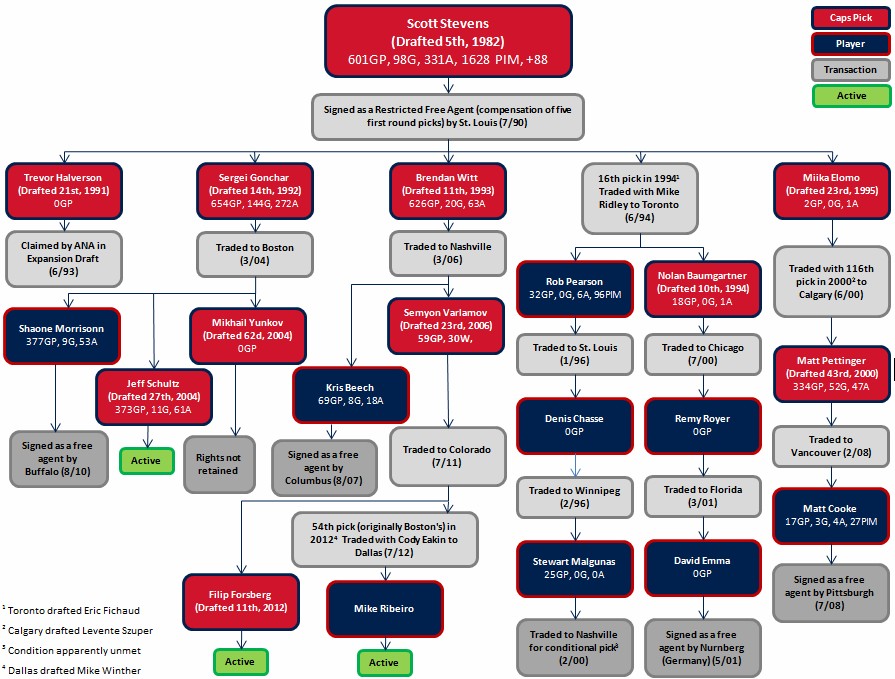
Michael Latta is the last remnant of the Forsberg-Erat trade and the end of a line in the legacy of the selection of Scott Stevens in the 1982 draft (the “Brendan Witt/Filip Forsberg” line in this chart).  Latta represents the last active line in that legacy.  Caps fans will be hoping it does not end for a while yet.

Projection:  26 games, 1-5-6, even

Photo: Patrick McDermott/NHLI via Getty Images


Washington Capitals Training Camp 2014 -- Day One

Washington Capitals Training Camp 2014 got underway yesterday at Kettler Capitals Iceplex, and Day One was the kind of affair that could not be held to just one squad or just a single rink.  Three squads – Blue, White, and Red in that order – on both the Arlington and Capitals rinks made for a busy day for new head coach Barry Trotz, his staff, and the 60-odd players invited to participate.

Before Team Blue kicked off the first session at 9:30, however, there was goaltenders coach Mitch Korn on the ice with Braden Holtby and Pheonix Copley going through some drills.  Korn started working with Holtby, the first player on the ice for this year’s camp, going through what looked like puck handling drills that focused on the goalie’s footwork and body positioning when moving the puck along either side. 

Copley joined in for some work in moving back and forth, up and down in the crease.  Then it was time for the ol’ medicine ball, one of many props that Korn uses for effect and to keep things interesting.  There were two drills involving this prop.  First, the goalies held the ball to their chest while maneuvering back and forth across the crease.  Then, while clutching the medicine ball to their chest, Holtby and Copley started at the goal line at one wall, then pushed off their skate down the length of the goal line to the opposite wall.  We were sore just watching them.

As this drill was underway, the skaters took the ice, and if there was a word to describe them as a group, it would be “business like.”  There wasn’t a smile among them, no chatting as they skated, no joking.  If you are looking for good (if trivial) signs about this team, there’s one.  They were down to business from the first blow of the whistle from Trotz.

Trotz wasted no time in pitting players against one another.  Using various combinations – one on one, two on two, and a series of odd man combinations – he had the players going against one another in long skate confrontations and in tight space situations starting in the faceoff circles.  Except for the occasional player sidling up to a coach for a question, the only sounds you heard on the ice were Trotz’ gravelly shouts and what seems to be a signature effect, his banging his stick on the ice to get players to step up the pace and hustle back into line after finishing a rush.

Because you might be wondering, for what it’s worth, watching Brooks Laich do end-to-end skates in the first half of the morning session, he looked pretty smooth out there.

Team Blue spent 45 minutes on the Arlington Rink before heading across the hall to the Capitals rink to complete their session, a series of end to end long skates to test endurance.  There were a few noteworthy things in that session.  Jay Beagle was consistently ahead of his group from end to end.  Alex Ovechkin was, well… he was not.  Dmitry Orlov and Aaron Volpatti wore the yellow (no contact) jerseys in doing the endurance skates.

Then there was Marcus Johansson.  We did not see what happened, but we did see him face down on the ice in front of the players’ bench, then get up to considerable distress to take his place on the bench.  After some limping around and being bent over the back of the bench, he headed off to the locker room.

Team White was next up on the Arlington Rink at the 11 o’clock hour.  Trotz took the group through the same drills, emphasizing player-versus-player contact and a fast pace.  And, there was the stick banging.  Just like the group the preceded them, there was not much player-player chattering on the ice.  Trotz appears to run a very disciplined, very ordered ship.  Some other things we took note of in Day One (with pictures).
-- A quiet moment between teacher and pupil before the fun begins…

-- The captain was the first skater on deck for the morning session


-- Then there were the footwork drills for the goalies...


...and the medicine ball drills.


 Leaving the one-on-one drills to the players.

Not Sidney Crosby (save it for the fantasy piece, Peerless).  It's Liam O'Brien, although he is from Nova Scotia, and he did once play for Rimouski.

More one-on-one


New Guy...


Johansson is down.  He looked to be in considerable distress once he got to the bench.


Justin Peters in a new setting.


Chris Brown lets fly.


A familiar...number.


Get used to it, Caps fans.  That stick banging is going to be in your dreams for a while.


Thursday, September 18, 2014

Washington Capitals 2014-2015 Previews -- Forwards: Brooks Laich

Brooks Laich

An old man passed me on the street today;
I thought I knew him but I couldn't say.
I stopped to think if I could place his frame.
When he tipped his hat I knew his name.

Hello old friend,
It's really good to see you once again.
Hello old friend,
It's really good to see you once again.

-- Eric Clapton


It only seems like forever since Brooks Laich played a full season in the NHL, and he is hardly an old man, but he is 15th on the all-time list of games played in Washington Capitals franchise history (616), second among active players on the club to Alex Ovechkin (679).  He would be the active leader in games played had he not missed 70 of 130 games over the past two seasons.

And that is the issue for this season.  Despite repeated comments over time that were variations on a “feeling good” theme, there is the fact that Laich has not played a full season of NHL hockey since 2011-2012.

Last season Laich managed 51 games of action, but it was a matter of skating on one and a half legs.  That was the product of lingering groin problems that seemed to stem from an injury he sustained while playing in Switzerland during the 2012 NHL lockout.  That he led the team in shorthanded ice time per game, situations that might put even greater stress on a wonky groin, and added another 1:20 per game on the power play speaks to his grit and determination, or his stubbornness over the extent of his injury, depending on your point of view.

His performance level since his injury is down form that of his first seven full seasons with the Caps.  Over those first seven seasons, Laich’s scoring line per 82 games was 17-24-41.  In 60 games over two seasons since he was injured it is 14-16-31, perhaps not as bad as one might have expected.  When one accounts for the fact that it was his power play production that was down substantially, from 6-6-12 per 82 games in his first seven full seasons to 2-5-7 per 82 games over the last two seasons, it further suggests a level of grit (or stubbornness) that permitted him to function at something approaching a career level, at least offensively, at even strength.

Fearless’ Take…

In 2011-2012, the last healthy season Brooks Laich had, he was one of 12 forwards in the NHL playing in at least 50 games who had at least 13 minutes of even strength ice time a game, and at least two minutes of both power play and shorthanded ice time a game.  That speaks to the versatility Laich possesses and that can be valuable to this team in 2014-2015. 

Given the presence of Troy Brouwer and Joel Ward (both right-handed shots) in the middle of the power play, it seems unlikely that the left-handed shooting Laich would get that kind of man advantage ice time, but this is a team that needs all the help it can get killing penalties.  Among forwards playing in at least 50 games in 2011-2012 Laich ranked 20th in 4-on-5 ice time per 60 minutes.

It might be at even strength, though, where Laich’s presence might be felt most.  Looking back again at that last healthy season, Laich had the second lowest share of offensive zone starts among 11 Caps forwards playing in at least 50 games (43.1 percent).  However, he has a higher share of offensive zone finishes, so he as least moved the tilt a little less in the defensive zone direction, and his team rank in goals-against/on ice per 60 minutes outperformed his offensive zone start shares, implying a certain effectiveness in dealing with tough geography on the ice.

Cheerless’ Take…

That all sounds real nice, Fearless, but he’s 31 years old, has more than 650 games of regular season and playoff experience, and has tried to skate through an injury that still took 70 of 130 games the last two seasons off his resume.  Is it reasonable to think, even if he is anything close to healthy, for him to return to that 2011-2012 version?   Maybe by winter or spring, but in October?

And, it’s a good thing he is versatile, because there is no position that is marked in pen with his name on it.  He could be the first line left wing.  He could be the second line left wing.  He could be the second line or third line center.

Fearless kept comparing Laich to his last healthy season in 2011-2012.  Fine, but that year was two years removed from the last of his career best three years, from 2007-2008 through 2009-2010, when he scored 69 goals and only missed four games.  Four seasons have passed since then.  Any chance he returns to that level of production?

The Big Question… Where will Brooks Laich play?

It is not an urgent question in October, but it might be nice if Brooks Laich had a position to call his own at some point this season.  For one thing, it would signal his being healthy in fact and not just in press releases.  For another it would signal stability across the rest of the forward lines.  The one place where Laich might be the first option is at third line center.  With him in this position, it is an indicator that the Evgeny Kuznetsov experiment at second line center is working.  One might envision such a lineup as having Alex Ovechkin on the left side, Nicklas Backstrom in the middle, and perhaps Eric Fehr on the right side of the top line.  Kuznetsov might be centering Marcus Johansson on the left and Troy Brouwer on the right on the second line.  Laich would be centering Jason Chimera on his left and Joel Ward on his right on the third line.  If Laich is moving around the forward lines, it could be a sign that other things are not working as well as hoped.

In the end…

Although Brooks Laich might feel like he’s five-years old again, he is one of the core players on whom the Caps will be depending for a solid year to get them back into the post-season.  On a team that struggled in 5-on-5 play and penalty killing, Laich will be expected to provide the means to improve in those areas.  It is not the youthful effervescence on which the Capitals will be relying, but the experience earned as the longest tenured Capital in continuous service.  His window, like that of the Caps, is still open a bit.

Projection: 72 games, 14-17-31, plus-2

Photo: Rob Grabowski-USA Today Sports

Washington Capitals 2014-2015 Previews -- Forwards: Evgeny Kuznetsov

Evgeny Kuznetsov

“Experience is something you don't get until just after you need it.”
-- Steven Wright


Foodies will probably recognize the term “amuse-bouche.”  A French term that can be translated, “to entertain the mouth,” they are generally bite-sized representations of the chef’s craft and skill, an indicator of what is to come in your meal.  We have no idea what how the term translates into Russian, but late last season Evgeny Kuznetsov provided a bite-sized version of what might be in store for 2014-2015.

In 17 games Kuznetsov went 3-6-9 (a 43 point pace, albeit in a small population of games) and had a couple of highlight reel moments.  Like his first NHL goal…


Or his first turn in the Gimmick…


Or his fake slap shot/pass to Tom Wilson…


But before we help young Mr. Kuznetsov clear some space on the mantel for a Calder Trophy as 2014-2015 rookie of the year, let’s all take a step back, take a deep breath, and remember that while he was 2-5-7 in his first nine games, he had only two points in his last eight games.

Then there is the matter of where he will play.  Kuznetsov spent those 17 games at the end of last season at left wing.  He is likely to start training camp auditioning for a new role: second line center, the persistent hole in the Capitals’ lineup.  If he takes to the position, he could be the answer for the next decade.  However, if he does not, it could mean a revolving door at that position once more.

Fearless’ Take…

In the 39-season history of the Washington Capitals, only 17 first year players playing in at least 15 games had more points-per-game than Evgeny Kuznetsov had last season (0.53).  Last year’s 43-point pace, even if it was in a small population of games, was one that would have had him fourth overall in rookie scoring over a full season.  Kuznetsov, who is still a rookie for purposes of the upcoming season, has some built in advantages in terms of hitting the ground running in October.  He spent four seasons with Traktor Chelyabinsk in the KHL, honing his game against professionals in preparation for his move to the NHL.  He also has significant international tournament experience – two world under-18 tournaments, three world junior tournaments, and three world championship tournaments. He is a rookie for NHL purposes, but perhaps not a "rookie" in terms of his experience, even if he is only 22 years old.

Cheerless’ Take…

Yeah, about that whole second line center thing.  It’s one thing to be a center moving to the wing, even it is a temporary thing – Nicklas Backstrom started his career with the Caps on the wing, Nathan MacKinnon spent a lot of time at right wing last season in Colorado.  Both are natural centers (yeah, and both were younger than Kuznetsov, too).  It is another thing for a player who has not played the position on a scoring line in the NHL to be put into that position as a rookie, even one with his international experience at the position.  It might be that the best to be said here is that the team was patient enough with him in the position to allow him to grow into it and be a lot better at it in March than he might be in October.

The Big Question… What would a reasonable rookie season look like for Kuznetsov?

Those nine points in 17 games and the occasional highlight reel play might have some Caps fans entertaining thought of a big rookie season for Kuznetsov.  Maybe 60 points, maybe even 70.  OK, let’s take a minute here.  Alex Ovechkin recorded 106 points as a rookie.  That’s the franchise record, and the sun will go dark before it’s broken.  Next on the list is Nicklas Backstrom, who had 69 points in 2007-2008.  Chris Valentine in 1981-1982 and Bengt Gustaffson in 1979-1980 are the next centers on the list with 67 and 60 points, respectively, in their rookie seasons, but that was a different era.

Even if one looks at centers since the 2005-2006 lockout overall, there is Sidney Crosby at 102 points in 2005-2006 and then a long way to Paul Stastny in Colorado in 2006-2007 (78 points).  Only five rookie centers since the 2004-2005 lockout have had 60 points, only 10 with more than 50, and some of those players were not full time centers in their rookie season.  

Given who his linemates might be, Troy Brouwer on the right side and any of Marcus Johansson, Brooks Laich, or possibly even Eric Fehr or Jason Chimera on the other side, anything north of, say, 55 points would look like a pipe dream.  But he has the skill and the experience (more so than most “rookies”) to perhaps challenge that 55-point level.

In the end…

We have seen Evgeny Kuznetsov entertain with a fair number of highlight plays in his young career to date.  Over an 82-game season the object, given his role as a scoring line center, is going to be one of providing consistent production more than bursts of flair and helping make those around him better.  Then there is the matter of his defensive responsibilities.  He will not have the same lock-down role that a checking line center might have, but he can’t be caught cheating so much into the offensive end that his line becomes a defensive liability, either. 

It is going to be a lot for Kuznetsov to assimilate in this role, even if he does have more than 200 regular season and playoff games of KHL experience and 37 games of world championship and world junior championship tournament experience.  Now he gets to add to his NHL experience, and just in time, because how quickly he fills his new role will be one of the plot twists to pay attention to as the Caps look to return to the post-season.

Projection: 75 games, 18-32-50, even

Photo: Bruce Bennett/Getty Images North America

Wednesday, September 17, 2014

Washington Capitals 2014-2015 Previews -- Forwards: Marcus Johansson

Marcus Johansson

“Your big opportunity may be right where you are now.”
-- Napoleon Hill


Marcus Johansson was drafted by the Washington Capitals in 2009 as a center.  It was that position which he played in his early career with the club.  He was not, it seemed, the answer to a perennial problem – who would be the team’s second line center – and he was moved to left wing on a line with Alex Ovechkin and Nicklas Backstrom. 

The move was not without its painful moments.  Johansson suffered a concussion in a collision with Ovechkin in a 2012 training camp session, an injury that would eventually cost Johansson 12 games in the regular season.  Since returning to the lineup after that concussion Johansson is 13-52-65 in 106 games over two seasons, a 10-40-50 scoring pace per 82 games, almost exclusively as a left winger.

That might make for an argument to keep Johansson at left wing, but the roster is in flux with a new head coach – Barry Trotz – calling the shots.  Ovechkin might be returned to the left side on the top line.  That move would ripple through the rest of the lineup with more options facing Johansson than perhaps any other player.  Johansson could be moved to the left side of the second line.  He could play in the middle of the second line, depending on how the Evgeny Kuznetsov experiment at center works.  He could be dropped to the middle of the third line where he would assume the duties previously fulfilled by Eric Fehr, a natural right winger.  And, if Trotz’ intention that Ovechkin develops to play both sides plays out,  Johansson could find himself back on the left side of the top.

Fearless’ Take…

Marcus Johansson is one of five players in his 2010 rookie class with at least 40 career goals, at least 90 career assists, and at least 130 career points (Derek Stepan, Tyler Seguin, Jordan Eberle, and Taylor Hall are the others).  Last season he was 5-27-32 in 37 wins, recording points in 23 of those wins.  As impressive as, say, Nicklas Backstrom (14-45-59 in 38 wins, points in 32 of them)?  No, but it isn’t a points pace far off a pace of a Daniel Sedin (13-18-31 in 32 wins).

Then there are the penalties.  The seemingly utter lack of them.  Over the last four seasons, among all skaters playing in at least 175 games, no player has logged fewer penalty minutes than Johansson (26).  Last season Johansson was sent off twice for minor penalties.  Not twice in one game, twice all season.  Two minors (high-sticking and hooking, for the record), that’s it.  Little wonder he finished sixth in the voting for the Lady Byng Trophy (including a first place vote) for gentlemanly play. 

Cheerless’ Take…

Two-point-five percent?  I ain’t no math whiz, but I know that’s not a big number.  And that was Johansson’s shooting percentage at even strength last season.  Two goals on 80 shots.  Neither was in a regulation win (one Gimmick win, against Minnesota on November 7th, one overtime loss; against Philadelphia on March 2nd).  His overall shooting percentage for the season (7.5 percent) was barely half of that over his first three seasons (14.2 percent).  His plus-minus on-ice per 60 minutes was second worst among Capital forwards playing in at least 20 games (-0.89).  Only Alex Ovechkin was worse (-1.45).  It was part of a whole first line meltdown.  Nicklas Backstrom was third worst (-0.86).  It was a team effort.

The Big Question… Will Marcus Johansson take the next step in his development?

Last year we asked this question in a slightly different way… “Can Johansson develop as a threat on his own on the left side to take some pressure off his linemates?”  Five goals, a 7.5 percent shooting percentage, 2.5 percent at even strength, a minus-21.  He didn’t answer that question in a way in which Caps fans might have hoped.  Johansson will start this season with more than 250 games of regular season under his belt (263 to be precise).  His apprenticeship is coming to an end.  He needs to be less of a passenger on a scoring line and more a player who can drive or create play on his own.

The uncertainty over just where Johansson will play muddies this issue somewhat.  That he can play a number of positions means that he might be called upon to play those positions.  If Barry Trotz moves Alex Ovechkin from wing to wing, that means another player (or more) moves, and Johansson might be just that player (although Brooks Laich also might fall into this category).

Johansson has demonstrated he can be a 50-point player (his points pace over his last 100-plus games).  Can he now: a) do it without the benefit of skating on a line with Nicklas Backstrom and Alex Ovechkin, and b) do it consistently?  That would be the next step in his development. 

In the end…

What is the Swedish word for “enigma?” Maybe “mystery” is a better word.  Despite those 263 games of regular season experience and the fact that he ranks so highly among his draft and rookie classes in career points, it is still hard to get a clear picture of just how much of his performance is due to talent and development, and how much is due to circumstance (playing with highly skilled linemates).

In 2014-2015 Johansson seems likely to come out from under that Backstrom-Ovechkin shield.  He might be asked to be the driver of a line (second or third line center).  It would be early to dismiss the likelihood that he can succeed in that role, given that his is more or less two seasons removed (and almost 120 games) removed from playing center on a consistent basis.

A lot of things have to go right for a hockey team to succeed, some of them within its power to control, others not so much.  With respect to Johansson there are two parts to this issue.  There is the matter of where head coach Barry Trotz chooses to deploy him.  That is not a matter under the player’s control.  Then there is the matter of taking advantage of the opportunity, no matter where he is deployed.  That is something over which Johansson can exert more control.  With four seasons and 250-plus games of experience, he has to take the training wheels off.  He has to be a contributing member of this squad on his own terms.  His big opportunity is where he is right now.  We just don’t quite know where he is right now on the ice yet.

Projection: 81 games, 15-33-48, plus-4

Photo: Greg Fiume/Getty Images North America

Monday, September 15, 2014

Washington Capitals 2014-2015 Previews -- Forwards: Eric Fehr

Eric Fehr

"Life isn't about finding yourself. Life is about creating yourself."
-- George Bernard Shaw


Some might think it a modest achievement that Eric Fehr set his second best career marks in goals (13), tied for his career best in assists (18), and set a second best career mark in points (31) last season.  He set career highs in games played (73) and average ice time (14:45).  However, given the journey of the former first round draft pick, 2013-2014 was a fine season.

Fehr, who was the 18th overall pick in the 2003 entry draft, has endured back injuries, multiple shoulder injuries, rib injuries, was traded away, returned as a free agent, and remade himself from a big goal scorer upon his draft by the club to more of a checking line, two-way winger in his current edition.

Fehr found his place last year on a third line with Jason Chimera and Joel Ward that provided the Capitals with consistently solid play.  There was a consistency in his game as well, despite what might be considered modest scoring numbers.  Although he finished the 2013-2014 season with 31 points, he registered points against 21 of the 29 teams against whom he played, including 11 of the other 14 teams in the Eastern Conference.

Fehr did this while learning a new position on the fly.  Drafted and playing most of his career as a right winger, Fehr was converted to center under head coach Adam Oates.  He was a solid possession player, at least in the context of the team for which he played, finishing fourth among all Capital forwards who played the entire season in Washington in Corsi-relative at 5-on-5 (+2.04 percent).  And, he did that while recording the third lowest share of offensive zone starts among forwards (46.76 percent; source: war-on-ice.com).  What it meant in terms of performance was that he and his most frequent linemates – Joel Ward and Jason Chimera – all ranked in the top four on the team among forwards in points per 60 minutes at 5-on-5.

Fearless’ Take…

Over the last two seasons Eric Fehr has remade himself into a reasonably reliable goal scorer, despite where he has been deployed.  Among forwards playing for the Caps in each of the past two seasons Fehr ranks sixth in goals per game (0.19, which works out to 16 goals per 82 games).  In fact, since his career best 21-goal season in 2009-2010, Fehr is fourth among forwards currently with the team in goals per game (0.23; minimum 150 games played). 

Cheerless’ Take…

Last season was a career high for Fehr in games played – 73.  The nine games he missed was a nine-game stretch in November in which he was a healthy scratch.  That might have been a product of his being a minus-8 in his first ten games of the season, although in one of those odd quirks that seemed to populate Adam Oates’ tenure as coach, Fehr was benched after he went 0-4-4, plus-3 in four games.

It is hard to find a lot to fault in Fehr’s game last season if it is placed in context.  He was put into a new position that he seemed to accept willingly.  He eventually came to play that position on what was not considered a scoring line, perhaps not what was envisioned when he was a prospect years ago.  He took to it as well as one could expect.  Which is not to say he is a long-term option at that position; his faceoffs might have been better (46.0 percent), and his assists/60 minutes at 5-on-5 (0.99) ranked tied for 80th among centers.  It was a good first year at the position, though, especially having to learn it on the fly.  It just might not be a long term solution.

The Big Question… Where will Eric Fehr play?

It seems unlikely that the Adam Oates experiment of making Eric Fehr a center will proceed in 2014-2015.  It does not mean that Fehr has a position waiting for him, though.  He could play on either side of the top two lines or provide some productivity for the fourth line.  He could, in a pinch, fill in at center on the third line, but that seems for the moment to be a fall-back position for the club.

Where Fehr plays might depend on how new head coach chooses to deploy Alex Ovechkin.  If Ovechkin is redeployed to left wing, where he played before Oates assumed the coaching responsibilities, Fehr could be a top line right winger.  If Ovechkin was on the right side of the top line, and Marcus Johansson was to move back into his top line left wing position, Fehr might be on the left side of the second line.

One other thing to wonder about with Fehr this season is whether he will get any more power play time than he has had.  Last season Fehr averaged 0:36 a game with the man advantage (less time than Jason Chimera, who had 0:50, and Dustin Penner, who had 0:56)), down from 0:49 in 2012-2013. 

In the end…

Eric Fehr has shown himself willing to play any role the team needs.  He has played all three forward positions and has played on all four lines in his eight seasons (over two tours) with Washington.  What he has not had in any of those eight seasons was a permanent home, a position he could call his.  Even last season, when he played primarily center, it seemed a stop-gap sort of move.  This season, at least to start, he seems to be once more a man looking for a steady role. 

Whatever role he plays, it could be at a bargain.  Looking at comparables from capgeek.com in terms of age and value, Fehr is in the neighborhood of such as Cody McCormick, Mike Santorelli, Tanner Glass, Drew Miller, Nate Thompson, Jim Slater, and Gregory Campbell.  Fehr compares well to that group, especially given is adaptability and versatility.

Lurking there, though, might be a goal scorer yet.  As noted, Fehr has scored goals at a 16-per-82 game pace the last two seasons, and his is not far removed from a 21-goal season (2009-2010).  It might get him a look at a scoring line role or on the power play.  Whatever role he is asked to play, though, it seems Eric Fehr is ready to give it a shot.

Projection: 77 games, 16-16-32, plus-2

Photo: Bruce Bennett

Washington Capitals 2014-2015 Previews -- Forwards: Jason Chimera

Jason Chimera

You go back Jack do it again
Wheel turnin' 'round and 'round
You go back Jack do it again

-- Walter Becker and Donald Fagen


In his first season with Washington Capitals, 2009-2010 being a partial one following his trade from the Columbus Blue Jackets, left wing Jason Chimera scored seven goals in 39 games, a 15-goal pace over 82 games.  The following season he had ten goals in 81 games.  A drop, yes, but still a respectable number for a bottom six winger.  Chimera hit the jackpot in 2011-2012, recording his first 20-goal season while playing in all 82 games. 

Then, the bottom fell out of his production.  In the abbreviated 2012-2013 season, Chimera did not record his first goal of the season until his 28th game and finished with only three goals in 47 games.  Last season he rebounded to score 15 goals in 82 games on what was, on many nights, the Capitals’ most reliable, most effective line: Chimera, Eric Fehr, and Joel Ward.

Chimera’s 2013-2014 goal total was consistent with his career average with the Caps and overall (about 14 goals per 82 games), but underneath it all there has been a certain lack of consistency in recent years. 

We have made a point over time that pairs might matter more than lines when it comes to forwards.  Nicklas Backstrom and Alex Ovechkin is an example.  Last yeaer, so was Jason Chimera and Joel Ward.  Chimera skated more with Ward than he did any other Capital forward last season, more than 80 percent of his 5-on-5 minutes.  When together in those situations, Chimera recorded more than a goal per 20 minutes with Ward.

Fearless’ Take…

There was an odd number coming out of Chimera’s 2013-2014 season.  He averaged less than half a penalty minute per game, the lowest total for a full season in his career.  His 0.44 PIMs/game was consistent with his most frequent linemates, Eric Fehr (0.44) and Joel Ward (0.39).  Of the 12 Caps forwards playing in at least 20 games last season, Chimera’s plus-minus/60 minutes (+0.29) was third best on the club, trailing only linemate Joel Ward (+0.48) and Mikhail Grabovski (+0.60).

Another odd number: 17.  Chimera had 17 of his 27 assists in wins last season.  That would not be so odd in itself but for the fact that he had only 6 of his 15 goals in 38 wins, 9 goals in 44 losses.  It was part of a season that reflected the importance of secondary scoring.  Chimera had five multi-point games last season, four of them coming in wins.  The 27 assists for Chimera was a career best, as were his 42 points.

Cheerless’ Take…

Let’s draw a picture, ok?  If you look at his goals, assists, and points per game over his career, those years with the Caps start to look like a muskrat-tooth pattern at the end…

He went from 0.12 goals per game in the Caps part of his 2009-2010 season, then up to 0.24, down to 0.06, then back up to 0.18 goals per game last season.  Part of that seems to be an uneven shooting performance.  Since he came to Washington in 2010-2011, Chimera is 13th among Caps forwards who played in at least 50 games in shooting percentage (7.7 percent).   What’s it going to be this year?

The Big Question… Can Chimera maintain the solid level of play he displayed last season?

Consider it asking Cheerless’ question in a slightly different way.  Start with this.  Absent a trade over the next three weeks, Jason Chimera will open the season as the Capitals’ oldest player (35 years old), the only player on the roster born in the 1970’s.  The number – 35 – is not insignificant. Last season, nine forwards age 35 or older played in at least 50 games, recorded 12 goals, and finished with 35 points:
  • Jaromir Jagr
  • Olli Jokinen
  • Brian Gionta
  • Martin St. Louis
  • Jarome Iginla
  • Marian Hossa
  • Shane Doan
  • Daniel Alfredsson
  • Patrik Elias

This group is, by and large, primarily scoring line forwards, not the third line type into which Chimera might fall.  And, although we set the parameters at 12 goals, 35 points, and 50 games, the fact is that of this group of nine players, none had fewer than 18 goals, none had fewer than 40 points.  Those numbers are at the outer edge of Chimera’s career best performances – one season with 18 or more goals, one season with 40 or more points.  The extent to which Chimera can hold back the advance of time might be a significant factor in whether the Caps are successful this season.

In the end…

Despite just four and a half seasons with the Caps, Jason Chimera will enter the season sixth among all players in games played with the Capitals (331).  He might be considered among the team leaders at this point based on longevity.  He also might be a bargain.  Entering the first year of a two-year contract with a $2.0 million annual salary cap burden, his comparables (in age and value, according to capgeek.com) might include Raffi Torres, Chris Neil, Travis Moen, or Matt Hendricks.  Based on last year’s performance, one might reasonably think Chimera is a bargain at that price, given his comparables.  At his performance level in 2012-2013, however, he is not a bargain.

And that is going to be the thing to watch with Jason Chimera as the 2014-2015 season unfolds.  His year-to-year consistency has been an issue since his arrival in Washington, and if his pattern holds, this season would be a “down” one for him.  The mitigating factor here might be in his partnership with Joel Ward.  Last season he skated those 80-plus percent of his 5-on-5 minutes with Ward to great effect.  In the previous season (the one in which he had three goals in 47 games), Chimera did not skate as many as 50 percent of his 5-on-5 minutes with any skater (he skated 42 percent of those minutes with Ward). 

Aesop said that “familiarity breeds contempt.”  It might be that familiarity, though, both with his surroundings and his linemates, that would enable Jason Chimera to do it again and once more make him an important ingredient to the Caps’ success this season.

Projection:  82 games, 14-22-36, plus-4

Photo: Rob Carr/Getty Images North America